What Is an LMIA — and When Do You Actually Need One in 2026?
Few terms cause more confusion for people hoping to work in Canada than LMIA. You'll see it in job postings, on immigration forums, and in conversations with employers — often as if it's a magic key. It isn't. But understanding what an LMIA is, who applies for it, and when you actually need one can save you a lot of wasted time and money. Here's a plain-language walkthrough.
What an LMIA actually is
LMIA stands for Labour Market Impact Assessment. It's a document issued by Employment and Social Development Canada (ESDC) — through Service Canada — that assesses whether hiring a specific foreign worker for a specific job would have a negative effect on the Canadian labour market. In plain terms, it's the government checking: is there a genuine need for a foreign worker here, or could a Canadian or permanent resident fill this role?
A key point that trips people up: the employer applies for the LMIA, not the worker. You cannot get one on your own. The employer submits the application, pays the processing fee (generally $1,000 per position — confirm the current amount before relying on it), and must show they tried to recruit Canadians first, usually through advertising the job.
If the assessment is favourable, the employer receives a positive LMIA (sometimes called a confirmation). If it isn't, the result is a negative LMIA, meaning the position should be filled by someone already able to work in Canada. A positive LMIA lets the worker then apply for a work permit tied to that job and employer.
When you need one — and when you don't
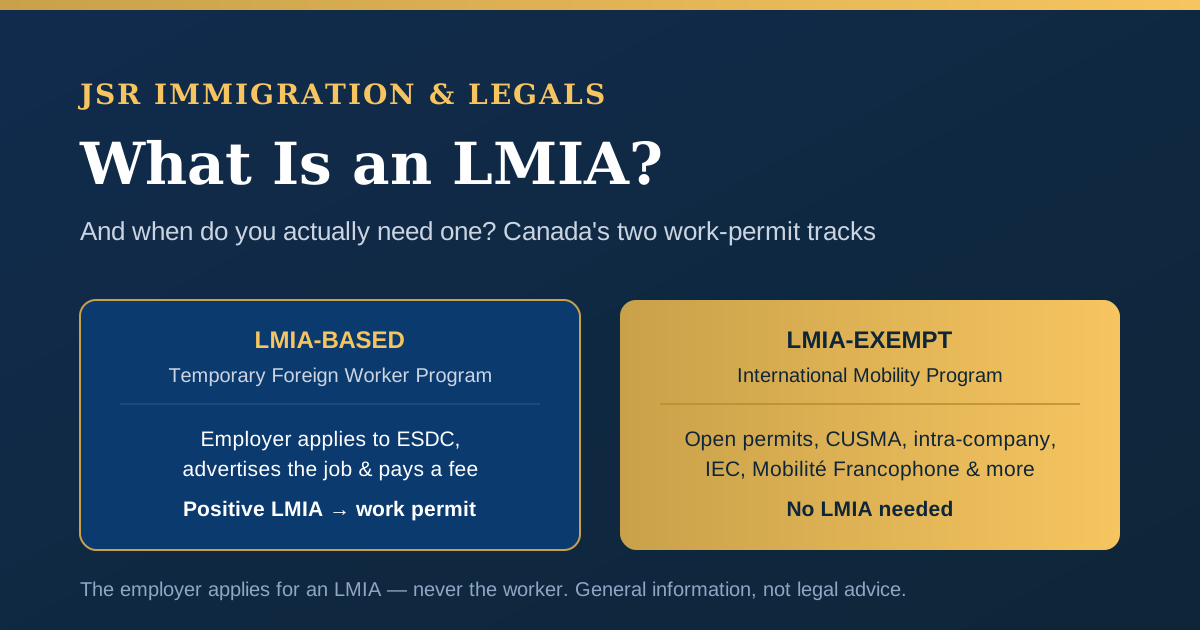
Here's the part worth internalising: most, but not all, work permits require an LMIA. Canada's temporary work system runs on two tracks:
- Temporary Foreign Worker Program (TFWP) — this is the LMIA-based track.
The employer needs a positive LMIA before you can apply for the permit.
- International Mobility Program (IMP) — this is the LMIA-exempt track.
These permits are allowed because of a broader Canadian interest — a treaty, a reciprocal exchange, or a category of open permits.
You generally do not need an LMIA if you fall into an IMP category. Common examples include:
- Open work permits, such as those for spouses of skilled workers or
students, or a post-graduation work permit — an open permit isn't tied to one employer, so no LMIA is involved.
- CUSMA (formerly NAFTA), CETA and other trade-agreement professionals.
- Intra-company transferees moving within the same multinational company.
- International Experience Canada (IEC) working-holiday and young-professional
participants.
- Mobilité Francophone — French-speaking workers destined outside Quebec in
eligible occupations.
- Certain provincial nominees with a job offer in the nominating province.
for an LMIA-exempt path?} B -- "Yes (open permit, CUSMA,
intra-company, IEC, etc.)" --> C[No LMIA needed] C --> D[Apply for a work permit
under the International Mobility Program] B -- No --> E[Employer applies to ESDC:
advertise, pay fee, submit LMIA] E --> F{Assessment result} F -- Positive LMIA --> G[Worker applies for an
employer-specific work permit] F -- Negative LMIA --> H[Role must go to a Canadian
or permanent resident]
What changed for LMIAs in 2026
If you're an employer or a worker relying on the TFWP, note that the rules tightened in 2026. New requirements for low-wage positions (roles paying below the provincial or territorial median wage) took effect around April 1, 2026. Broadly, they include longer advertising periods, stronger recruitment efforts aimed at Canadian youth, and regional limits — in some higher-unemployment metropolitan areas, low-wage LMIA applications may not be processed at all. Rules like these change often, so employers should confirm the current program requirements on canada.ca before advertising a role.
LMIAs and Express Entry — a quick word
Many people ask whether an LMIA-backed job offer boosts their Express Entry score. This is an area that has been actively changing — the weight a job offer carries in the Comprehensive Ranking System has shifted recently and may change again. Rather than count on a specific number of points, treat an LMIA first and foremost as what it is: the basis for a valid work permit. If CRS points are part of your plan, verify the current rules before deciding.
The bottom line
An LMIA isn't a visa, and it isn't something you apply for yourself. It's an employer-driven labour-market test that underpins one of Canada's two work-permit tracks. Knowing whether your situation is LMIA-based or LMIA-exempt is often the single most useful thing to figure out early — it shapes your entire timeline.
If you're an employer weighing an LMIA, or a worker trying to understand which path fits your job offer, get in touch with JSR Immigration & Legals — we're happy to help you map it out.
This article is general information, not legal advice. For guidance on your own situation, please consult a qualified professional and confirm current requirements with official sources.

Immigration & paralegal practitioner at JSR Immigration & Legals, helping newcomers and Ontario residents with their cases.
This post is general information about Canadian immigration and Ontario paralegal matters and is not legal advice. Rules change and every case is different — confirm current requirements for your own situation.