9,226 Invitations in Four Days: Inside Canada's Express Entry Surge of June 22–25, 2026
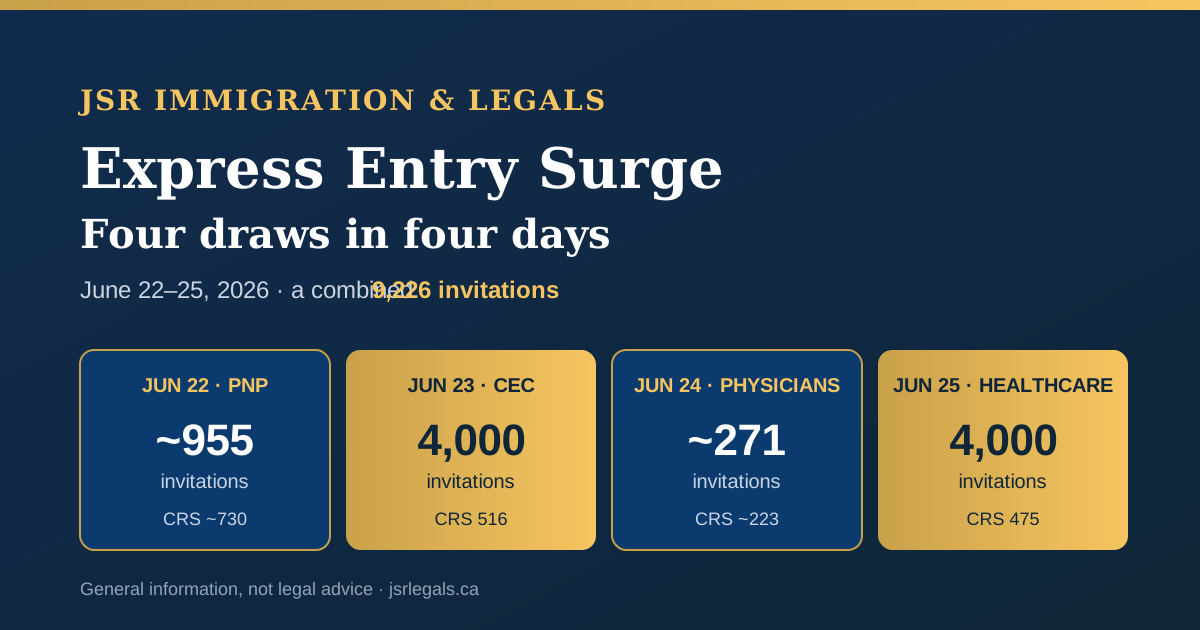
Express Entry just had one of its busiest weeks of the year. Between June 22 and June 25, 2026, Immigration, Refugees and Citizenship Canada (IRCC) held four draws on four consecutive days and issued a combined 9,226 invitations to apply (ITAs) for permanent residence. After a spring of smaller, high-cutoff rounds, that's a notable shift in pace.
Here's what each draw delivered, who it targeted, and what the surge does — and doesn't — mean for your own plan.
The four June draws at a glance
| Date | Category | Invitations | CRS cutoff |
|---|---|---|---|
| June 22 | Provincial Nominee Program (PNP) | ~955 | ~730 |
| June 23 | Canadian Experience Class (CEC) | 4,000 | 516 |
| June 24 | Physicians (Canadian work experience) | ~271 | ~223 |
| June 25 | Healthcare and Social Services | 4,000 | 475 |
You can confirm every figure on IRCC's official Express Entry rounds of invitations page, which lists each round's date, category, size and cutoff.
A few things stand out. The PNP cutoff of around 730 looks sky-high, but that's normal: a provincial nomination adds 600 points, so those scores aren't comparable to a general draw. The physicians round had an unusually low cutoff (around 223) because it's a tightly targeted category with a small pool. And the two large 4,000-ITA rounds — CEC and Healthcare — are where most candidates will feel the impact.
Why category-based draws matter so much right now
Three of the four draws were category-based selection — IRCC inviting candidates in specific occupations or programs rather than simply taking the highest scores across the whole pool. For 2026, IRCC's categories include healthcare and social services, trades, education, and targeted streams like physicians, alongside French-language proficiency.
e.g. eligible healthcare job + experience] C --> E{Score at or above cutoff?} D --> F{Meet category AND cutoff?} E -- Yes --> G[Receive an ITA] F -- Yes --> G E -- No --> H[Stay in pool · improve CRS] F -- No --> H G --> I[File complete PR application within 60 days]
The practical takeaway: a category-based draw can invite candidates at a lower CRS than a general round — but only if you actually qualify for that category. Eligibility usually depends on having recent, qualifying work experience in an occupation on the category list, and meeting any language or other criteria IRCC sets. If your work history lines up with healthcare, trades, or another active category, your realistic odds can be far better than your raw CRS score suggests.
If you received an ITA
An invitation starts a clock. You have 60 days to submit a complete permanent residence application, and a clean, well-documented package matters more than speed. Before you submit, confirm that:
- your language test results are valid and match your profile;
- your work history — job titles, NOC codes, dates and hours — is backed by
proper reference letters;
- police certificates and any required medical exam are arranged early,
because they take time;
- everything in the application matches what you claimed in your profile,
since inconsistencies are a common cause of delay or refusal.
An ITA is not approval. IRCC still assesses the full application, so accuracy is what carries you across the finish line.
If you weren't invited this time
A burst of draws doesn't help only the people invited this week — it can change the pool for everyone. Here are the levers that tend to matter most:
- Improve your CRS. Retaking a language test, completing an educational
credential assessment, or adding Canadian work experience can move your score more than people expect.
- Check whether you fit an active category. Healthcare and social services
is clearly a priority right now. If your experience qualifies, a future category draw may reach your score even if a general round wouldn't.
- Consider a Provincial Nominee Program. A nomination adds 600 points and
effectively guarantees an invitation in a PNP round, though each province sets its own streams and timelines.
The bigger picture
Four draws in four days suggests IRCC is moving more decisively through the pool as it works toward its annual admissions targets, with a clear lean toward healthcare and in-Canada candidates. That's encouraging — but draw patterns shift month to month, and one busy week is not a guarantee about the next. Treat each round as a snapshot, keep your profile accurate and current, and be ready to act the moment your category or score lines up.
If you'd like a clear read on which Express Entry programs and categories you genuinely qualify for — and the most realistic way to raise your score — that's exactly the review we do at the start of every file. Reach out to JSR Immigration & Legals and we'll look at your profile together.
This article is general information, not legal advice. Your eligibility depends on your own facts and the rules in force when you apply, so confirm current requirements with IRCC or a licensed representative before you act.

Immigration & paralegal practitioner at JSR Immigration & Legals, helping newcomers and Ontario residents with their cases.
This post is general information about Canadian immigration and Ontario paralegal matters and is not legal advice. Rules change and every case is different — confirm current requirements for your own situation.