How Your CRS Score Works: The Four Building Blocks, Explained Simply
If you've created an Express Entry profile, you've been handed a number — your Comprehensive Ranking System (CRS) score — and told it decides whether you get invited to apply for permanent residence. What that number actually measures, and where you can move it, is less obvious. With IRCC consulting on broader Express Entry reforms in 2026, understanding the score you have today is the best foundation for whatever comes next.
Here's the plain-language version of how the CRS is built.
The four blocks your score comes from
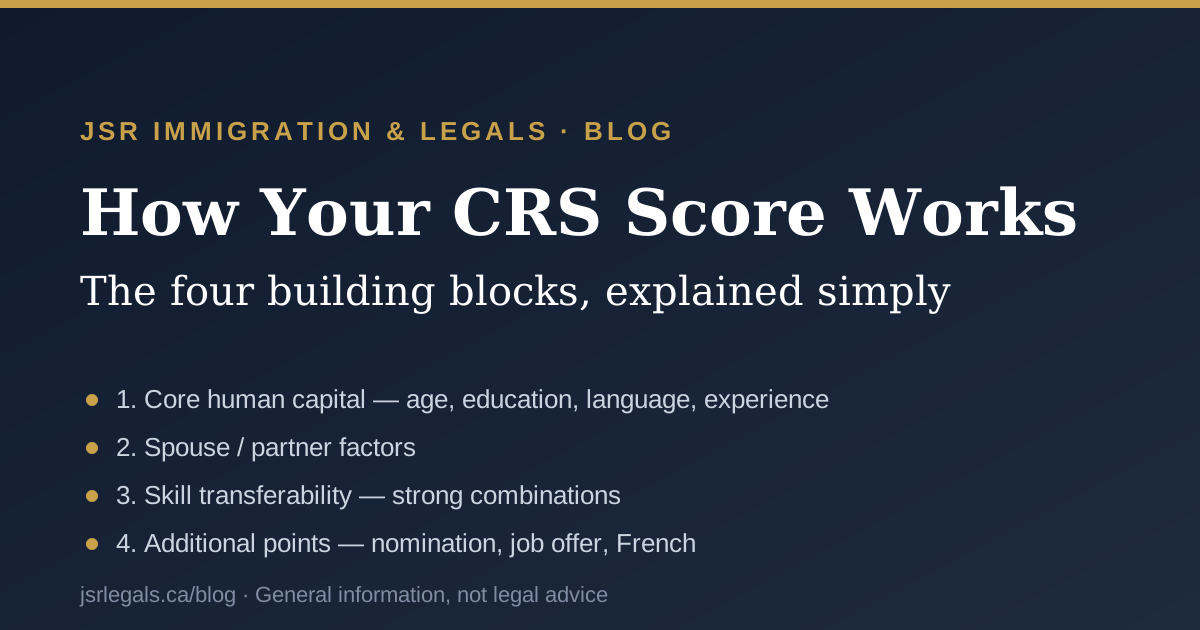
The CRS adds up points from four groups of factors. Think of them as building blocks stacked on top of each other:
age, education, language, Canadian experience] --> T[Your total CRS score] B[Spouse / partner factors
their education, language, experience] --> T C[Skill transferability
combinations of language, education & experience] --> T D[Additional points
provincial nomination, job offer, French, sibling, study] --> T T --> E{Meets the round's cutoff?} E -- Yes --> F[Receive an Invitation to Apply] E -- No --> G[Stay in the pool & improve your profile]
1. Core human capital
This is the largest block for most people. It rewards the things that tend to predict success in Canada: your age, your level of education, your official language ability, and any Canadian work experience. Younger candidates, higher credentials, and stronger language test results all push this block up. Language, in particular, carries far more weight than many applicants expect — a higher test band can be worth a surprising number of points.
2. Spouse or partner factors
If you're applying with a spouse or common-law partner, a portion of their profile counts too — their education, language ability, and Canadian experience. The amounts are smaller than your own core points, but they're real, and they're the reason couples sometimes choose carefully which partner is the principal applicant.
3. Skill transferability
This block rewards strong combinations. For example, good language results plus a post-secondary credential, or foreign work experience plus Canadian experience, are worth more together than the sum of their parts. It's designed to recognise candidates whose skills are likely to transfer well into the Canadian labour market.
4. Additional points
This is where scores can jump dramatically:
- A provincial nomination adds a large block of points and, in practice,
all but guarantees an invitation.
- A qualifying job offer, strong French-language results, **Canadian
study, or a sibling who is a citizen or permanent resident** in Canada can each add points.
Where most candidates can realistically gain
Not every block is within your control — you can't change your age, and it quietly costs points each year. But several levers are very much worth pursuing:
- Language first. Re-testing to reach a higher band is often the single
fastest, cheapest way to add points, and it benefits both your core score and your skill-transferability score at the same time.
- French as a second language. Even moderate French can unlock additional
points and access to French-category rounds, which have repeatedly invited candidates at lower scores.
- Provincial nomination. If your occupation or ties match a province's
needs, a nomination is the biggest single boost available.
- Get your credentials and experience documented correctly. An accurate
Educational Credential Assessment and properly recorded work history make sure you're actually credited for points you've already earned.
A few honest cautions
- The CRS is recalculated against the pool every round, so the "cutoff" moves —
there's no fixed pass mark.
- Point values and the rules behind them can change. IRCC has signalled possible
reforms to Express Entry selection, so confirm the current rules before making decisions based on points.
- Use the official CRS tool on Canada's website to estimate your score, and
treat any third-party calculator as an approximation only. You can read how the system is structured directly on the Government of Canada's Comprehensive Ranking System page.
The bottom line
Your CRS score isn't a single mysterious number — it's four blocks you can read, and at least three of them have levers you can pull. The candidates who do best usually aren't the ones with naturally perfect profiles; they're the ones who understood where their points came from and worked the blocks they could move.
If you'd like a clear read on which blocks are realistically worth chasing in your situation — and which Express Entry programs and categories you qualify under — that's exactly the kind of review we do at the start of every file. This article is general information, not legal advice; your own eligibility and score depend on your specific facts and the rules in force when you apply.

Immigration & paralegal practitioner at JSR Immigration & Legals, helping newcomers and Ontario residents with their cases.
This post is general information about Canadian immigration and Ontario paralegal matters and is not legal advice. Rules change and every case is different — confirm current requirements for your own situation.