French Flash Mob: Canada's Latest Express Entry Draw is All About \"Oui\"!
French Flash Mob: Canada's Latest Express Entry Draw is All About "Oui"!
/ Custom Tailwind Configuration / .gradient-bg { background: linear-gradient(135deg, #1A1B2E 0%, #2A2C42 100%); } .card-bg { background: linear-gradient(145deg, rgba(41, 43, 67, 0.7) 0%, rgba(50, 52, 80, 0.7) 100%); backdrop-filter: blur(15px); -webkit-backdrop-filter: blur(15px); border: 1px solid rgba(74, 76, 111, 0.3); box-shadow: 0 8px 32px 0 rgba(0, 0, 0, 0.3); } .highlight-text { background: linear-gradient(90deg, #6EE7B7 0%, #3B82F6 100%); -webkit-background-clip: text; -webkit-text-fill-color: transparent; background-clip: text; color: transparent; }
/ Basic scrollbar styling for a cleaner look / ::-webkit-scrollbar { width: 8px; } ::-webkit-scrollbar-track { background: #2A2C42; } ::-webkit-scrollbar-thumb { background: #4A4C6F; border-radius: 4px; } ::-webkit-scrollbar-thumb:hover { background: #6EE7B7; }
/ Micro-animations / .hover-lift:hover { transform: translateY(-5px); box-shadow: 0 12px 24px rgba(0,0,0,0.4); } .hover-scale:hover { transform: scale(1.02); }
tailwind.config = { theme: { extend: { fontFamily: { display: ['Outfit', 'sans-serif'], body: ['Inter', 'sans-serif'], }, colors: { primary: '#1A1B2E', / Deep almost black-blue / secondary: '#2A2C42', / Slightly lighter blue-purple / tertiary: '#4A4C6F', / Medium desaturated blue / accent: '#6EE7B7', / Vibrant teal / accentDark: '#3B82F6', / Complementary blue for gradients / textLight: '#E0E0E0', / Off-white for body text / textMuted: '#A0A2BF', / Muted text for subtle details / } } } }
December 17th, 2025
French Flash Mob: Canada's Latest Express Entry Draw is All About "Oui"!
A date etched in the annals of Canadian immigration, particularly for those with a penchant for Voltaire and a proficiency in the language of love. Today, a staggering 6,000 Invitations to Apply (ITAs) landed in the inboxes of French-speaking candidates. But this isn’t just a a one-off event; it's the crescendo of a December that has already witnessed over 19,000 ITAs issued – a veritable blizzard of opportunity, making it the busiest month in Express Entry history.
But what exactly is happening here? Express Entry, Canada's flagship system for skilled worker immigration, has always been a complex dance of points and profiles. Now, a new element has been introduced - a linguistic leverage, if you will.
Why French? Is it mere politesse or something far more profound? The answer, as always, lies in a nuanced understanding of Canada's past, present, and future aspirations.
Express Entry 101: It's More Than Just a Game
Imagine Express Entry as a sophisticated game. You, the potential immigrant, create a profile, showcasing your skills, experiences, and qualifications. Each element – your age, education, work history, and, crucially, your language abilities – contributes to your Comprehensive Ranking System (CRS) score. In the past, general draws favored those with the highest overall scores. However, since June 2023, the game has evolved. Category-based draws now target specific attributes, with French language proficiency emerging as a particularly potent trump card.
A Little History Lesson: Canada's Enduring Francophilia
Canada's relationship with the French language is far more profound than maple syrup and poutine might suggest. It’s woven into the very fabric of the nation.
The story begins in the 17th century, with early French settlements dotting the landscape. Even after the Conquest, French speakers were not only tolerated but welcomed. As Canada transitioned into the modern era, the focus shifted from origin-based criteria to skills and language proficiency, a change solidified by the Official Languages Act of 1969.
Recent years have seen a renewed emphasis on Francophone immigration. Initiatives like Mobilité Francophone, Provincial Nominee Programs (PNPs) tailored to French speakers, and the ambitious Official Languages Action Plan 2023-2028, backed by significant financial investment, underscore Canada's commitment.
French Proficiency: Your Express Entry Excalibur
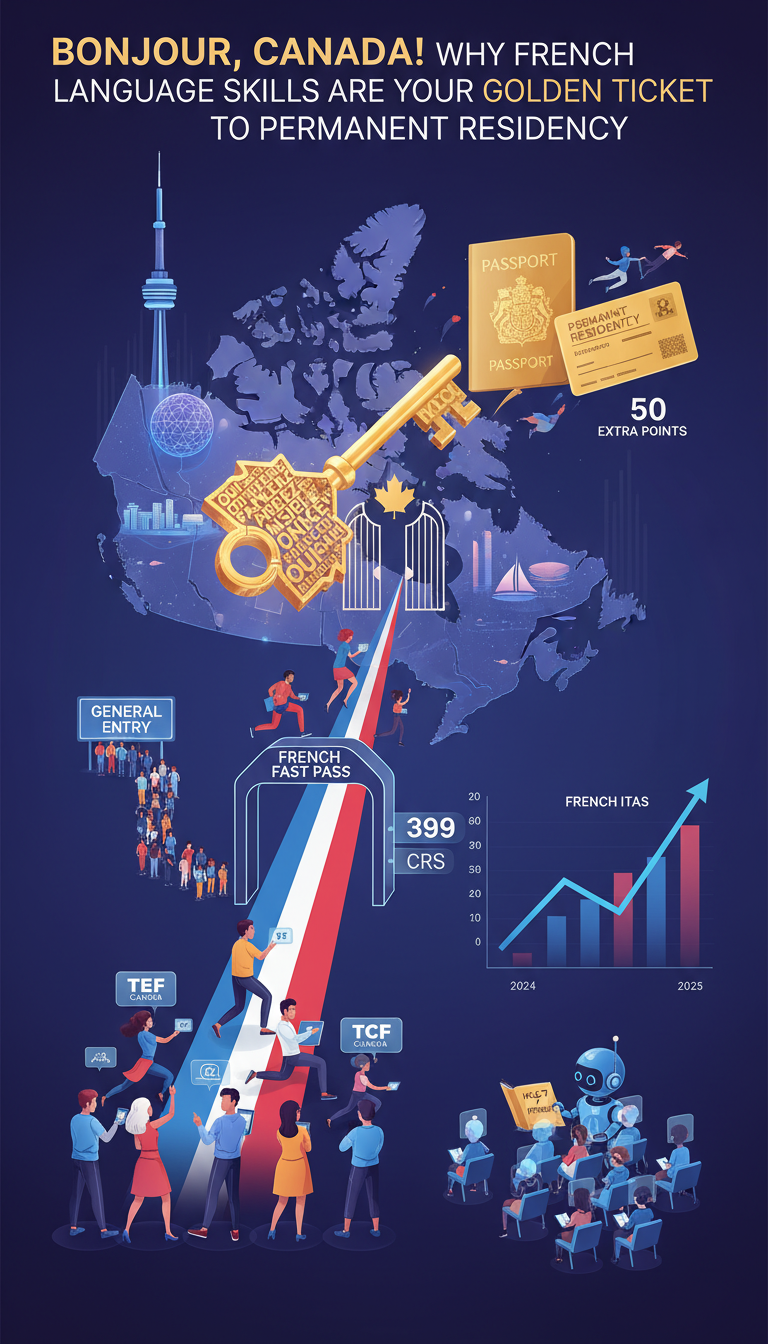
The key to unlocking this linguistic advantage lies in achieving a minimum Canadian Language Benchmark (CLB) level of 7 in French – demonstrating proficiency in reading, writing, listening, and speaking. Accepted tests include TEF Canada and TCF Canada.
Bonus Points Scenario 1
Achieve NCLC 7 in French with a CLB of 4 or lower in English (or no English test at all) and you'll receive 25 bonus CRS points.
Bonus Points Scenario 2
If you boast NCLC 7 in French and CLB 5 or higher in English, the bonus doubles to 50 points.
These points, seemingly modest on their own, can dramatically alter your position, especially when combined with other factors like education (potentially boosting your score by 310-320 points).
But the real magic lies in the cut-off scores. While general draws often demand CRS scores exceeding 500, French-specific draws have seen cut-offs as low as 399, as witnessed in the latest draw. To further illustrate the point, in 2025, there were 9 draws with an average of 5,333 ITAs per draw while there were 11 draws and an average of 2,091 ITAs per draw in 2024. This represents a substantial growth in the frequency and size of the draws.
The Buzz, The Bumps, and The Bad Actors: Navigating the Controversy
This newfound emphasis on French proficiency isn't without its detractors. While many celebrate the increased opportunities, concerns linger.
Fraudulent Certificates
The proliferation of fraudulent TEF/TCF certificates raises serious questions. A black market has reportedly emerged, exploiting the system and undermining the efforts of genuine French learners. IRCC's response – in-person interviews – is a welcome step.
Prioritization Questions
French-specific draws often account for the highest number of ITAs, even surpassing healthcare, STEM, or trades. This raises a crucial question: is Canada prioritizing language over other pressing labor market needs?
The Quebec Shuffle
While the intention is to bolster Francophone communities outside Quebec, there are concerns that many French-speaking immigrants eventually gravitate to the province, undermining the strategy's original goal. And what of those who don't speak French? They now face a considerably higher CRS barrier to entry.
Looking Ahead: What's Next for French in Express Entry?
Despite the controversies, IRCC's commitment to Francophone immigration remains unwavering. The government aims to achieve 9% Francophone admissions outside Quebec by 2026, rising to 10.5% by 2028, and 12% by 2029. In 2025, the focus remains on candidates with Canadian Experience Class experience, as well as those in healthcare, trades, and education sectors (although STEM, transport, and agriculture have been removed from the priority list).
Beyond French, expect to see the introduction of a new Physician category in 2026, along with proposed categories for Leadership and Research/Innovation. And for those seeking to demonstrate their English proficiency, TOEFL will be added as an accepted test from August 2025.
Regardless of these changes, French language proficiency is poised to remain a crucial pathway to Canadian permanent residency.
Parlez-vous français? It Might Be Time to Start!
The power of French in Express Entry is undeniable. The lower cut-off scores, the bonus CRS points, and the unwavering commitment from IRCC all point to a clear advantage for French speakers.
For many, learning French is no longer just a cultural pursuit; it's a strategic imperative. While challenges and controversies persist, the opportunity is clear.
So, if you're considering making Canada your new home, perhaps it's time to dust off those old French textbooks or embark on a new linguistic adventure. It might just be the smartest immigration hack you ever make.

Immigration & paralegal practitioner at JSR Immigration & Legals, helping newcomers and Ontario residents with their cases.
This post is general information about Canadian immigration and Ontario paralegal matters and is not legal advice. Rules change and every case is different — confirm current requirements for your own situation.