PR Card Renewal and the Residency Obligation, Explained Simply
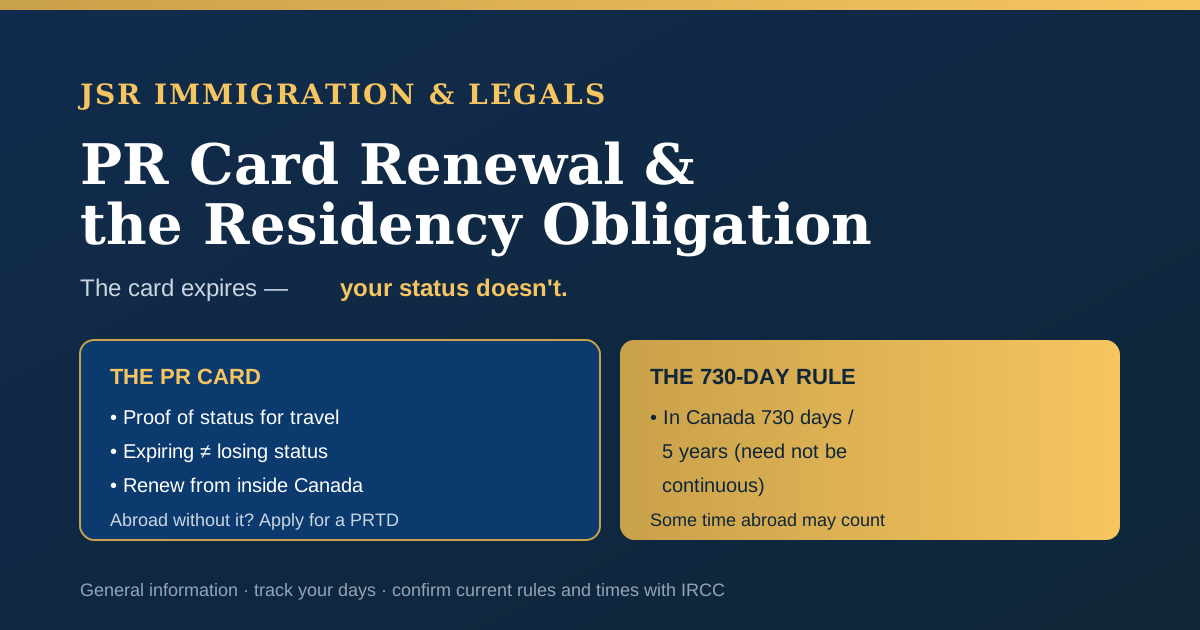
A permanent resident (PR) card with an expiry date coming up causes a lot of needless panic. The single most important thing to understand is this: your PR status does not expire when your card does. The card is just a travel document — proof of your status — not your status itself. Losing the card, or letting it expire, doesn't strip you of being a permanent resident.
What can affect your status is a separate rule called the residency obligation. Renewing your card and meeting that obligation are two different things that people constantly mix up. Here's a clear, general explanation of how both work.
The card vs. the status
Your PR status continues until you either become a Canadian citizen, formally renounce it, or lose it through an official process (for example, after failing to meet the residency obligation, or because of serious inadmissibility). None of those happen automatically just because a plastic card reaches its printed expiry date.
The PR card is what you show to board a flight or other commercial carrier back to Canada. If you never leave the country, an expired card mostly affects convenience — but you'll still want a valid one for travel, employment, and proof of status. If you're outside Canada without a valid card, you generally can't simply fly back on it; you'd apply for a Permanent Resident Travel Document (PRTD) at a visa office instead.
The 730-day residency obligation
To keep your PR status, you must meet the residency obligation. In plain terms, you must have been physically present in Canada for at least 730 days during the last five years. Those 730 days — roughly two years out of every five — don't need to be continuous. You can add them up across multiple trips and stays.
Some time spent outside Canada can still count toward the 730 days in specific situations, including:
- Time abroad accompanying a Canadian citizen spouse, common-law partner, or
parent (if you're a child);
- Time employed full-time by a Canadian business and assigned to work outside
Canada;
- Time abroad accompanying a PR spouse, partner, or parent who is themselves
employed full-time by a Canadian business abroad.
These exceptions have precise definitions, so if you're relying on one, confirm the current rules on the official IRCC pages before you count those days.
some time abroad may still count] F --> E C -- No --> G[Get advice before applying
a review of your status may follow] E --> H[Keep proof of presence:
travel records, taxes, employment]
How renewal actually works
You don't have to wait until the exact expiry date to renew, and there's no penalty for a card that has already lapsed — you can apply once it's expired. Renewal is generally done from inside Canada. In broad strokes:
- Gather your proof of presence. IRCC may want to see that you've met the
residency obligation — think travel history, tax records (Notices of Assessment), employment letters, lease or utility documents. Keeping a simple log of your entries and exits saves a lot of stress later.
- Apply online or by paper using the current IRCC application, pay the fee,
and provide a photo that meets the specifications.
- Wait for processing. Times vary and are updated regularly; PR card renewals
have often been among the faster processing lines, but don't assume — check the current processing time on IRCC's website and apply well before any planned travel.
If your renewal is straightforward and you clearly meet the obligation, it's usually an administrative formality.
If you're short on days
This is where care matters. If you've spent long stretches abroad and may be under 730 days, applying without a plan can trigger a review of your status, and in some cases a finding that you no longer meet the obligation. That doesn't automatically mean you lose everything — there are limited humanitarian and compassionate considerations, and appeal rights in certain situations — but these are exactly the scenarios where getting proper advice before you file is worth it. Don't guess, and don't ignore an expiring card in the hope it resolves itself.
A few practical reminders
- Track your days. A running list of every entry and exit is the simplest way
to know where you stand against the 730-day rule.
- Renew early for travel. If you have a trip planned, start the renewal well
ahead — being stuck abroad with an expired card and no PRTD is a headache.
- Confirm current figures. Fees, processing times, and document checklists
change; always verify against the official IRCC pages before you rely on them.
- PR isn't the same as citizenship. If long-term certainty is your goal and
you're eligible, becoming a Canadian citizen removes the residency-obligation worry entirely.
Get in touch
Most PR card renewals are simple — but if you've been abroad, are close to the 730-day line, or aren't sure whether time outside Canada counts, a short conversation before you apply can save a lot of trouble. The team at JSR Immigration & Legals is happy to help you understand where you stand and plan your renewal with confidence.
This article is general information about Canadian immigration and is current as of its publication date — it is not legal advice for your specific situation. Confirm current requirements with official sources or a licensed professional before you act.

Immigration & paralegal practitioner at JSR Immigration & Legals, helping newcomers and Ontario residents with their cases.
This post is general information about Canadian immigration and Ontario paralegal matters and is not legal advice. Rules change and every case is different — confirm current requirements for your own situation.