Canada's New Citizenship Law: 5 Surprising Changes You Need to Know - BILL C-3
The Law May Create Two Tiers of Canadians
Canadian citizenship is a deeply valued status, a symbol of belonging that connects families and individuals across international borders. However, the path to citizenship has been a complex and often fraught journey, shaped by a series of legislative changes over the decades. For years, evolving rules in key laws like the Citizenship Acts of 1977 and 2009 created a cohort of "Lost Canadians"—people with clear family ties to the country who were denied citizenship. To address the latest of these challenges, the government has passed Bill C-3, a significant amendment to the Citizenship Act.
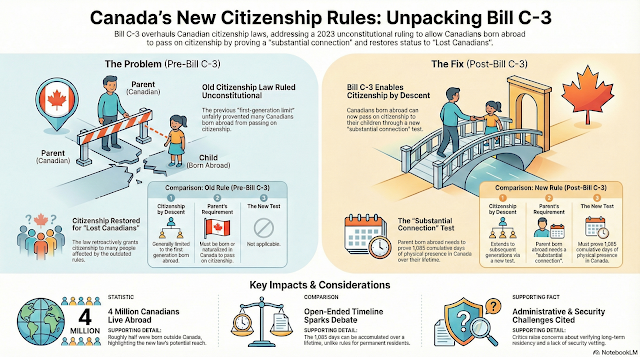
This new legislation is a direct response to the Ontario Superior Court of Justice's December 2023 ruling in Bjorkquist et al. v. Attorney General of Canada, which found the previous "first-generation limit" on citizenship by descent to be unconstitutional. While Bill C-3 aims to remedy this long-standing issue, it also introduces several surprising and counter-intuitive changes with far-reaching implications. It is important to note that this Bill C-3, an amendment to the Citizenship Act, should not be confused with earlier legislation of the same name concerning the Indian Act.
This article breaks down the five most impactful takeaways from the new law, explaining the new "substantial connection" test, its unusual timeline, and the complex questions it raises about administrative burdens, national security, and the very definition of what it means to be Canadian.
It's Not a Free-for-All: The "Substantial Connection" Test
The new law does not create an open door for anyone with a distant Canadian relative. This legislative reform was prompted by the December 2023 Ontario Superior Court of Justice ruling in Bjorkquist et al. v. Attorney General of Canada, which declared the previous "first-generation cutoff" unconstitutional. In its place, Bill C-3 introduces a core requirement known as the "substantial connection test."
To pass the test and confer citizenship on a child born abroad, a Canadian parent who was also born abroad must demonstrate a significant link to Canada. Specifically, the parent must have been physically present in Canada for a cumulative total of 1,095 days (three years) before the child's birth or adoption. This requirement ensures that the right to pass on citizenship is tied to a tangible, established connection to the country.
The Clock Never Stops: You Could Take a Lifetime to Qualify
Perhaps the most counter-intuitive aspect of the new rule is that there is no time limit within which the 1,095 days of physical presence must be accumulated. This stands in stark contrast to the requirement for permanent residents seeking citizenship, who must accumulate their residency days within a five-year period.
This open-ended timeframe means that the days can be gathered over a person's entire lifetime. For example, a Canadian born abroad who spends eight weeks every summer at a cottage in Canada would take nearly 20 years to meet the three-year requirement. According to the government, this flexibility is intentional.
A senior official explained the rationale to a Senate committee, stating:
"...eliminating the time requirement was intended to make it easier for qualified recipients to claim citizenship, including those who 'come to Canada to study every summer or visit their grandparents so they have built up that connection to Canada over many years and not in a short time frame.'"
The Law May Create Two Tiers of Canadians
A key criticism, articulated by policy analyst Andrew Griffith, is that by establishing two different residency accumulation periods—a five-year limit for permanent residents but no time limit for citizens by descent—the bill effectively creates two different classes of Canadians with divergent pathways to the same rights. This outcome appears to contradict a well-known principle of Canadian identity.
Griffith highlights this tension by citing a famous statement from former Prime Minister Justin Trudeau:
"A Canadian is a Canadian is a Canadian."
While Bill C-3 aims to be more inclusive by restoring rights to "Lost Canadians," the mechanism it uses has been criticized for creating a new form of inequality within the country's citizenship framework.
No One Agrees on How Many New Citizens to Expect
There is a significant discrepancy between official government estimates and international perceptions regarding how many people will gain citizenship under the new law. The government’s position is based on the relatively low numbers of previous "Lost Canadians" cohorts, which have numbered some 20,000 since 2009, and most recently at a rate of about 35 to 40 people per year.
Then-immigration minister Marc Miller addressed this directly, stating:
"It’s sure to go up, but I don’t think there are these wild scenarios where we’ll have hundreds and thousands of people."
This conservative estimate contrasts sharply with perceptions abroad, where international headlines proclaimed the new law would "allow thousands of people to claim Canadian citizenship." Immigration, Refugees and Citizenship Canada (IRCC) has not provided detailed estimates, leaving the true number of potential new citizens uncertain.
It Comes with Unexpected Risks and Headaches
Critics have raised concerns about several potential unintended consequences of the new legislation. The open-ended nature of the residency requirement, while flexible, could introduce significant new challenges.
- Administrative Burden: The lack of a timeframe will make it difficult for applicants to prove their physical presence over many decades and equally challenging for officials to verify it. This could significantly affect government workload and bloat processing times for citizenship proofs, which already take five months or longer.
- National Security Concerns: The "porous timeframe" could provide opportunities for long-term foreign interference by countries like China and India in recruiting and exploiting their own expats who have acquired Canadian citizenship. A key concern is that there is currently no security or criminality vetting for citizens by descent, a standard that would presumably apply to this new category of citizens as well.
- Demographic Demand: The number of applicants is difficult to predict because demand is likely to be uneven. It may not be a top priority for second- and subsequent-generation expatriates in the U.S., EU, and other politically stable places. However, it would be a much more urgent concern for those in less stable countries, a factor that complicates official forecasts.
Conclusion: A Solution with New Questions
Bill C-3 successfully resolves the long-standing and unfair problem of "Lost Canadians" who were stripped of their citizenship by outdated laws. In doing so, however, it introduces a new and complex set of rules that have sparked controversy and raised important questions about fairness, security, and administrative capacity.
The legislation’s core tension lies in its attempt to balance facilitation with meaningfulness—making it easier to become a citizen while ensuring that citizenship reflects a significant connection to Canada. The debate now centers on whether these changes ultimately strengthen or dilute the meaning of being Canadian.
In trying to correct the mistakes of the past, has Canada created a new set of challenges for the future of its citizenship?

Immigration & paralegal practitioner at JSR Immigration & Legals, helping newcomers and Ontario residents with their cases.
This post is general information about Canadian immigration and Ontario paralegal matters and is not legal advice. Rules change and every case is different — confirm current requirements for your own situation.