Canadian Citizenship: The 1,095-Day Physical Presence Rule, Counted Day by Day
For many permanent residents, applying for Canadian citizenship feels like the finish line. But before you can apply, you have to clear one very specific hurdle: the physical presence requirement. It sounds simple — spend enough time in Canada — yet it's where a surprising number of applications go wrong. Miscount by even a few days and IRCC can return or refuse your application. Here's how the rule actually works, counted day by day.
The core rule: 1,095 days in 5 years
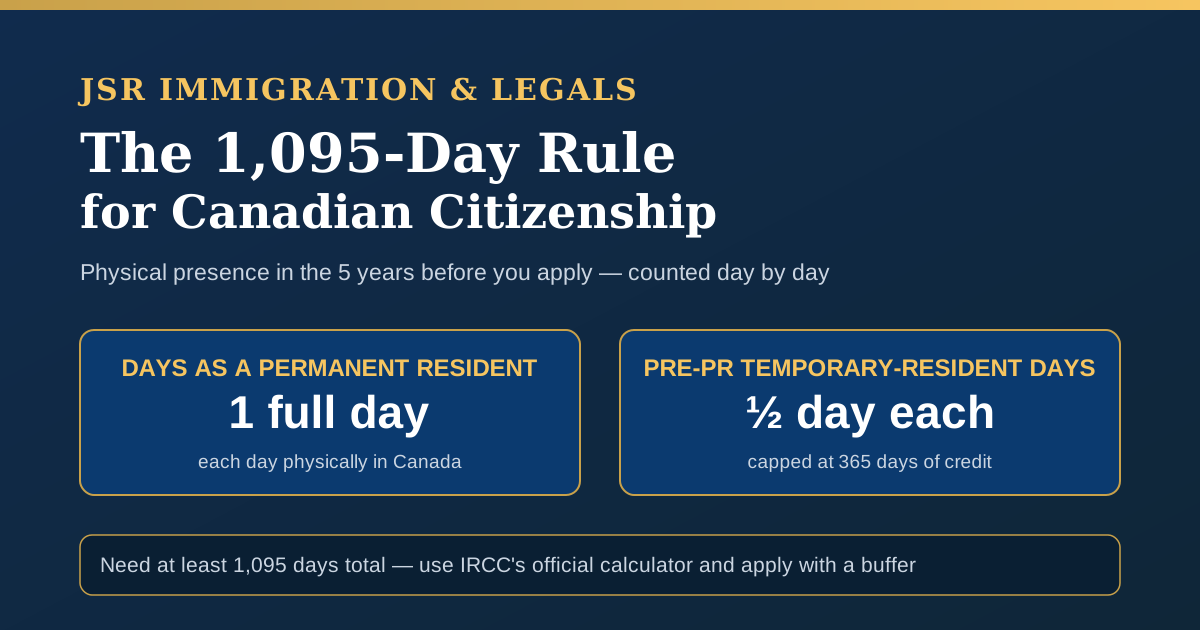
To be eligible to apply for citizenship as an adult, you must have been physically present in Canada for at least 1,095 days (that's three years) during the five years immediately before the date you sign your application.
Two things trip people up here:
- The days don't have to be consecutive. They add up across the five-year
window. You can leave and return; what matters is the total.
- Only days you were actually in Canada count. Time spent outside the
country — vacations, work trips, family visits abroad — does not count toward the 1,095, even if you kept your PR status the whole time.
Because 1,095 is a minimum, most practitioners suggest building in a buffer of extra days rather than applying the moment you hit exactly 1,095. It leaves room for any miscount or a forgotten trip.
The half-day credit for time before PR
Here's the part that genuinely helps many applicants. If you lived in Canada as a temporary resident or protected person before you became a permanent resident — for example on a study permit, work permit, or as a visitor — you can count each of those days as a half-day toward the requirement.
There's a cap: the half-day credit is worth a maximum of 365 days. To reach that full 365-day credit, you'd need 730 days of pre-PR physical presence (730 × ½ = 365).
A quick example: if you were in Canada on a work permit for 800 days before landing as a PR, you can claim 400 days of credit toward citizenship (800 ÷ 2 = 400). Days as a temporary resident after you become a PR are not what this is about — once you're a PR, each day in Canada counts as a full day.
5 years before you apply] --> B{Were you a PR
on that day?} B -- "Yes — permanent resident" --> C[Counts as 1 full day] B -- "No — temporary resident or
protected person before PR" --> D[Counts as 1/2 day] D --> E[Half-day credit capped
at 365 days total] C --> F[Add it all up] E --> F F --> G{Total at least
1,095 days?} G -- Yes --> H[Physical presence met —
check the other requirements] G -- No --> I[Keep accumulating days
and reapply later]
The other boxes you still have to tick
Physical presence is central, but it isn't the only requirement. To apply as an adult you generally also need to:
- Have valid PR status — you can't have an unresolved issue like a removal
order, and you don't need to hold a physical PR card to apply.
- Have filed your taxes for at least three of the five years, if you were
required to file under the Income Tax Act.
- Meet language and knowledge requirements if you're between 18 and 54 —
demonstrating adequate English or French and passing the citizenship test on Canada's history, values, institutions and symbols.
Requirements and age ranges can change, so confirm the current criteria on canada.ca before you rely on any specific number.
A 2026 note: use the official calculator
One practical update worth knowing: IRCC now leans heavily on its online Physical Presence Calculator, and applicants filing in 2026 are expected to complete it and include the printout with the application. Don't count on the back of an envelope. The calculator walks you through each entry and exit and produces the summary IRCC wants to see — using it is the single best way to avoid a math error that could delay or sink your file.
Keep a travel history as you go: dates you left and re-entered Canada, supported by passport stamps, boarding passes, or border records. If your application is ever questioned, that record is what protects you.
Common mistakes to avoid
- Applying at exactly 1,095 days with no cushion, then realising a trip was
miscounted.
- Forgetting short trips — a weekend across the border still comes off your
total.
- Assuming pre-PR time counts fully — remember it's a half-day, capped at
365.
- Signing the application on a different date than you calculated — the
five-year window is measured back from your signature date, so a late signature shifts the whole window.
The bottom line
The physical presence requirement rewards careful record-keeping more than anything else. Know your window, count PR days as full and eligible pre-PR days as half (up to the 365 cap), keep an accurate travel log, and give yourself a buffer before you apply.
If you're getting close to eligibility and want a second set of eyes on your day count — or you're not sure how your temporary-resident time factors in — get in touch with JSR Immigration & Legals. We're happy to help you check the numbers before you file.
This article is general information, not legal advice. For guidance on your own situation, please consult a qualified professional and confirm current requirements with official sources such as canada.ca.

Immigration & paralegal practitioner at JSR Immigration & Legals, helping newcomers and Ontario residents with their cases.
This post is general information about Canadian immigration and Ontario paralegal matters and is not legal advice. Rules change and every case is different — confirm current requirements for your own situation.