IRCC Asks Some New Citizens to Return Their Certificates: What the Bill C-3 Review Means
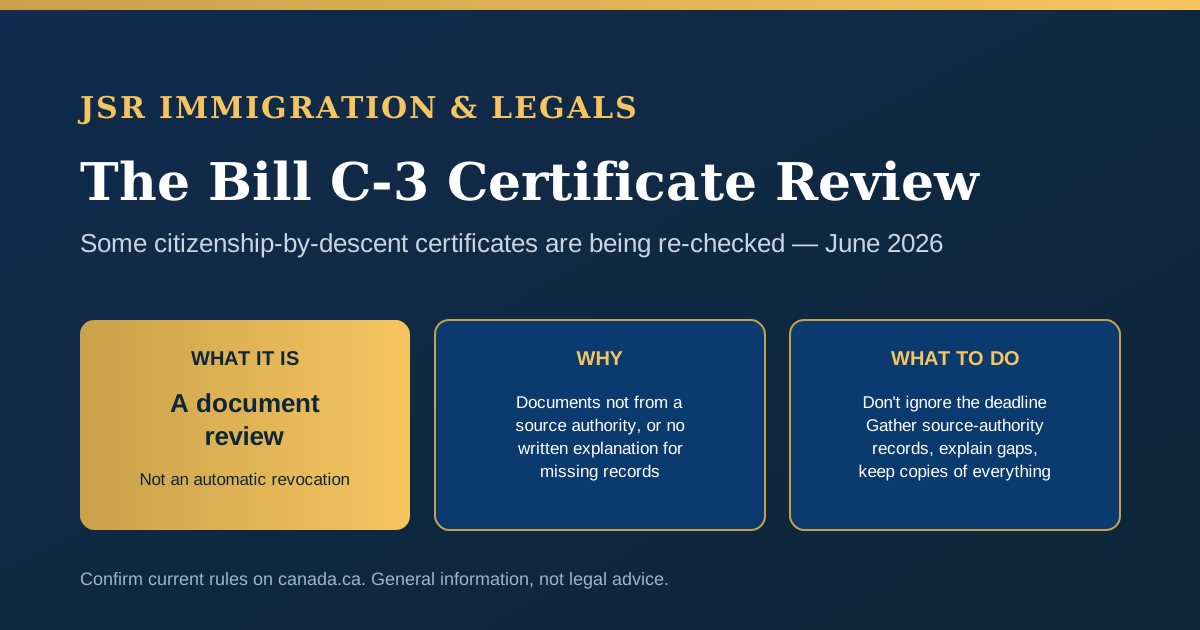
If you recently became a Canadian citizen by descent and a letter from the government just landed asking you to send your certificate back, you are not alone — and you have not necessarily lost your citizenship. In mid-June 2026, Immigration, Refugees and Citizenship Canada (IRCC) began reviewing a set of citizenship certificates that had already been approved under the Bill C-3 changes to citizenship by descent. Here's a plain-language look at what happened, who it touches, and what a recipient should do.
What actually happened
Bill C-3 amended the Citizenship Act to remove the long-standing first-generation limit on citizenship by descent for many people born abroad before December 15, 2025, and to add a "substantial connection" test for children born abroad on or after that date. It received royal assent on November 20, 2025, and came into effect on December 15, 2025. You can read the government's own explainer on the Bill C-3 changes and the news release.
After processing a wave of these applications, IRCC sent notices — reported to have gone out around June 13–15, 2026 — telling certain recipients that their already-approved files are being re-examined. According to news reporting on the letters, recipients were asked to surrender their physical citizenship certificate while the review takes place. Importantly, the reviews are described as a suspension and re-check of the documents, not an automatic revocation of citizenship: if IRCC ultimately confirms entitlement, the certificate is to be returned.
Why IRCC says it's doing this
The letters reportedly cited two document-related reasons:
- Source-authority documents. Some supporting documents did not come from an official "source authority" — for example a vital statistics office, civil registry, or provincial archive — rather than a copy or a secondary record.
- Missing explanation for gaps. Where an applicant could not obtain a required source document, they did not include a written explanation plus proof that they had genuinely tried to get it.
In other words, the review centres on the quality and provenance of the proof of lineage, not on whether the underlying family relationship is real. That distinction matters: it often means a file can be fixed with better paperwork rather than lost outright.
Who is most likely affected
This review targets a specific group — people who obtained, or were in line to obtain, citizenship by descent under the C-3 changes, particularly second-generation-and-beyond cases that relied on older or hard-to-source civil records. Many of these are "Lost Canadians" with family ties going back decades, sometimes across borders. If you became a citizen through birth in Canada, through the regular grant (naturalization) process, or by descent in a clearly documented first-generation case, this particular review is unlikely to involve you.
citizenship-by-descent certificate?} B -- No --> C[Likely unrelated to this review
read carefully, confirm with IRCC] B -- Yes --> D[Read what IRCC is asking for] D --> E[Gather source-authority documents
civil registry / vital stats / archives] D --> F[Write explanation + proof of effort
for any document you can't obtain] E --> G[Respond by the stated deadline] F --> G G --> H{IRCC confirms entitlement?} H -- Yes --> I[Certificate returned] H -- No / unclear --> J[Get professional advice
on next steps]
What to do if you get a letter
- Don't ignore it, and don't panic. A review is not a revocation. But these letters come with deadlines, so read yours closely and note exactly what is being requested and by when.
- Follow the instructions on returning the certificate only as the letter directs, and keep a copy and a record of how and when you sent it.
- Build a stronger document package. Request records directly from the source authority (the vital statistics office, civil registry, or archive that holds them), and ask for certified copies where possible.
- Document your effort. If a record simply cannot be obtained, include a clear written explanation and any proof of your attempts — a "letter of no record" from the relevant office, correspondence, or fee receipts can all help.
- Respond on time and keep everything. Save copies of every document you submit and every communication you receive.
The bigger picture
The backdrop here is a citizenship system under real strain. IRCC's own data has shown tens of thousands of people waiting on citizenship-certificate applications, and processing times for some citizenship lines have lengthened in 2026. This review has also drawn political attention and questions about how it was rolled out. For affected families, though, the practical task is narrower: respond carefully, prove lineage with source documents, and explain any gaps.
If this is genuinely confusing, that's understandable — citizenship-by-descent cases turn on old records and fine legal points, and the stakes are high. The safest move is to treat the letter as a request to strengthen your proof, not as a final word.
Talk to us
If you've received one of these letters, or you're worried a Bill C-3 certificate in your family might be caught up in the review, the team at JSR Immigration & Legals can help you understand what's being asked and put together a solid response — get in touch.
This post is general information only and reflects what was publicly known as of June 17, 2026. It is not legal advice. Citizenship rules and review processes change, and individual cases differ, so confirm current requirements with IRCC or a qualified professional before acting.

Immigration & paralegal practitioner at JSR Immigration & Legals, helping newcomers and Ontario residents with their cases.
This post is general information about Canadian immigration and Ontario paralegal matters and is not legal advice. Rules change and every case is different — confirm current requirements for your own situation.