Express Entry Draws Are Expected to Slow Down for the Rest of 2026 — What It Means If You're in the Pool
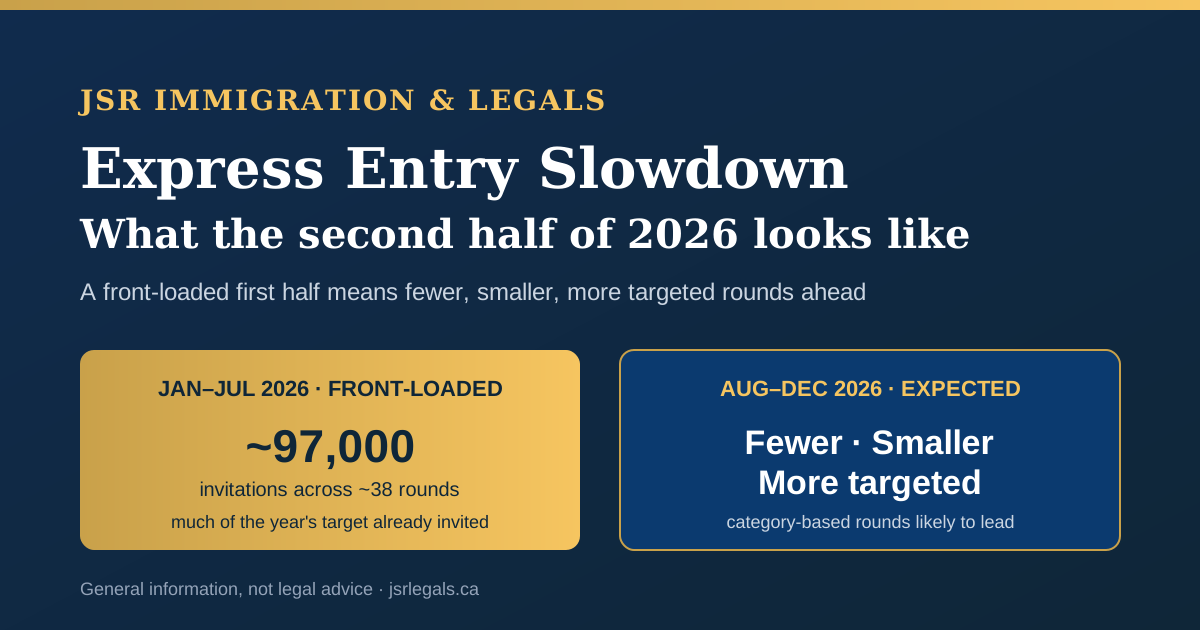
If you've been refreshing the Express Entry page waiting for your number to come up, you may have noticed the pace has changed. After a very busy first half of 2026 — dozens of rounds and tens of thousands of invitations — several immigration analysts now expect draws to become smaller, less frequent, and more targeted for the rest of the year. Here's what's driving that, and what it practically means if your profile is sitting in the pool.
What actually happened in the first half of 2026
Through roughly the first half of the year, Immigration, Refugees and Citizenship Canada (IRCC) issued invitations at a fast clip — on the order of tens of thousands of Invitations to Apply (ITAs) across many rounds, including Provincial Nominee Program (PNP), Canadian Experience Class (CEC), French-language proficiency, and occupation-based category draws. You can see every round, with its date, category, cutoff, and number of invitations, on IRCC's official rounds of invitations page.
The important context is the annual plan. Under the 2026–2028 Immigration Levels Plan, overall permanent-resident admissions are set at about 380,000 per year, with the economic categories making up the largest share. Express Entry feeds a specific slice of that plan (the Federal High Skilled space), and there is a limited number of PR spots the system is meant to fill this year.
Why the slowdown makes sense
Think of the annual target as a bucket. IRCC appears to have front-loaded invitations — filling much of that bucket early — so that applications are in processing well before year-end. Once a large share of the year's spots have already been invited or are already being processed, the department has room to ease off without falling behind its targets.
target already invited?} C -- Yes --> D[Fewer / smaller rounds
for the rest of 2026] C -- No --> E[Steady pace continues] D --> F[More weight on category-based
and PNP rounds]
That doesn't mean draws stop. It more likely means fewer rounds, smaller invitation counts, and a heavier lean toward category-based selection — targeting specific occupations or language ability — rather than large, across-the-board draws. Note that IRCC has signalled it does not expect broad "all-program" general draws to be a feature of 2026; selection has been running through PNP, CEC, French-language, and occupation categories instead.
What this means if you're in the pool
A slower back half of the year changes the math for candidates, but it is not a reason to panic. A few practical takeaways:
- A high CRS score matters more when rounds are smaller. Fewer, more targeted
draws tend to favour candidates who are either near the top of the pool or who fit an active category. Points you can still influence — language test results, a second official language, education credential assessments, and eligible work experience — are worth revisiting.
- Category-based selection can be your fastest route. If your occupation,
French ability, or field lines up with an active category, you may be invited at a lower cutoff than a general round would require. Check which categories IRCC is drawing from this year before assuming your score is "too low."
- A provincial nomination is still powerful. A PNP nomination adds a large
number of points and effectively moves you to the front of the line. If your profile fits a province's stream, that pathway is worth exploring in parallel.
- Keep your profile accurate and current. Update your profile as soon as
anything changes — new test scores, more experience, a new credential — so you're ranked correctly whenever the next relevant round lands.
- Watch your temporary status. If you're in Canada on a work or study permit
while you wait, keep an eye on expiry dates and any bridging options so you don't fall out of status while the pool moves more slowly.
The bigger picture
The predicted slowdown is a natural consequence of planning, not a sign the door is closing. Canada is still committed to substantial economic immigration over the 2026–2028 period — the pace within a single year simply rises and falls as IRCC manages its annual limits. If draws are quieter this fall, that's the plan working as intended, and the pace typically resets when a new year's targets begin.
Draw predictions are exactly that — predictions. Cutoffs, categories, and timing can change on short notice, so treat any forecast as a planning tool rather than a promise, and always confirm the current picture against IRCC's official rounds page.
We're here to help
Wondering whether to chase a higher CRS score, target a category, or pursue a provincial nomination while draws are quieter? Every profile is different, and the right move depends on your specific situation. The team at JSR Immigration & Legals can help you read the current landscape and build a realistic plan — get in touch for a consultation.
This article is general information, not legal advice. For guidance on your own Express Entry profile, please consult a licensed immigration professional.

Immigration & paralegal practitioner at JSR Immigration & Legals, helping newcomers and Ontario residents with their cases.
This post is general information about Canadian immigration and Ontario paralegal matters and is not legal advice. Rules change and every case is different — confirm current requirements for your own situation.