August 25, 2026: IRCC Updates Citizenship Certificate Forms for the 1,095-Day Test
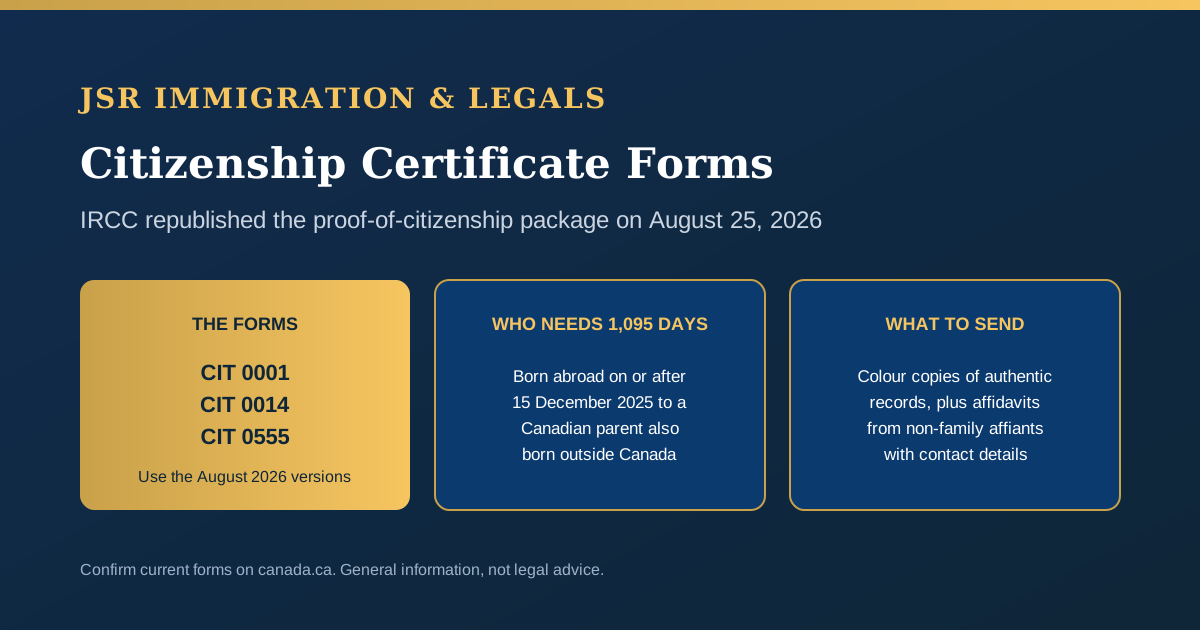
Immigration, Refugees and Citizenship Canada (IRCC) republished its proof-of-citizenship package on August 25, 2026. The application (CIT 0001), checklist (CIT 0014), physical-presence form (CIT 0555), and paper guide all carry that date. IRCC’s forms catalogue lists the three forms as 2026-08.
Bill C-3 did not change this week. The update is the paperwork for a citizenship certificate, especially where a child born abroad on or after December 15, 2025 must show a parent’s time in Canada.
Who must prove 1,095 days
The guide says applicants born outside Canada on or after December 15, 2025 to a Canadian parent who was also born outside Canada must show that at least one Canadian citizen parent had 1,095 days of physical presence in Canada before the child’s birth. If that applies, complete CIT 0555.
Appendix F then asks a series of questions. The physical-presence section does not apply if you were born before December 15, 2025; you are applying only for a replacement certificate; you were born in Canada; your Canadian parent was born in Canada or naturalized before your birth (except a parent granted citizenship as an adopted person); or a Canadian parent or grandparent was a Crown servant at the time the guide names.
If none of those apply, and your parent was born outside Canada to a Canadian citizen — or was granted citizenship as an adopted person under section 5.1 of the Citizenship Act — then proof of that parent’s physical presence is required.
People born before December 15, 2025 often still need a certificate after Bill C-3. They do not use the 1,095-day test. They still need current forms and source-authority documents for each generation.
What the current package asks for
Download the August 2026 versions. Do not reuse an older CIT 0001, CIT 0014, or CIT 0555.
Proof for the days on CIT 0555 must be clear, easy-to-read colour copies of authentic documents or records. IRCC may ask for more and may contact the people or organizations you identify.
Acceptable proof includes, but is not limited to:
- employment or educational records, such as T4 slips or school transcripts
- travel records, such as passports or entry and exit records
- residential records, such as rental, mortgage, or insurance records
- Canadian government records (federal, provincial/territorial, or municipal)
- affidavits from religious institutions, unions, volunteer programs, or other organizations that know about the parent’s time in Canada
- affidavits from third parties with that knowledge
- other proof of the parent’s physical presence in Canada
Affidavits must include the affiant’s name, mailing address, and email address and/or phone number. The affiant swears the statement before someone authorized to administer oaths where they live: in Canada, a notary public, a commissioner of oaths, or a commissioner for taking affidavits; outside Canada, a notary or equivalent. That person must be proficient in English or French. Stamps and seals that are not in English or French must be translated.
You cannot swear your own affidavit. Family cannot either, even if they are a lawyer or notary — including a parent, guardian, sibling, spouse, common-law or conjugal partner, grandparent, child, aunt, uncle, niece, nephew, or first cousin.
How to keep the file from coming back
Use CIT 0014, answer every question or write “N/A”, sign and date the form, and include the fee receipt. The listed fee is $75 per person. Incomplete applications are returned. If you mail more than one application together and one is incomplete, IRCC says all of them come back.
Other return risks: a form dated more than 90 days before IRCC receives it, a post-dated form, missing colour copies of two pieces of identification (one with a photo), photos that miss the citizenship specifications, missing translations, and no letter of explanation for a gap.
Online applicants get a personalized checklist in the account. Confirm the live steps on IRCC’s how to apply page.
What to do this week
- Download CIT 0001, CIT 0014, and CIT 0555 and confirm each page says August 2026.
- Work through Appendix F before you fill CIT 0555. Many Bill C-3 files do not need it.
- If you do need the calculator, gather colour copies from original authorities and line up non-family affiants who will give contact details.
- If a record does not exist, say so in writing and keep proof that you asked the issuing office.
- Check IRCC’s processing-times tool before you plan travel or a passport around a new certificate.
If you want help deciding whether Appendix F applies, or assembling the affidavit and source-authority package, contact JSR Immigration & Legals at jsrlegals.ca or by phone.
This article provides general information only and is not legal or immigration advice. Citizenship rules and forms change. Confirm the current versions on the official Government of Canada pages and consult a licensed professional for advice specific to your circumstances.

Immigration & paralegal practitioner at JSR Immigration & Legals, helping newcomers and Ontario residents with their cases.
This post is general information about Canadian immigration and Ontario paralegal matters and is not legal advice. Rules change and every case is different — confirm current requirements for your own situation.