Demerit Points and Your Insurance: How One Ontario Ticket Really Follows You
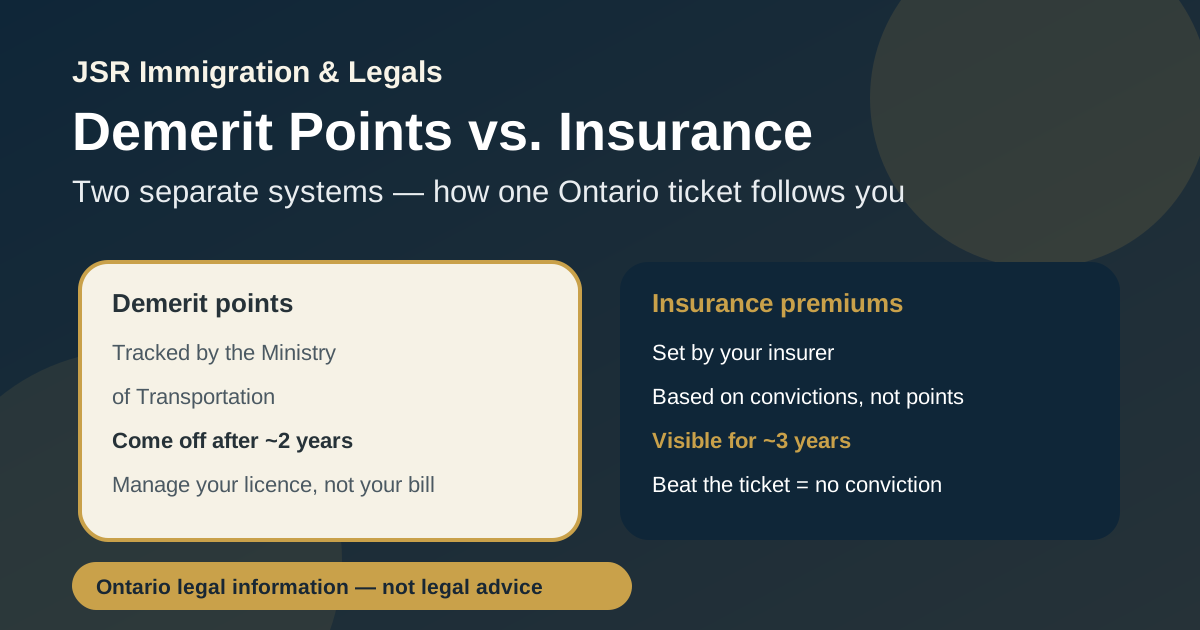
Get a ticket in Ontario and two worries usually hit at once: how many demerit points is this, and how much will my insurance go up? Most drivers assume those are the same thing. They are not. Demerit points and insurance premiums run on two separate tracks — kept by different organizations, triggered at different moments, and lasting for different lengths of time. Understanding the difference is the key to deciding whether to just pay a ticket or fight it. Here is a plain-language guide to how a single conviction actually follows you.
Two systems, not one
Demerit points are the government's system, tracked by the Ministry of Transportation on your driver's record. They exist to flag risky driving and, if you rack up enough, to warn or suspend you.
Insurance premiums are set by your insurer, a private company. Insurers generally do not look at your demerit-point count at all. What they look at is your record of convictions — the offences you were actually found guilty of, whether you pleaded, paid the fine, or lost in court.
That distinction matters more than almost anything else about a ticket:
- A ticket that carries demerit points but that you successfully fight and beat
leaves you with no conviction — and usually no insurance impact.
- A ticket you simply pay is a guilty plea. Even a "minor" one with just a
couple of points becomes a conviction on your record that an insurer can see.
In other words, paying a ticket to "make it go away" can be the exact move that raises your premium. The points fade on their own; the conviction is the part that costs you money.
How demerit points work
Demerit points are added to your record when you're convicted of certain moving violations. Common examples in Ontario include roughly 3 points for going 16–29 km/h over the limit or for distracted driving, 4 points for 30–49 km/h over, and 6 points for going 50+ km/h over or for careless driving. (Confirm the current value for your specific offence — the schedule can change.)
The points then sit on your record and are counted against thresholds:
- Fully licensed (G) drivers typically get a warning letter around 6
points, may be called for an interview around 9, and face a 30-day suspension at 15 points or more.
- Novice (G1/G2) drivers face lower thresholds — a warning letter at just a
couple of points and a suspension at a much smaller total.
Crucially, demerit points come off your record about two years after the offence date. They are a licence-management tool, not a bill.
~2 years on record] C --> F[Conviction visible to insurer
~3 years — premium may rise] D --> G[No points, no insurer impact] E --> H[Enough points? Warning,
interview, or suspension]
How insurance actually reacts
When your policy renews, your insurer pulls your driving record and looks at your convictions over roughly the past three years. Convictions are generally grouped as:
- Minor — speeding, improper turns, following too closely. One minor
conviction may be forgiven or have a small effect; a second or third usually pushes your premium up.
- Major — things like distracted driving, failing to report a collision, or
driving without insurance. These hit harder.
- Serious/criminal — stunt/racing, careless driving, or impaired driving,
which can lead to large increases, non-renewal, or placement in the high-risk market.
Two things about timing surprise people. First, an insurer usually only sees the conviction at your next renewal, so the increase can arrive months after the ticket. Second, because a conviction stays visible for about three years while the demerit points disappear after two, your premium can still be affected after the points themselves are gone.
What this means for your decision
This is exactly why "should I just pay it?" is the wrong first question. The better question is: will paying create a conviction I'll regret at renewal?
- A first minor ticket with clean history may cost little at renewal — but
it's still a conviction, and a second one within three years compounds.
- A major or serious charge is where fighting it — or negotiating it down to
a lesser offence — can save you far more in premiums than the fine itself.
- Novice drivers have the most to lose on the licence side, because
suspension thresholds are low.
Fighting a ticket won't always succeed, and it takes time. But the value of a good outcome isn't just the fine you avoid — it's the three years of premium increases a conviction can trigger. That math is often what tips the balance.
Where to confirm the current rules
- Ontario's demerit point system (official thresholds and point values):
ontario.ca/page/understanding-demerit-points.
- Your driving record — order an abstract to see your own convictions:
ontario.ca/page/driver-record-abstract-request.
- Ontario Court of Justice — Provincial Offences (fighting a ticket):
Get in touch
Whether to pay a ticket or challenge it is really a question about your record three years from now, not just today's fine. If you've received a traffic charge in Ontario and want to understand what it could do to your licence and your premium, JSR Legals can help you weigh your options. Reach us at info@jsrlegals.ca.
This article is general information about Ontario law, current as of July 2026, and is not legal advice for any specific situation. Point values, thresholds and insurance practices can change — confirm the current details with the Ministry of Transportation, your insurer, or a licensed professional before you act.

Immigration & paralegal practitioner at JSR Immigration & Legals, helping newcomers and Ontario residents with their cases.
This post is general information about Canadian immigration and Ontario paralegal matters and is not legal advice. Rules change and every case is different — confirm current requirements for your own situation.