Took a Lower-Paying Job After Being Let Go? What Ontario's New Mitigation Ruling Means for Your Severance
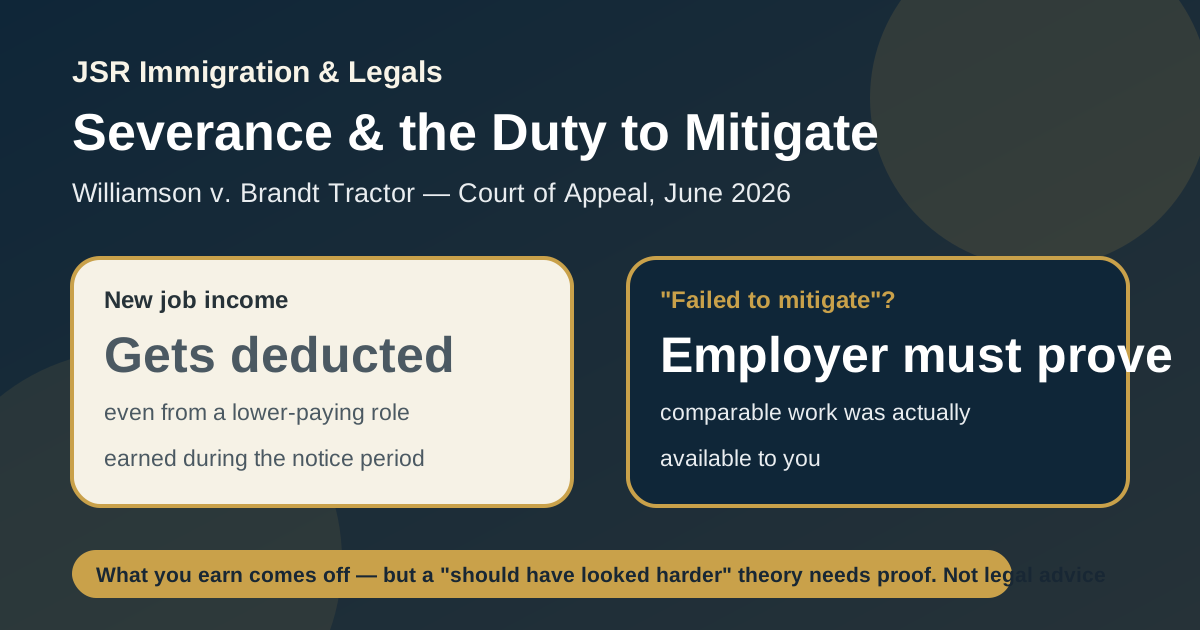
If you lose your job in Ontario without cause and then find new work, a tricky question follows you into any severance dispute: does the money you earn at the new job get subtracted from what your old employer owes you? In June 2026, the Court of Appeal for Ontario gave its clearest answer yet — and it cuts both ways.
The case is _Williamson v. Brandt Tractor Inc._, 2026 ONCA 272. Here is what it decided and what it means for everyday workers.
The "duty to mitigate" in plain language
When an Ontario employer dismisses someone without cause, the employee is usually owed a period of reasonable notice (or pay in place of it). But the law also expects the dismissed worker to take reasonable steps to find comparable work — this is called the duty to mitigate. The logic: severance is meant to bridge you to your next job, not to pay you twice.
If you do land a new job during your notice period, the income you earn is generally deducted from what the old employer owes. That keeps you from being fully paid by two employers for the same stretch of time.
What happened in Williamson
The employee was a salesperson. After he was dismissed, he didn't chase another sales role. Instead he took a significantly lower-paying job driving a parts vehicle, telling the court he wanted a career change and was content with the new position. During his roughly 17-month notice period, he earned about $32,881 at the new job.
His former employer argued two things:
- Because the new job paid far less and ranked lower, the earnings shouldn't
count against the severance owed; and (in the alternative)
- The employee failed to mitigate by not even looking for a comparable sales
job, so his damages should be cut.
The trial judge had sided with the employee. The Court of Appeal took a more nuanced path.
What the Court of Appeal actually held
Point one — lower-paying earnings still count. The court confirmed there is no rule that income from an "inferior" or lower-ranking job escapes deduction. Money earned during the notice period is generally subtracted from the severance owed, even if the new job pays less or ranks lower than the old one. So the employee's roughly $32,881 was deducted.
Point two — but employers carry a heavy burden. The employer's separate argument — that the worker should be penalised for not seeking a comparable sales role — failed. Here's the key point for workers: to win a "failure to mitigate" argument, an employer must prove not just that the employee didn't search hard enough, but also that comparable work was actually available — that if the person had taken reasonable steps, they likely would have landed a similar job. The employer couldn't show that comparable employment was out there, so its "failure to mitigate" argument went nowhere.
In short: the actual money you earn comes off your award, but an employer can't slash your severance on a theory that you "should have" found something better unless it backs that theory with real evidence about the job market.
How it generally flows
during that period?} C -- Yes --> D[Actual earnings generally
deducted — even from a
lower-paying job] C -- No --> E{Employer claims you
failed to mitigate?} E -- Yes --> F{Can employer prove
comparable work was
actually available?} F -- No --> G[No deduction —
full award stands] F -- Yes --> H[Court may reduce
the award] E -- No --> G
What this means for you
- **Earnings from a new job usually reduce your severance — keep that in mind
when negotiating.** Whether the new role is a step down or not, what you actually earn during the notice period generally comes off the top.
- You're allowed to take a different or lower-paying job. Choosing a career
change doesn't automatically count as "failing to mitigate." An employer who wants to dock your pay for not chasing a comparable role has to prove such a role was genuinely available to you.
- Documents matter on both sides. Your job-search records, pay stubs from new
work, and the dates everything happened all feed into how a court or a Small Claims judge sizes up the final number.
A note on where these claims are heard
Wrongful-dismissal claims in Ontario can be pursued in the Superior Court or, where the amount fits, in the Small Claims Court (which now handles claims up to $50,000). The mitigation principles from Williamson apply either way — the math of what's deducted, and who must prove what, doesn't change with the courtroom.
Where to confirm the details
- The decision itself is on CanLII:
Williamson v. Brandt Tractor Inc., 2026 ONCA 272.
- The basics of notice and severance under the Employment Standards Act, 2000
are explained on Ontario.ca: Termination of employment.
Get in touch
Whether you've just been handed a severance offer, you've started a new job and aren't sure how it affects what you're owed, or you're an employer trying to understand your exposure, the details of mitigation can move the number a lot. JSR Legals can help you understand where you stand. Reach us at info@jsrlegals.ca.
This article is general information about Ontario law, current as of June 2026, and is not legal advice for any specific situation. Court decisions are fact-specific and the law can change — confirm the current rules before you act.

Immigration & paralegal practitioner at JSR Immigration & Legals, helping newcomers and Ontario residents with their cases.
This post is general information about Canadian immigration and Ontario paralegal matters and is not legal advice. Rules change and every case is different — confirm current requirements for your own situation.