Fired After Speaking Up? Reprisal Under Ontario's Human Rights Code
Most people know the Ontario Human Rights Code protects you from discrimination based on things like race, disability, age, sex, or family status. What fewer people realize is that the Code separately protects something else: your right to speak up about your rights without being punished for it. That protection is called the rule against reprisal, and a recent decision from the Human Rights Tribunal of Ontario (HRTO) is a useful reminder of how it works.
What "reprisal" actually means
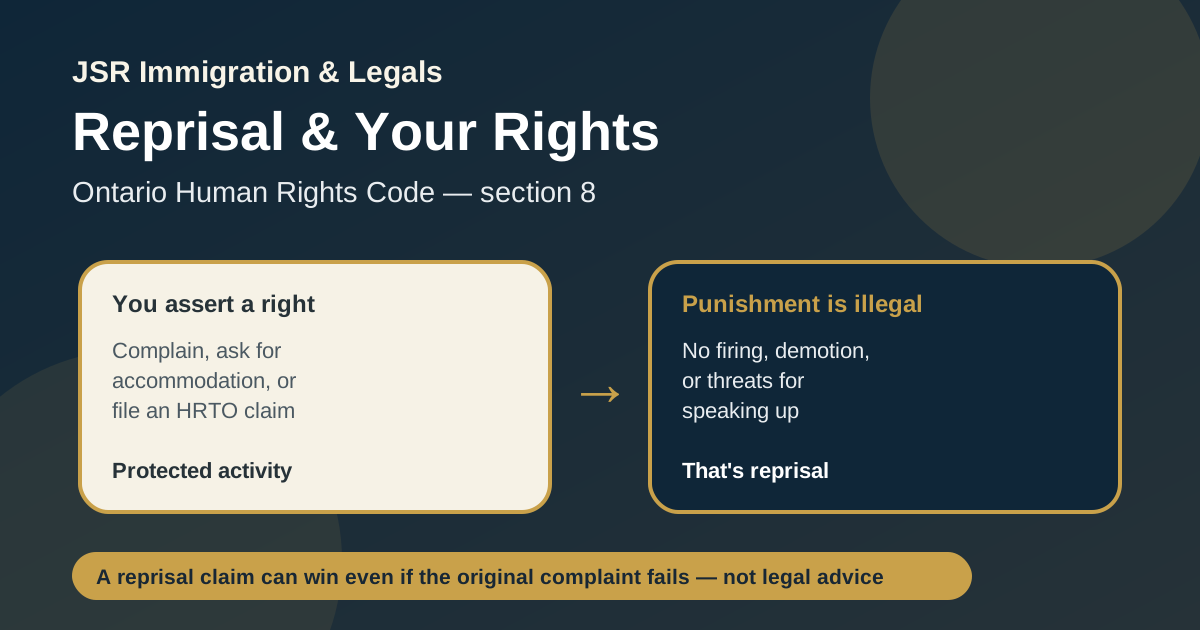
Reprisal is retaliation for asserting a right under the Code. Section 8 of the Code gives every person the right to claim and enforce their Code rights, to take part in proceedings, and to refuse to discriminate against someone else — "without reprisal or threat of reprisal for so doing."
In plain terms: if you complain about discrimination or harassment, file an HRTO application, support a co-worker's complaint, or simply ask your employer to accommodate a disability, your employer is not allowed to punish you for it. Punishment can mean firing, demotion, a sudden cut in hours, discipline, exclusion, or threats to do any of those things.
Crucially, a reprisal claim can succeed even if the original complaint does not. The two are separate. You might raise a concern that the Tribunal later finds was not discrimination — but if your employer fired you because you raised it, that retaliation can still be a stand-alone Code violation.
A recent reminder from the HRTO
In McLennon v. Elite Residential Concierge Services Inc., 2026 HRTO 831, the Tribunal looked at a situation where a worker asserted their rights under the Code and the employment relationship then came to an end. The worker argued the termination was tied to the fact that they had taken steps in a human rights proceeding.
The case illustrates how the Tribunal approaches these claims. There is rarely a memo that says "we are firing you for complaining." Instead, the HRTO looks at the surrounding circumstances — especially the timing of the negative action, whether the employer knew about the protected activity, and whether the employer's stated reasons hold up. Where the evidence lines up, the Tribunal can draw an inference of reprisal without a written admission.
The general test the Tribunal applies
To establish reprisal, an applicant generally needs to show three things:
- They claimed or tried to enforce a Code right, or took part in a Code
proceeding (the "protected activity").
- The employer took an adverse action against them — for example, termination,
discipline, or a threat.
- The protected activity was a factor in the employer's decision. It does not
have to be the only reason — just a real part of it.
The employer can respond with a legitimate, non-retaliatory explanation. The Tribunal then weighs the whole picture, including credibility, to decide what really drove the decision.
complain, ask for accommodation,
or file/support an HRTO claim] --> B[Employer takes adverse action
firing, demotion, threat, discipline] B --> C{Was the protected activity
a factor in the decision?} C -- Yes --> D[Employer offers a legitimate,
non-retaliatory reason] D --> E{Does that reason hold up
against timing and evidence?} E -- No --> F[Reprisal can be found
even if the original complaint fails] E -- Yes --> G[Claim may not succeed] C -- No --> G
Why this matters to everyday workers
Reprisal protection is one of the most practical parts of the Code because it addresses a very common fear: "If I say something, I'll lose my job." The rule exists precisely so that people can raise legitimate concerns — about harassment, a missing accommodation, or unequal treatment — without that fear being used against them.
It is not a blank cheque. An employer can still manage, discipline, or even let someone go for genuine, unrelated reasons. The line is about motive: adverse action that is genuinely about performance or restructuring is lawful; the same action taken because you exercised a Code right is not.
What to do if you think you've been retaliated against
- Write down the timeline. Note when you raised the issue, who knew about it,
and when the negative action followed. Timing is often central.
- Keep records. Emails, texts, schedules, and any reasons the employer gave in
writing can all matter later.
- Mind the deadline. An HRTO application generally must be filed **within one
year** of the event (or the last in a series of related events). Don't wait.
- Check the official sources. Read the Code's reprisal protection in
section 8 of the Human Rights Code, and see how the HRTO process works at Tribunals Ontario. HRTO decisions, including the case above, are published on CanLII.
Get in touch
Reprisal cases turn on the details — the timeline, the documents, and the reasons your employer gave. If you believe you were punished for standing up for your rights, or you're unsure whether what happened to you counts, JSR Legals can help you understand your options before a deadline passes. Reach us at info@jsrlegals.ca.
This article is general information about Ontario law, current as of June 2026, and is not legal advice for any specific situation. Outcomes depend on the facts of each case — confirm the current rules and deadlines, or get advice, before you act.

Immigration & paralegal practitioner at JSR Immigration & Legals, helping newcomers and Ontario residents with their cases.
This post is general information about Canadian immigration and Ontario paralegal matters and is not legal advice. Rules change and every case is different — confirm current requirements for your own situation.