Could Two Words in Your Job Contract Cost You Thousands? Ontario's Termination-Clause Showdown
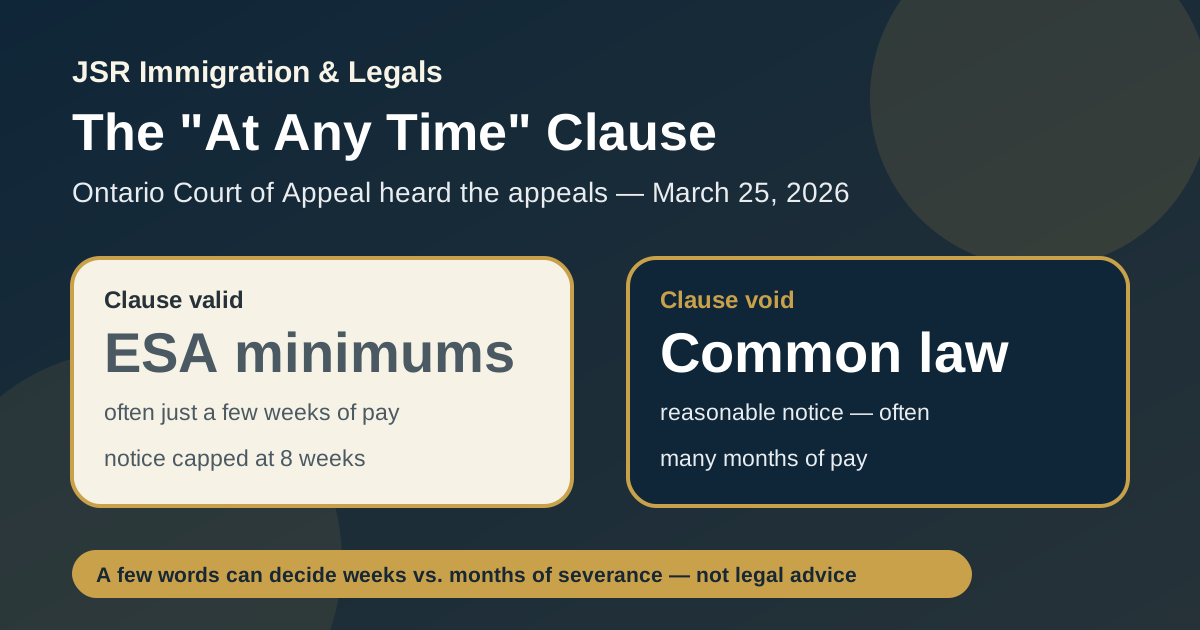
Buried in most Ontario employment contracts is a short paragraph almost nobody reads when they sign — the termination clause. It says what your employer owes you if they let you go without cause. And right now, a battle over a few words in those clauses is working its way through Ontario's highest court. The outcome could be the difference between a laid-off worker getting a few weeks of pay and getting many months of it.
Why the termination clause matters so much
When an Ontario employer dismisses someone without cause (meaning no serious misconduct — just a restructuring, a downsizing, or "it isn't working out"), the law gives the employee a financial cushion. How big that cushion is depends almost entirely on one thing: is the termination clause in the contract enforceable?
- If the clause is valid, it usually limits you to the minimums under the
Employment Standards Act, 2000 (ESA) — generally one week of notice (or pay) per year of service, capped at eight weeks, plus severance pay of up to 26 weeks for longer-service employees of larger employers.
- **If the clause is not valid,** it falls away entirely. You then fall back on
common-law reasonable notice, which the courts decide case by case and which is often far more generous — sometimes roughly a month of pay per year of service, up to a practical ceiling of around 24 months.
So an unenforceable clause can turn a few weeks of ESA pay into many months of common-law pay. That is why this issue is fought so hard.
The "at any time" saga
The fight comes down to wording. Ontario courts have repeatedly struck down termination clauses that conflict — even slightly — with the ESA. In the 2024 decision _Dufault v. Township of Ignace_ (2024 ONSC 1029), a judge found that language letting an employer terminate "at any time" and in its "sole discretion" offended the ESA, because the Act actually protects employees from being fired at certain times (for example, while on a protected leave or for asserting their rights). The clause was void, and the employee fell back to common-law notice.
That set off a wave of conflicting rulings:
- _Baker v. Van Dolder's Home Team Inc._ (2025 ONSC 952) followed Dufault
and held that the words "at any time," on their own, were enough to sink the clause.
- Other decisions, such as _Li v. Wayfair Canada_, went the other way —
finding that "at any time" language survived when the clause was expressly made subject to the ESA.
The result has been real uncertainty for both employees and employers across the province.
What just happened — and what's next
On March 25, 2026, the Court of Appeal for Ontario heard the appeals in Baker and Li together (the hearing had been adjourned from earlier in the year). The court is expected to finally decide whether the phrase "at any time" is fatal to a termination clause. As of June 2026, the decision has not yet been released — the employment-law world is waiting for it.
When the ruling lands, it will set the rule for a huge number of Ontario contracts. A worker-friendly outcome could invalidate countless existing clauses and push more dismissed employees toward larger common-law packages; an employer-friendly outcome could rehabilitate "at any time" wording that has been voided over the past two years.
How the entitlement question generally flows
termination clause?} B -- No --> E[Common-law reasonable notice
usually well above ESA minimums] B -- Yes --> C{Is the clause
ESA-compliant and enforceable?} C -- Yes --> D[Limited to ESA minimums
notice + any severance pay] C -- No / void --> E E --> F[Amount depends on age, service,
role, and job market]
What this means for you right now
- Don't assume the number in your contract is the most you can get. A clause
that looks airtight may not survive a closer read against the ESA — and a single non-compliant phrase can void the whole termination section.
- Be careful before signing a release. If you are offered a severance package,
the amount is often the ESA minimum. Signing a full release in exchange can give up a potentially larger common-law claim.
- Mind the clock. There are deadlines to pursue a wrongful-dismissal claim, and
ESA complaints and court actions run on different timelines.
- Keep your documents. Your signed contract, offer letter, pay records, and the
termination letter all matter to how your entitlement is assessed.
Where to confirm the details
- The ESA rules on notice and severance are explained on Ontario.ca:
- The cases themselves are on CanLII — for example,
Baker v. Van Dolder's Home Team Inc., 2025 ONSC 952.
Get in touch
Whether you have just been handed a severance offer, are unsure if your contract's termination clause holds up, or are an employer wondering if your contracts need updating, the wording matters — and so does the timing. JSR Legals can help you understand where you stand. Reach us at info@jsrlegals.ca.
This article is general information about Ontario law, current as of June 2026, and is not legal advice for any specific situation. The Court of Appeal's decision in these cases had not been released at the time of writing, and the law in this area can change — confirm the current rules before you act.

Immigration & paralegal practitioner at JSR Immigration & Legals, helping newcomers and Ontario residents with their cases.
This post is general information about Canadian immigration and Ontario paralegal matters and is not legal advice. Rules change and every case is different — confirm current requirements for your own situation.