Saskatchewan's SINP Just Reshaped Its 2026 Streams: Priority Sectors, Capped Sectors, and the Six-Month Rule
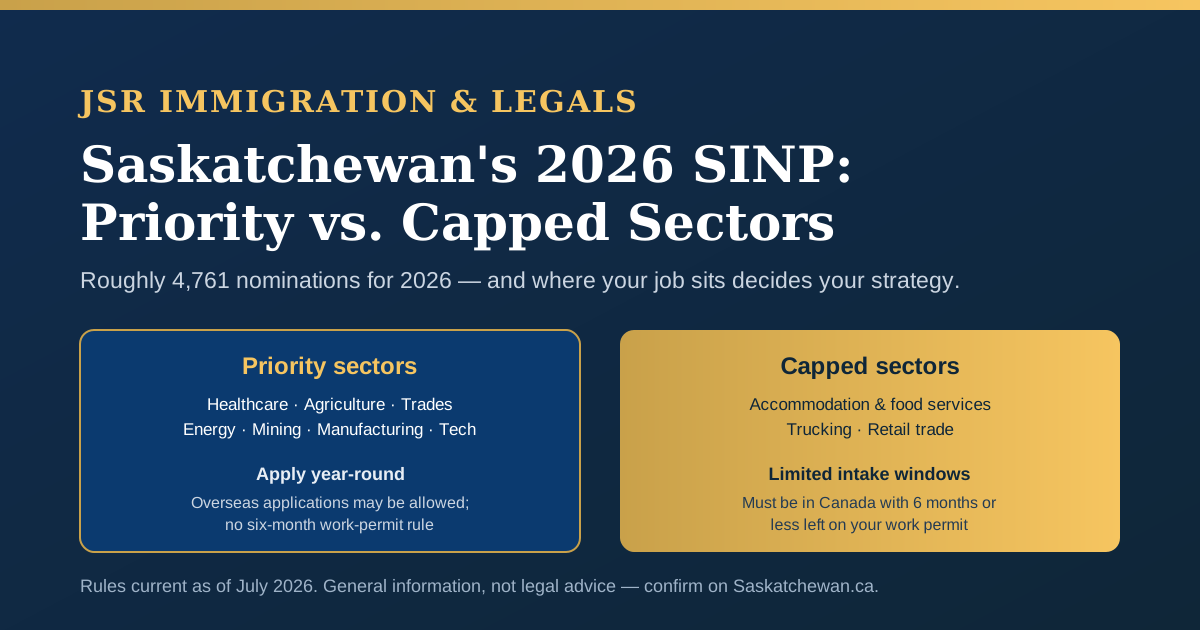
If Saskatchewan is on your radar as a path to permanent residence, the rules for 2026 have changed in a meaningful way. The Saskatchewan Immigrant Nominee Program (SINP) has reorganised its work-based streams around two buckets — priority sectors and capped sectors — and added timing restrictions that decide when some applicants can even submit. With a mid-year intake window having run in early July, this is a good moment to understand where you'd fit.
This is general information to help you get oriented, not advice on your specific file. Always confirm the current rules on the official SINP pages before you act.
The headline: a smaller, more targeted allocation
For 2026, Saskatchewan was given an initial allocation of roughly 4,761 provincial nominations — a notably tighter number than in past years, with the possibility of more later at the federal government's discretion. Because the province can only nominate so many people, it has chosen to steer most of those spots toward the industries it most needs to fill.
That's the whole logic behind the new priority-versus-capped split.
Priority sectors: apply year-round
At least half of the 2026 allocation is reserved for priority sectors — the industries Saskatchewan wants to grow. These generally include:
- Healthcare
- Agriculture
- Skilled trades
- Energy
- Mining (including critical minerals)
- Manufacturing
- Technology
If your occupation falls in a priority sector, the process is more open:
- You can generally apply at any time — there's no narrow intake window to catch.
- You may be able to apply from outside Canada, not only from inside.
- You aren't subject to the six-month work-permit rule described below.
The province has also set aside a portion of these spots specifically for Saskatchewan post-secondary graduates working in priority industries — a nod to keeping local talent in the province.
Capped sectors: limited spots, strict timing
A smaller share of nominations is set aside for capped sectors, each with a hard ceiling. The main capped groups are:
- Accommodation and food services
- Trucking
- Retail trade
These sectors matter to Saskatchewan's economy, but the province is deliberately limiting how many nominations they can absorb. Two features make capped sectors much more competitive:
- Fixed intake windows. Instead of applying whenever you're ready, capped-sector candidates can only submit during scheduled windows spread across the year (early 2026 windows ran on a roughly every-other-month cadence, including one in early July 2026). Once a window's limited spots are gone, they're gone.
- The six-month work-permit rule. For capped sectors, applicants generally must be in Canada on a valid work permit with six months or less of validity remaining at the time they apply. The intent is to prioritise people already established and working in the province whose status is running down.
priority sector?} B -->|Yes: healthcare, trades,
agriculture, tech, etc.| C[Apply year-round
Overseas applications may be allowed] B -->|No: accommodation/food,
trucking, retail| D{In Canada on a work permit
with 6 months or less left?} D -->|No| E[Not eligible for the capped
intake right now — reassess options] D -->|Yes| F[Watch for the next intake window
Limited spots, apply fast] C --> G[Provincial nomination if selected] F --> G
What changed for open work permit holders
The province has also tightened eligibility for some open work permit holders, including certain spousal open work permits, for some SINP pathways. Saskatchewan has pointed to concerns about exploitation risk and worker-retention outcomes as the reasoning. If you were counting on qualifying through an open work permit, don't assume the old rules still apply — check whether your permit type is still accepted for the stream you're targeting.
Why this matters for you
The practical takeaway is simple: which sector your job sits in now shapes your whole strategy.
- If you're in a priority sector, you have flexibility — you can prepare carefully and apply when your documents are ready.
- If you're in a capped sector, timing is everything. You need to know the next intake window, make sure you meet the six-month work-permit condition, and have a complete application ready to submit the moment the window opens.
A few things worth doing regardless of your sector:
- Confirm your occupation's classification against the current SINP lists — job titles and NOC codes don't always map the way you'd expect.
- Track your work-permit expiry closely if you're in a capped sector, since your eligibility depends on it.
- Have an Express Entry backup in mind. A Saskatchewan nomination can pair with the federal Express Entry system for a large CRS boost, but eligibility runs on its own rules.
Talk to us
Saskatchewan's 2026 changes reward people who know exactly where they fit and move at the right time. If you're unsure whether your occupation counts as a priority or capped sector — or whether your work permit still qualifies you under the new rules — the team at JSR Immigration & Legals can help you map out a realistic plan. Get in touch.
This post is general information only and reflects what was publicly known as of July 13, 2026. It is not legal advice. SINP allocations, sector lists, intake windows, and eligibility rules can change — always confirm the current requirements on Saskatchewan.ca or with a qualified professional before acting.

Immigration & paralegal practitioner at JSR Immigration & Legals, helping newcomers and Ontario residents with their cases.
This post is general information about Canadian immigration and Ontario paralegal matters and is not legal advice. Rules change and every case is different — confirm current requirements for your own situation.