OINP Redesign Phase 1: Eight Streams Closed, One New Workforce Priority Stream
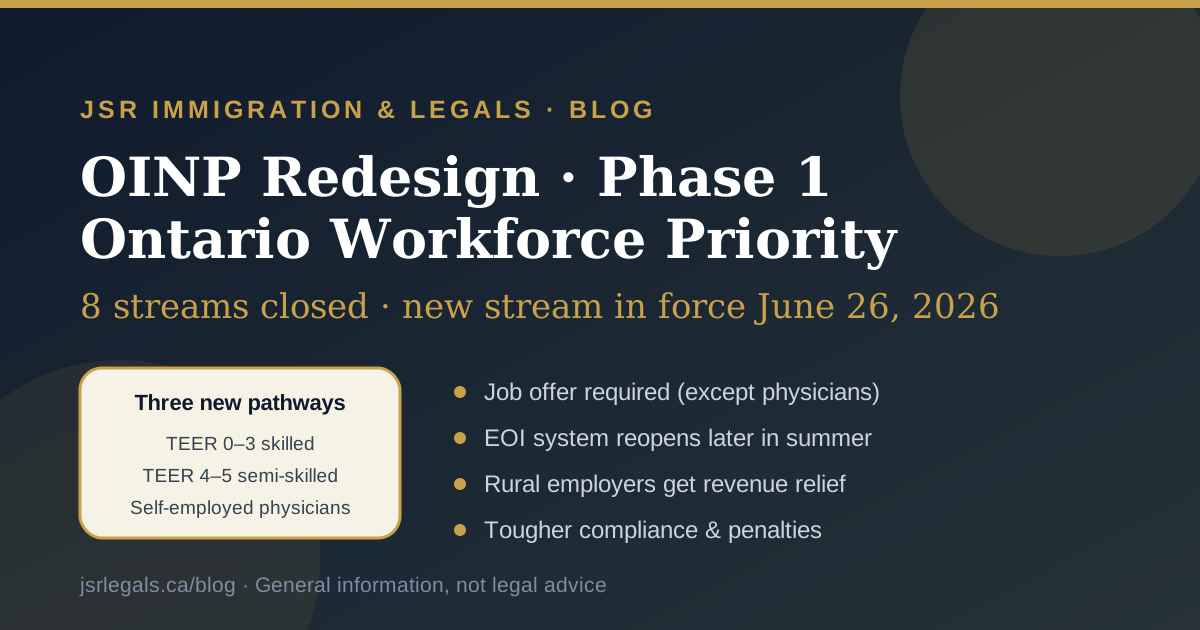
If you were counting on the Ontario Immigrant Nominee Program (OINP) for your path to permanent residence, the program you knew no longer exists. On June 26, 2026, amendments to Ontario Regulation 422/17 came into force, closing eight OINP streams and replacing them with a single new pathway: the Ontario Workforce Priority stream. This is "Phase 1" of a broader redesign the province has signalled is coming.
This is one of the biggest structural changes to the OINP in years. Below is a plain-language breakdown of what closed, what opened, who qualifies, and the practical steps to take while the new system comes online.
What changed on June 26, 2026
Ontario consolidated its employer- and education-based streams into one employer-driven program. The province says the goal is to "streamline pathways to permanent residence for individuals with arranged employment in Ontario."
The following eight streams are now closed to new applications:
- Employer Job Offer: Foreign Worker
- Employer Job Offer: In-Demand Skills
- Employer Job Offer: International Student
- Master's Graduate
- PhD Graduate
- Express Entry: Human Capital Priorities
- Express Entry: French-Speaking Skilled Worker
- Express Entry: Skilled Trades
In their place, Ontario introduced the Ontario Workforce Priority stream, which becomes the main route for employer-sponsored nominations.
8 streams] --> B[Phase 1 redesign
June 26, 2026] B --> C[Ontario Workforce Priority stream] C --> D[Pathway 1
TEER 0-3 skilled workers] C --> E[Pathway 2
TEER 4-5 semi-skilled workers] C --> F[Pathway 3
Self-employed physicians] D --> G[Permanent job offer required] E --> G F --> H[No job offer required]
The three new pathways
The Ontario Workforce Priority stream has three pathways. Two are built around a permanent job offer in Ontario; the third is for physicians.
1. Skilled workers — TEER 0 to 3
This pathway is open to workers with permanent job offers in occupations classified as TEER 0, 1, 2 or 3 under the National Occupational Classification.
- Language: Canadian Language Benchmark (CLB) 6 — or CLB 5 for
certain roles.
- Education: a post-secondary degree or diploma.
- Work experience — one of the following:
- 6 months consecutive in the last 12 months in the position; or
- 3 months for recent Ontario graduates; or
- 2 years cumulative in the last 5 years in the occupation; or
- licensed applicants are exempt from the experience requirement.
2. Semi-skilled workers — TEER 4 to 5
This pathway covers all TEER 4 and 5 occupations with a permanent job offer — a meaningful opening for lower-skilled workers who often had limited PNP options.
- Language: CLB 4.
- Education: a Canadian secondary school diploma or equivalent.
- Work experience: 9 months cumulative in the last 2 years.
3. Self-employed physicians
Physicians get their own pathway with no job offer required. To qualify you must:
- be a member in good standing with the **College of Physicians and Surgeons of
Ontario**;
- hold a valid certificate of registration (independent, academic or
provisional); and
- be eligible to bill through the Ontario Health Insurance Plan (OHIP).
This recognizes that many physicians practise as independent practitioners rather than as employees with a conventional job offer.
Relief for rural employers
Ontario built in support for smaller communities. Employers in census divisions with populations under 150,000 face lower gross annual revenue requirements when supporting a candidate. The intent is to make it easier for rural and northern businesses — which often struggle to hit the revenue thresholds designed for large urban firms — to sponsor the workers they need.
The catch: the EOI system is closed for now
Here is the most important practical point. The redesign came into force on June 26, but the Expression of Interest (EOI) system is now closed to new registrations. Ontario says the new EOI platform for the Workforce Priority stream is anticipated to open later in the summer.
In other words, the streams are written into law, but you generally cannot submit a new profile yet. This is a transition window — use it to prepare, not to panic.
Stronger compliance and enforcement
Alongside the new pathways, Ontario tightened program integrity. Most notably, the response time for an Administrative Monetary Penalty (AMP) notice has been cut from 60 days to 30 days. Notices can now be delivered by email, mail or in person, and are treated as "deemed delivered" rather than requiring proof of receipt. Employers and applicants should watch their inboxes and mail closely — the window to respond to a compliance notice is now half what it was.
What this means for you
If you already submitted an application under one of the closed streams before the cut-off, your file should continue to be processed under the rules that applied when you applied. Keep your contact information current and respond promptly to any request from the OINP.
If you were planning to apply, the path forward depends on your profile:
- Skilled and semi-skilled workers: the most important asset is now a
permanent job offer from an Ontario employer in an eligible occupation. If you have one, get your language test booked and your education and work history documented so you are ready the moment the EOI platform opens.
- International graduates and master's/PhD holders: the dedicated graduate
streams are gone. Your route now generally runs through a permanent job offer under the TEER 0–3 pathway (where recent Ontario graduates get a reduced 3-month experience requirement), or through federal Express Entry.
- Physicians: confirm your CPSO registration and OHIP billing eligibility,
since the new pathway does not require a job offer.
or explore Express Entry] C --> I[Get documents ready before EOI reopens] F --> I G --> I H --> I
The bottom line
Phase 1 of the OINP redesign narrows Ontario's provincial nomination program into an employer-driven model anchored by a permanent job offer, with a carve-out for physicians and some breathing room for rural employers. The graduate and Express Entry-aligned streams that many candidates relied on are gone. With the EOI system temporarily closed, the smart move right now is preparation: secure a qualifying job offer, get your language results and documents in order, and be ready to act the day the new platform opens later this summer.
This is also Phase 1 — the province has signalled more change is coming, so the rules you plan around today may keep evolving.
If you want a clear read on which pathway you realistically qualify for under the new OINP — and how to position yourself before the EOI platform reopens — that is exactly the review we do at the start of every file. Reach out to JSR Immigration & Legals and we will look at your situation together.
This article is general information, not legal advice. Eligibility depends on your own facts and the rules in force when you apply, so confirm current requirements with the OINP or a licensed representative before you act.

Immigration & paralegal practitioner at JSR Immigration & Legals, helping newcomers and Ontario residents with their cases.
This post is general information about Canadian immigration and Ontario paralegal matters and is not legal advice. Rules change and every case is different — confirm current requirements for your own situation.