July 31, 2026: Only 28,200 New Student Arrivals Versus a 155,000 Target
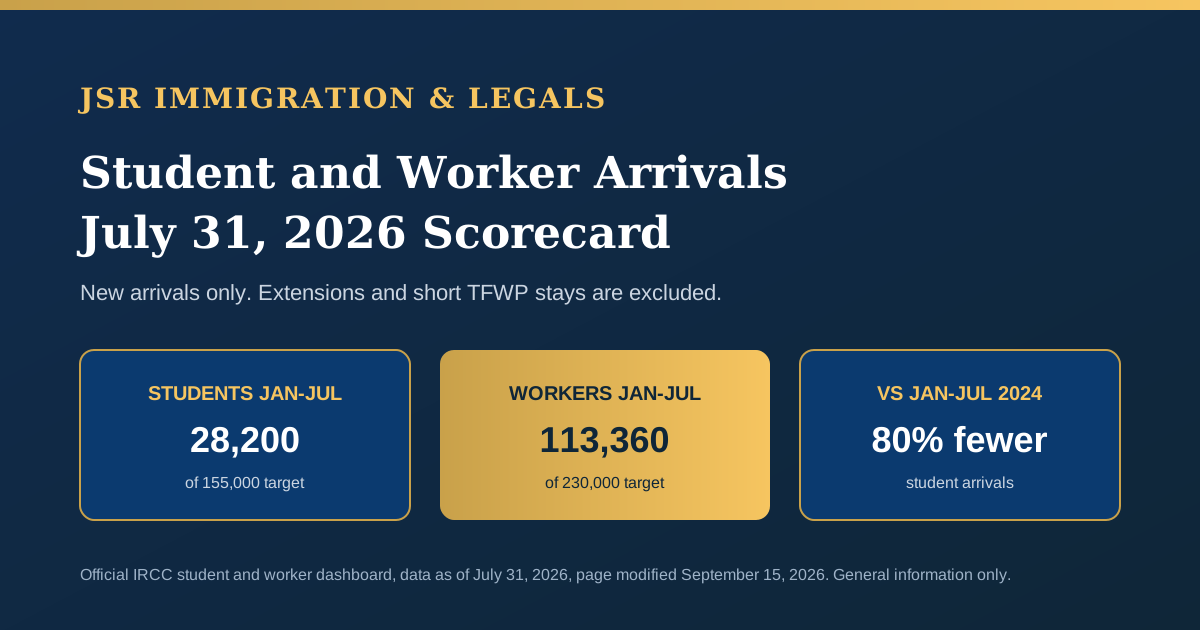
IRCC’s dashboard on student and temporary worker numbers, last modified September 15, 2026, now publishes a seven-month count. Data is as of July 31, 2026. New student arrivals from January to July 2026 total 28,200. The 2026 student arrivals target is 155,000. New worker arrivals in the same seven months total 113,360. The 2026 worker arrivals target is 230,000.
Those are official arrival counts, not permit-holder stock. Combined student and worker arrivals from January to July 2026 were 66% fewer than the same period in 2024, a drop of 275,010 people. New student arrivals were 80% fewer than January to July 2024, down 113,830. New worker arrivals were 59% fewer, down 161,180.
This is not a new program. It is the next official scorecard against the reduced 2026-2028 levels plan. Our June 30 count used 22,405 student arrivals and 98,125 worker arrivals. The change that matters now is the July landing pace and the gap that remains against the yearly lines.
What the official tables say
IRCC’s annual arrivals table on the current page:
| Year | New student arrivals | New worker arrivals |
|---|---|---|
| 2024 | 292,875 | 393,185 |
| 2025 | 114,975 | 208,580 |
| 2026 (January to July) | 28,200 | 113,360 |
July 2026 added 5,820 new student arrivals and 15,400 new worker arrivals (the monthly worker table sums to 15,395 after rounding). Worker arrivals remain mostly International Mobility Program. In July 2026 IRCC counted 3,580 TFWP arrivals and 11,815 IMP arrivals.
The stock of people already in Canada is larger than these arrival numbers. As of July 31, 2026, IRCC counts 590,205 people who hold a study permit and 1,560,565 people who hold only a work permit. People who hold both a study permit and a work permit are counted as study permit holders. The study-permit stock is down from the 632,535 figure on the June 30 dashboard.
IRCC states that the figures are approximate and subject to change, and that values are rounded. Earlier monthly lines moved slightly when the dashboard moved from June 30 to July 31. Use the live table, not a screenshot from last month.
What these numbers do and do not include
Do not treat an arrival total as a refusal rate or as spaces left in the cap.
IRCC excludes permit extensions, asylum claimants, seasonal agricultural workers, and Temporary Foreign Worker Program stays of 270 days or less where the start and end dates fall in the same calendar year. A person issued both a study permit and a work permit in the same month is counted in the student group.
What this means if you are a student or a worker
A 155,000 student arrivals target for the full year is already a cut from earlier years. After seven months, 28,200 arrivals leave most of that target unused on paper. That does not mean a study permit filed now is easy. PAL and TAL rules, school allocation, and the living-cost table of $23,448 for a single applicant outside Quebec on files submitted on or after September 1, 2026 still control who can file. We covered that table in our September 1 proof-of-funds explainer.
If you already hold a study permit, use the stock figure. 590,205 study permit holders were in Canada on July 31. Status, work hours, and PGWP eligibility turn on the permit you hold and the program you finish, not on the arrival target. An in-Canada extension is not an arrival on this dashboard. Do not read a low arrival number as proof that an extension will be fast.
IRCC’s same page records 127,135 former temporary residents who became permanent residents from January to July 2026. That is 57% of new permanent residents in the period. The companion July 31 permanent residence dashboard sits against a 380,000 levels-plan target.
What to do with the seven-month gap
If you plan to apply for a study permit, confirm the live PAL or TAL rules and the living-cost table that matches your filing date. The arrival target is a levels-plan number. It is not a promise that a complete file will be approved.
If you are already in Canada on a study or work permit, treat expiry dates as hard. An extension, a restoration, or a switch of status is a different count than an arrival. File while you still have status.
If your goal is permanent residence, Canadian work experience still feeds CEC and several category-based Express Entry rounds. A provincial nomination still adds 600 CRS points when the nomination is valid.
If you need a structured review of a study permit, a work permit, or an in-Canada PR plan, contact JSR Immigration & Legals through our consultation page, the study permit service page, or the work permit service page.
This article is general information current to September 18, 2026, and is not legal or immigration advice. Confirm the live tables on Canada.ca before you file.

Immigration & paralegal practitioner at JSR Immigration & Legals, helping newcomers and Ontario residents with their cases.
This post is general information about Canadian immigration and Ontario paralegal matters and is not legal advice. Rules change and every case is different — confirm current requirements for your own situation.