5 Things Canadians Need to Know About the New U.S. Biometric Border Rule
The End of an Era for Border Crossings
For generations, crossing the border between Canada and the United States has felt less like an international checkpoint and more like a visit to a neighbour. That long-standing relationship is about to change. A major new regulation from the U.S. Department of Homeland Security, effective December 26, 2025, will require nearly all non-U.S. citizens to have a digital photograph, or "headshot," taken for facial recognition screening when entering and exiting the country. This article breaks down the five most important and surprising details of this new rule that every Canadian traveller needs to understand.
- The Special Treatment for Canadians is Ending
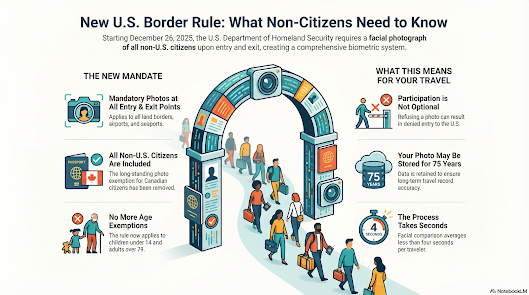
For many years, Canadian citizens have benefited from a special exemption from U.S. biometric collection requirements—a hallmark of the uniquely close relationship between the two countries. That exemption has now been eliminated. The new rule is part of a U.S. initiative to create a comprehensive biometric entry-exit system. It mandates that Canadian citizens, along with other non-U.S. nationals, must be photographed upon both entry to and exit from the United States at all land, air, and sea ports of entry.
2. You Can't Opt Out
This new biometric screening process is mandatory for all non-U.S. citizens. U.S. Customs and Border Protection (CBP) uses facial recognition technology to match these live "headshots" against existing government records, such as passport and visa photos. This stands in clear contrast to the policy for U.S. citizens, who are permitted to opt out of the facial recognition process. For a Canadian or any other non-U.S. citizen, refusal to be photographed has a direct consequence: you can be denied entry into the U.S. or barred from boarding a commercial flight or vessel.
3. Age Exemptions Have Been Eliminated
Previous U.S. regulations exempted children under the age of 14 and seniors over the age of 79 from biometric screening. These age-based exemptions have been completely removed. Under the new rule, travellers of all ages are now required to be photographed—from newborns in car seats to great-grandparents visiting family.
4. Your Biometric Data Has a Very Long Shelf Life
The U.S. government has established a significant data retention policy for the photographs collected at the border. The photos taken upon your entry and exit may be retained by U.S. authorities for up to 75 years. To put that in perspective, a photo taken of a 25-year-old traveler could remain in the DHS system until they are 100 years old. The stated purpose for this long-term storage is to ensure long-term travel record accuracy.
5. The Rule is Official, But Full Implementation Varies
While the regulation's official date is December 26, 2025, the complete rollout of the technology will take time. U.S. authorities estimate that full implementation across every single land crossing and smaller port is expected to take between three and five years. The system serves dual purposes: it verifies your identity upon entry and logs your departure upon exit, creating a complete travel record. The high-speed facial comparison process, which takes an average of less than four seconds, is what enables the U.S. government to pursue its stated security objectives—like combating identity fraud and preventing human trafficking—with minimal disruption to traffic flow.
The New Face of U.S. Travel
This new regulation marks a fundamental shift in U.S. border policy. For Canadians, it means mandatory photos, the end of long-held exemptions based on nationality and age, and the long-term storage of biometric data. As security technology becomes more integrated into our travel, what does the future balance between convenience, security, and personal privacy look like?

Immigration & paralegal practitioner at JSR Immigration & Legals, helping newcomers and Ontario residents with their cases.
This post is general information about Canadian immigration and Ontario paralegal matters and is not legal advice. Rules change and every case is different — confirm current requirements for your own situation.