Budget 2026 Tax Changes: Flat-Rate Deductions and One May 15 Filing Deadline
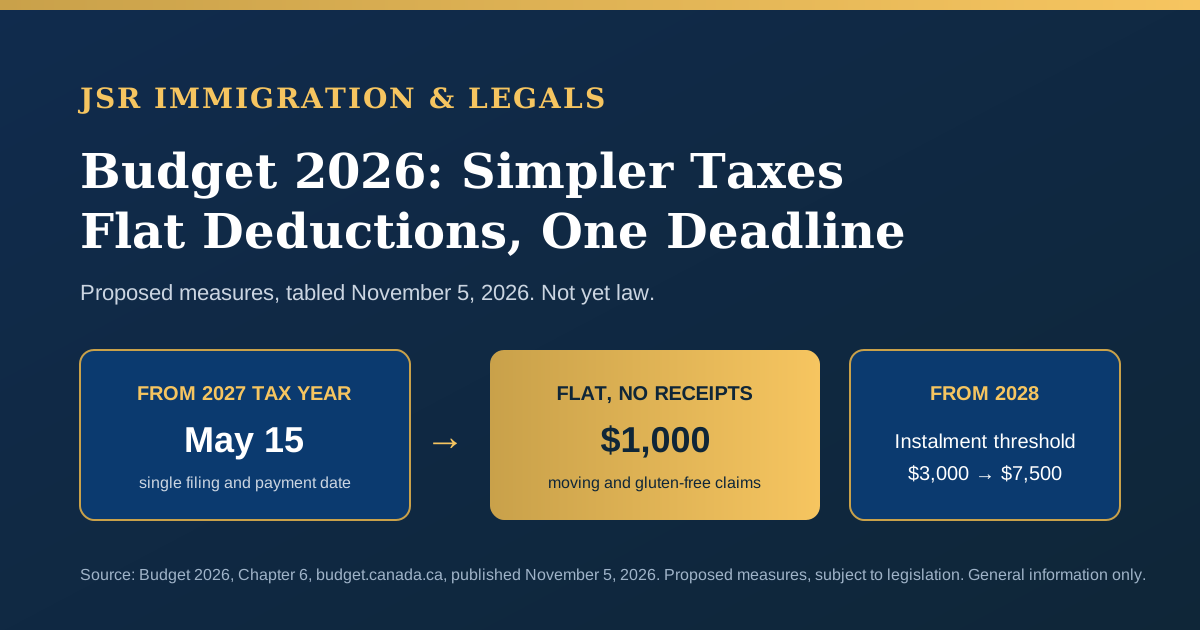
Budget 2026, tabled on November 5, 2026, calls itself the most ambitious tax simplification effort in decades. Behind the packaging sit practical changes that would affect how millions of Canadians file, pay, and challenge their taxes: one filing deadline instead of two, fewer quarterly instalments, receipt-free flat deductions, and a longer window to object to an assessment. The measures are proposed, not yet law. Each one has its own start year, and the start year is what matters for you.
The headline changes
According to Chapter 6 of the budget, published on budget.canada.ca on November 5, 2026:
- A single May 15 deadline for filing your return and paying taxes owing, including for self-employed individuals. Today the filing deadline for most people is April 30, while self-employed individuals file by June 15 but pay by April 30. The budget says the change would apply for the 2027 and subsequent taxation years and is expected to save Canadians about $230 million in interest and penalty payments over five years.
- A higher instalment threshold. The threshold that forces quarterly tax instalments would rise from $3,000 to $7,500 and be indexed to inflation, for 2028 and later years. Nearly 1.1 million individuals and 185,000 small incorporated businesses would stop paying instalments. Self-employed business owners could make a single payment of two-thirds of their net tax owing by December 31.
- More time to object. Instead of 90 days to file a notice of objection to an income tax assessment, most taxpayers would have one year after the notice of assessment is sent. Individuals and graduated rate estates would have until the later of that date and two years after their filing due date.
- A higher foreign-reporting threshold. The Foreign Income Verification Statement (T1135) threshold would double from $100,000 to $200,000 of specified foreign property, for taxation years ending after 2026.
Receipt-free flat-rate claims
The budget proposes flat amounts you could claim without keeping every receipt. These would amend the Income Tax Act for the 2027 and subsequent taxation years, with one exception noted below.
| Claim | Optional flat amount | Who benefits (budget estimate) |
|---|---|---|
| Moving Expense Deduction | $1,000 | About 30,000 individuals |
| Medical Expense Tax Credit, service dog | $2,000 | About 30,000 individuals |
| Medical Expense Tax Credit, incontinence products | $500 | Included above |
| Medical Expense Tax Credit, gluten-free food (2026 and later years) | $1,000 | About 35,000 individuals |
| Home Accessibility Tax Credit | $1,000 one-time per year | About 14,000 individuals |
| Clergy Residence Deduction | $1,000 per month | About 9,000 individuals |
| Adoption Expense Tax Credit | $1,200 | About 1,700 individuals |
| Labour Mobility Deduction for Tradespeople | $1,500 per year | Eligible tradespeople and apprentices |
The gluten-free measure is the earliest: individuals with celiac disease could claim a flat $1,000 under the Medical Expense Tax Credit for the 2026 taxation year, instead of tracking the price difference between gluten-free and regular products all year.
The flat amounts are optional. If your documented expenses exceed the flat rate, you can still itemise.
What this does not mean
None of this is in force on budget day. Budget proposals take effect only through legislation, and the budget itself says a second tranche of simplification measures will come in the Spring Economic Update 2027. Until a measure is enacted, the current rules apply: April 30 filing for most people, June 15 filing for the self-employed, 90 days to object, and the $3,000 instalment threshold.
The budget also announces an intention to merge RRSP and RRIF rules into an RRSP-for-life, removing the requirement to convert to a RRIF at 71. That is an announcement of intent, not a change you can act on yet.
For seniors and self-employed people, the practical gains are cash-flow and paperwork. An Ontario senior with $40,000 of unwithdrawal-taxed income from OAS, CPP, and a RRIF would, under the $7,500 threshold proposed for 2028, pay the tax bill at filing time instead of quarterly instalments of roughly $750.
Practical takeaways
- Do not change your 2026 filing plans. The May 15 deadline and most flat-rate claims start with the 2027 tax year at the earliest.
- Keep receipts for now. The flat gluten-free claim is the only measure aimed at 2026.
- If you missed an instalment or objected late, the current 90-day objection rule still governs. A late objection needs the CRA's permission today.
- Watch for legislation, not announcements. Budget Day, November 5, 2026, is when the proposals were published, not when they took effect.
Tax disputes often sit next to legal ones: a CRA assessment after a workplace dispute, an instalment problem after a termination, or a Small Claim against a contractor that turns on documented expenses. Those are the points where advice pays.
JSR Immigration and Legals assists Ontario clients with employment matters, Small Claims Court, Landlord and Tenant Board issues, WSIB claims and notarial services. See our services page or contact us at (647) 286-4266 or info@jsrlegals.ca.
This is general information, not legal advice, as of November 10, 2026. Budget measures are proposed and subject to legislative approval; confirm current rules on canada.ca before relying on them.
Sources
- Government of Canada, Budget 2026, Chapter 6: A more efficient government (published November 5, 2026): https://budget.canada.ca/2026/report-rapport/chap6-en.html
JSR Legals / JSR Immigration Ltd. 9300 Goreway Drive, Suite 205, Brampton, ON L6P 4N1 (647) 286-4266 info@jsrlegals.ca

Immigration & paralegal practitioner at JSR Immigration & Legals, helping newcomers and Ontario residents with their cases.
This post is general information about Canadian immigration and Ontario paralegal matters and is not legal advice. Rules change and every case is different — confirm current requirements for your own situation.