Canada's 2027–2029 Immigration Levels Plan: Have Your Say Before June 14
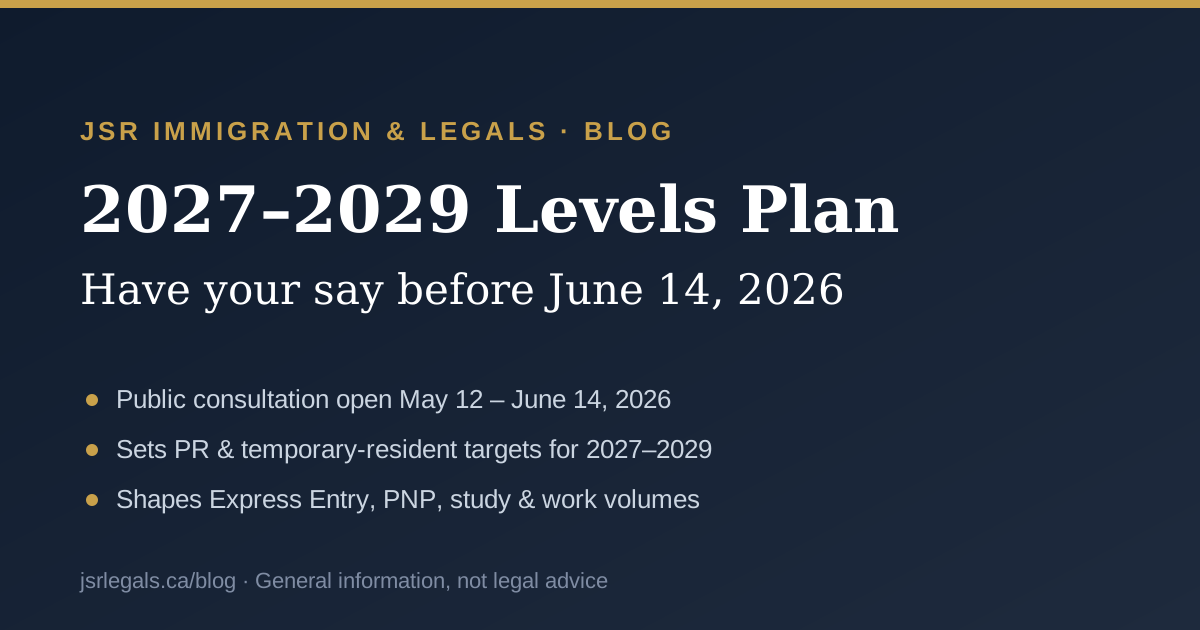
Once a year, the federal government sets the numbers that quietly shape almost every Canadian immigration pathway — how many people can become permanent residents, and roughly how those spots are split between economic immigrants, families, and refugees. Right now, Immigration, Refugees and Citizenship Canada (IRCC) is asking the public to help shape those numbers for 2027 to 2029 — and the window to weigh in is open only until June 14, 2026.
If you're a newcomer, a prospective applicant, an employer, or someone waiting in an Express Entry pool or a provincial nominee queue, this is one of the rare moments where your voice can actually feed into national policy.
What's happening
IRCC opened its 2026 consultations on immigration levels on May 12, 2026, running through June 14, 2026. The feedback collected will help inform the 2027–2029 Immigration Levels Plan, which the government is expected to table in Parliament later this year (typically in the fall).
The Immigration Levels Plan is the document that announces target ranges for permanent resident admissions — and, in recent years, targets for new temporary residents (workers and students) as well. Those targets influence how often Express Entry draws happen, how large provincial nominee allocations are, and how quickly family and humanitarian streams move.
May 12, 2026] --> B[You submit feedback
online survey · by June 14, 2026] B --> C[IRCC reviews input
summer 2026] C --> D[Government tables the
2027–2029 Levels Plan] D --> E[Target ranges set for PR
and temporary residents] E --> F[Affects Express Entry, PNP,
family & study/work volumes]
Why it matters to you
The levels plan isn't an abstract spreadsheet — it ripples down into real outcomes:
- Express Entry candidates: higher economic-class targets generally mean more invitations and, often, more frequent draws.
- Provincial nominee hopefuls: provincial allocation sizes are tied to the federal plan, so the totals affect how many nominations each province can issue.
- Students and workers: for the first time in recent plans, the government has also set targets for temporary residents, which shapes study- and work-permit volumes and intake controls.
- Families: family reunification (including spousal sponsorship and parents and grandparents) competes for space within the overall plan.
For context, under the current 2026–2028 plan, the permanent resident target for 2026 was set in the range of roughly 380,000, with the economic share growing in later years and a deliberate reduction in new temporary residents versus the prior year. The 2027–2029 plan now being consulted on will set the path beyond that. Because the exact figures change with each plan, always confirm the current numbers on the official IRCC page rather than relying on older reporting.
What the consultation covers
IRCC's survey is built around open-ended questions this year — designed to let you explain your views in your own words rather than just tick boxes. Broadly, it asks for input on how Canada should balance:
- economic immigration and labour-market needs across regions;
- family reunification;
- refugee protection and humanitarian commitments; and
- the role and volume of temporary residents (students and workers).
Because the questions are open-ended, it helps to prepare your answers in advance — you can review the questions before you start, then complete the online survey in one sitting.
Who can take part, and how
The consultation is open to individuals responding on their own behalf and to organizations — including employers, settlement agencies, educational institutions, advocacy groups, municipalities, and industry associations.
To participate, go to IRCC's official consultation page and follow the link to the online survey: 2026 consultations on immigration levels — Canada.ca.
A few practical tips:
- Don't wait — the survey closes June 14, 2026, and there's no guarantee of an extension.
- Be specific. Concrete examples ("processing delays in X stream affected my family this way") tend to be more useful than general statements.
- Speak from experience. Newcomers, employers, and students each see a different side of the system, and that lived perspective is exactly what the open-ended format is trying to capture.
A realistic note
Submitting feedback won't change a decision on your own file, and the final plan is the government's call — your input is one of many sources IRCC weighs. But levels planning is genuinely upstream of the rules that decide whether the door opens a little wider or a little narrower in the years ahead. It's worth ten minutes.
If you'd like help understanding how the current or upcoming levels plan might affect your own pathway — Express Entry, a provincial nominee program, a work or study permit, or a family application — we're happy to talk it through. This article is general information about Canadian immigration and is not legal advice; confirm the current requirements and dates on canada.ca, or with a qualified representative, before you act.

Immigration & paralegal practitioner at JSR Immigration & Legals, helping newcomers and Ontario residents with their cases.
This post is general information about Canadian immigration and Ontario paralegal matters and is not legal advice. Rules change and every case is different — confirm current requirements for your own situation.