Canada launches AI for All: what it means for workers, SMEs and immigrants
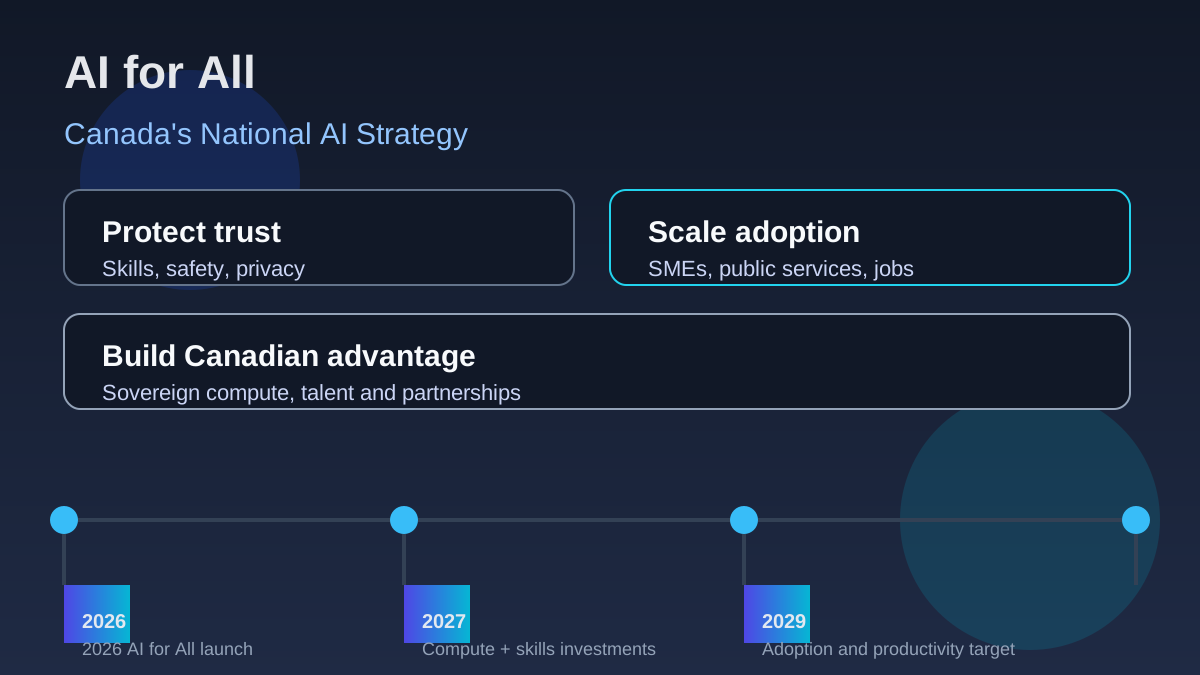
Canada launched a major national AI reset on June 4, 2026, with the Prime Minister announcing AI for All: Canada’s national artificial intelligence strategy. The strategy sets a five-year roadmap to close the gap between strong AI research and limited AI adoption in everyday business and public services, while building stronger privacy, safety and sovereignty protections. (Read the official announcement on the PM site).
What was announced, in plain terms
The official strategy overview and the full strategy release describe six operational pillars:
- Protecting Canadians and safeguarding democracy
- Empowering Canadians with AI skills
- Powering AI adoption for shared prosperity
- Building a sovereign AI foundation for compute, data, cloud and talent
- Scaling Canadian AI champions
- Building trusted international partnerships
The government is presenting AI for All as a trust-based growth model, not just a tech expansion plan. The PM release says the strategy aims to add up to $200 billion in economic growth, and to create up to 250,000 AI-related jobs over five years, with about 90,000 work placement opportunities for youth. It also includes a target to lift AI adoption from roughly 12% to 60% by 2034. (Both targets are in the PM and ISED announcements.)
Why this is a significant shift
Canada has world-class AI talent and research, but a slower adoption curve than expected. The strategy states that this gap is now the key constraint. AI for All is designed to move from pilots and experiments to broad, scaled use across sectors where value is measurable: healthcare, energy, transportation, agriculture and manufacturing.
Recent federal moves ahead of and around the strategy show the direction:
- The government opened applications for the AI Sovereign Compute Infrastructure Program, including supercomputing and public compute commitments in the sovereign AI compute portfolio. (ISED release)
- It announced support for 44 Canadian projects under the AI Compute Access Fund with $66 million to offset compute costs, showing demand for practical scale-up support in real sectors like finance, agriculture, health and advanced manufacturing. (ISED release)
- The public consultation phase was one of the largest in ISED history, with over 11,300 participants and major themes around talent pipelines, trust, sovereign infrastructure and responsible deployment. (Consultation summary)
What this may change for businesses and workers now
The strategy has both immediate and medium-term effects:
- Access to support becomes more structured
- SMEs already need practical pathways to use AI in daily operations. The compute access announcements confirm federal pressure to reduce the cost and speed barriers.
- Compliance requirements likely increase
- The strategy repeatedly ties adoption to trust, transparency and safety. Expect clearer expectations around use of personal data, model transparency and high-risk applications as implementation detail firm up.
- Workforce transitions are front and center
- AI literacy, teacher training, post-secondary access to AI agents, and youth placement targets suggest the strategy is explicitly tied to workforce replacement and upskilling risk, not only innovation.
- Skilled migration becomes part of competitiveness
- The strategy mentions strengthening talent pipelines and accelerated pathways for highly skilled workers, which can affect immigration demand in specialist roles.
In short, the strategy’s strongest practical message is this: future competitiveness is expected to depend on combining AI adoption with compliance and talent access.
What to watch in the next 12 months
There is a lot of momentum. There is also a lot still to be operationalized.
Practical watch points
For clients and residents, these are likely to become meaningful in 2026 and 2027:
- how quickly provinces and federal departments operationalize training and certification standards
- which sectors receive first-phase funding for AI missions and pilot-to-scale support
- whether compute timelines in public infrastructure match private demand from startups and research labs
- what practical standards are enforced around data protection, AI-generated content transparency and model documentation
Bottom line for readers
AI for All is the most coordinated federal AI commitment we have seen in recent years, with clear targets and a visible sovereign compute angle. It is not yet a finished system. It is a governance architecture in motion.
If your business is planning AI adoption, the signal is to prepare early on three tracks:
- data governance and privacy controls
- practical employee training tied to actual workflows
- supplier diligence on where AI and compute infrastructure are sourced
If your household or business is planning a work-related immigration case in a high-skill AI area, the broader policy direction supports stronger demand for AI and advanced technology roles, but outcomes still depend on each future policy instrument, not just headlines.
The strategy is real and already influencing funding and direction. The biggest immediate uncertainty is implementation, not intent. Businesses that build safe, documented, skilled-driven AI workflows now are in the best position to benefit.

Immigration & paralegal practitioner at JSR Immigration & Legals, helping newcomers and Ontario residents with their cases.
This post is general information about Canadian immigration and Ontario paralegal matters and is not legal advice. Rules change and every case is different — confirm current requirements for your own situation.