Dependent Children on a PR Application: Declare Them Right the First Time
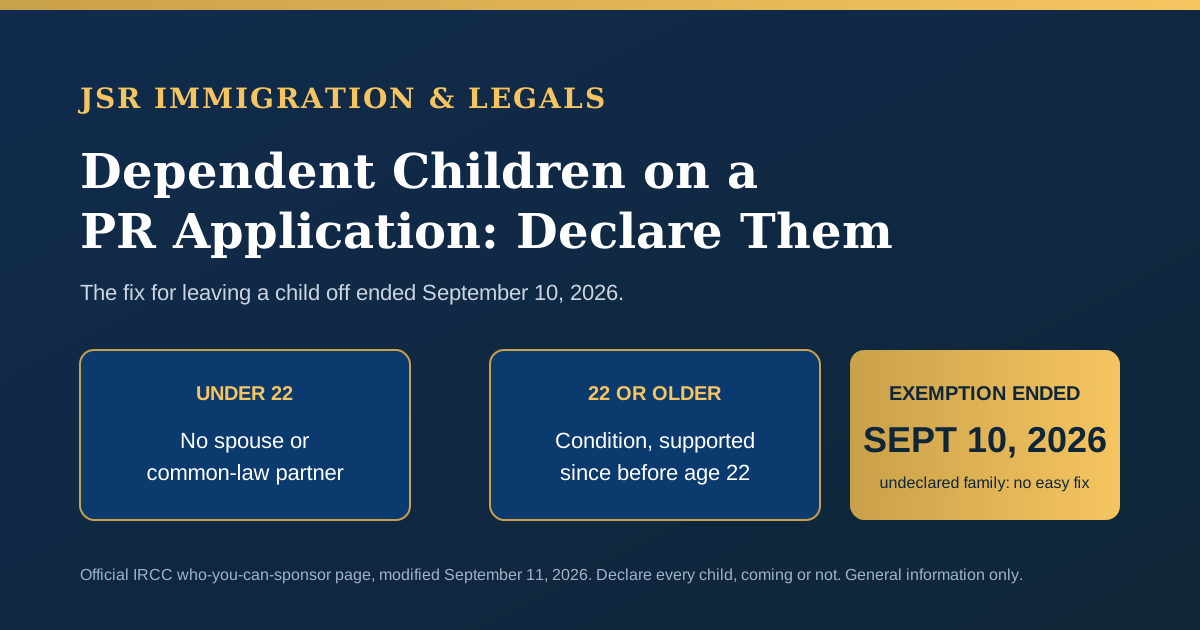
When you apply for permanent residence, every dependent child must be on the application, even a child who is not coming to Canada. That rule has teeth now. On its who you can sponsor page, last modified September 11, 2026, IRCC confirms the temporary public policy that rescued some undeclared family members ended on September 10, 2026. It continues to apply only to applications IRCC received between May 31, 2019 and September 10, 2026. For anything filed after that date, the page states plainly: previously undeclared family members are not eligible for family sponsorship.
We covered the deadline before it hit in our undeclared-family post. This post is about the practical task that deadline now makes permanent: getting dependent children onto a PR application correctly the first time.
Who counts as a dependent child
IRCC's definition has not changed. A child qualifies as a dependant if they are your biological or adopted child, or your spouse or partner's biological or adopted child, and they meet one of two tests.
| Route | Age test | Relationship test |
|---|---|---|
| Under 22 | Under 22 years old | No spouse or common-law partner |
| 22 and over | 22 or older | Unable to financially support themselves because of a mental or physical condition, and financially dependent on their parents since before age 22 |
Except for age, the child must keep meeting these requirements until IRCC finishes processing the application. A 21-year-old who marries mid-process can fall out of the definition.
The rule that now has no safety net
A PR applicant must declare all family members, even those not accompanying them. If a dependent child was not declared and examined when the parent became a permanent resident, the family-class bar in the Immigration and Refugee Protection Regulations generally stops that child from being sponsored later. Between May 2019 and September 10, 2026, a public policy exempted some people from that bar. That policy is over. IRCC also warns that a permanent resident who does not declare all family members on the application could risk losing their permanent resident status.
The September 10 date is a receipt date, not a program date. It applied to when IRCC received the sponsorship application under the old exemption. It does not change any child's age limit or eligibility test today.
Where the child goes on the application
The structure depends on who is being sponsored. IRCC sets out the combinations on the official page.
- Only sponsoring your child: the child is the principal applicant. You must show the other parent or legal guardian agrees to the child immigrating to Canada.
- Sponsoring a spouse or partner and their child: the spouse or partner is the principal applicant and the child is the dependant.
- A grandchild exists: the grandchild must be declared as a dependant, whether or not they are coming to Canada.
- A child in the sole custody of the other parent: still declare the child. That child must also complete medical exams and pass background and security checks, even with a custody agreement or court order saying otherwise. Declaring the child keeps open the possibility of sponsoring them later if custody or living arrangements change.
What sponsorship costs and requires
The sponsor a spouse, partner or child program page, last modified March 5, 2026, lists the program as open, with sponsorship of a child starting at $180 and a spouse or partner at $1,260.
On the sponsor eligibility page, last modified June 23, 2026, IRCC confirms there is normally no income requirement to sponsor a dependent child. You only need to show enough money if the child you are sponsoring has dependent children of their own, or if your sponsored spouse or partner has a dependent child who has dependent children. Sponsors must be 18 or older, be a Canadian citizen, a permanent resident, or a person registered under the Canadian Indian Act, and live in Canada, with limited exceptions for citizens abroad. Quebec sets its own requirements.
What to do before you file
- List every child, including stepchildren, adopted children, and children of a dependent child, and decide who is accompanying.
- Check each child against the two-part definition, not just their age on the filing date.
- Declare non-accompanying children too. The examination protects their future options.
- Match the principal applicant to the situation: child alone, or spouse with child as dependant.
- If you are already a permanent resident with an undeclared child, do not assume a fix exists. The exemption ended September 10, 2026, and options now depend on your specific circumstances.
If you are preparing a PR application through Express Entry or a spousal or family sponsorship, contact JSR Immigration and Legals through our consultation page or at (647) 286-4266.
This post is general information, not legal advice, as of October 31, 2026. Rules change; confirm current requirements on the official IRCC pages and speak to a licensed professional about your specific case.
Sources
- IRCC, Who you can sponsor, page modified September 11, 2026: https://www.canada.ca/en/immigration-refugees-citizenship/services/immigrate-canada/family-sponsorship/spouse-partner-children/who-you-can-sponsor.html
- IRCC, Sponsor your spouse, partner or child, page modified March 5, 2026: https://www.canada.ca/en/immigration-refugees-citizenship/services/immigrate-canada/family-sponsorship/spouse-partner-children.html
- IRCC, Sponsor eligibility, page modified June 23, 2026: https://www.canada.ca/en/immigration-refugees-citizenship/services/immigrate-canada/family-sponsorship/spouse-partner-children/eligibility.html
JSR Legals / JSR Immigration Ltd. 9300 Goreway Drive, Suite 205, Brampton, ON L6P 4N1 (647) 286-4266 info@jsrlegals.ca

Immigration & paralegal practitioner at JSR Immigration & Legals, helping newcomers and Ontario residents with their cases.
This post is general information about Canadian immigration and Ontario paralegal matters and is not legal advice. Rules change and every case is different — confirm current requirements for your own situation.