Newcomer Money in 2026: The Renamed Grocery Benefit and Child Benefit You Can Claim
One of the most common questions new arrivals ask us has nothing to do with a permit — it's "what money am I actually entitled to now that I'm here?" Two of the most useful federal benefits are the quarterly grocery/tax credit and the Canada Child Benefit (CCB). There's a small but important change worth flagging in 2026, plus a first-year rule that trips up a surprising number of newcomers.
What changed: a new name for a familiar credit
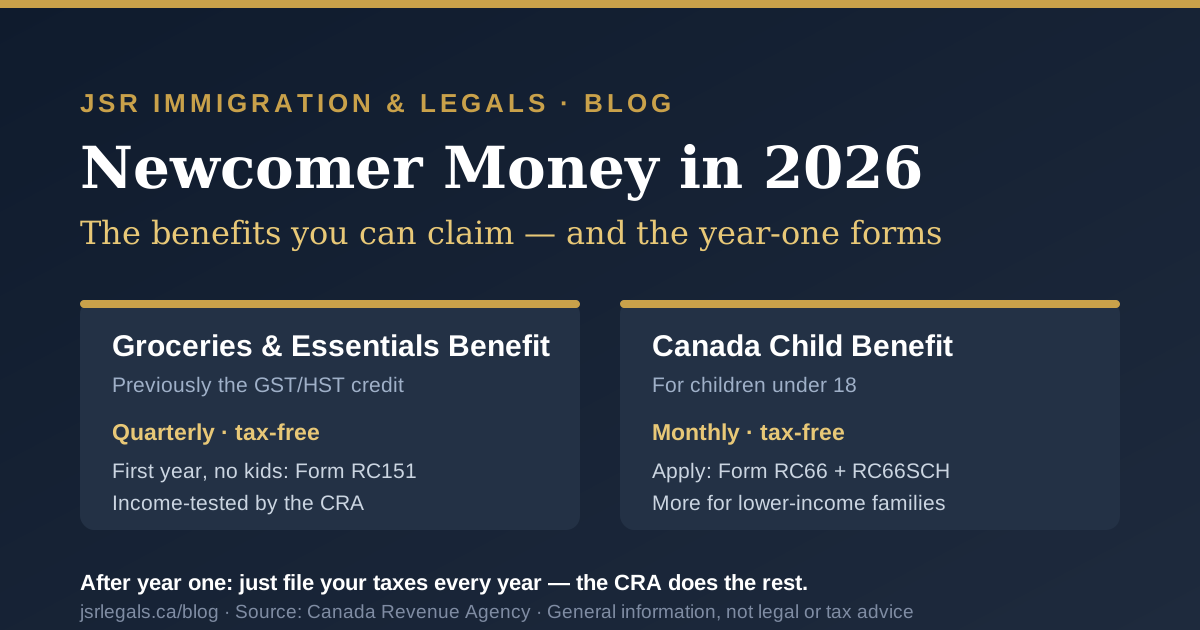
The benefit many people still call the GST/HST credit is now the Canada Groceries and Essentials Benefit (CGEB). The Canada Revenue Agency (CRA) page for it literally notes "Previous name: GST/HST credit." It's still a tax-free quarterly payment meant to offset sales tax for people with low and modest incomes — the label is what's new.
If you were already receiving the GST/HST credit, you don't need to do anything differently; the CRA continues to assess and pay it automatically. The reason it's worth knowing about is simply so you recognise it on your bank statement and in your CRA account under its new name.
Who can claim the grocery/essentials benefit
Broadly, to qualify you generally must:
- Be a resident of Canada for tax purposes, and
- Be at least 19 years old (younger people can qualify if they have a spouse
or common-law partner, or are a parent living with their child), and
- Have a family income below the CRA's thresholds, which change each year and
depend on your family size.
Because it's income-tested, the amount varies from person to person, and some higher-income families receive nothing. Don't assume — let the CRA assess you.
The Canada Child Benefit (CCB)
If you have children under 18, the Canada Child Benefit is usually the bigger number. It's a tax-free monthly payment based on your family's net income and the ages of your children — lower-income families receive more. Newer residents with kids should apply promptly, because CCB isn't paid retroactively without limit, and every month you delay filing can be a month of payments you don't get back.
The first-year rule newcomers miss
Here's the part that catches people out. In most years, you don't "apply" for these benefits at all — you just file your tax return, and the CRA automatically checks your eligibility. But in your first year as a resident, the CRA doesn't yet have your information, so you may need to send a form:
- No children? Apply for the grocery/essentials benefit using Form RC151.
You can do this even before you've filed your first Canadian tax return.
- Have children? Use Form RC66 (the Canada Child Benefit application),
along with Form RC66SCH to report your status in Canada and income before you arrived. Include proof of birth for each child.
After that first year, the machine takes over: file your taxes every year — even with no income to report — and the CRA assesses you automatically. Filing is the single most important habit for keeping benefits flowing.
of Canada] --> B{Is this your
first year here?} B -- Yes, no children --> C[File Form RC151 for the
grocery/essentials benefit] B -- Yes, with children --> D[File Form RC66 + RC66SCH
with proof of birth] B -- No, already filed before --> E[Just file your tax return] C --> F[CRA assesses income
and residency] D --> F E --> F F --> G[Quarterly CGEB and/or
monthly CCB payments begin] G --> H[File taxes every year
to keep payments flowing]
A few honest cautions
- Amounts and income cut-offs change and are set by the CRA — always confirm
the current figures on canada.ca rather than relying on a number a friend quoted last year.
- Temporary residents (for example, on a work or study permit) can sometimes
qualify once they meet the CRA's residency-for-tax-purposes and other conditions, but the rules are specific. If you're on a permit, check your own situation with the CRA rather than assuming you're in or out.
- These are CRA benefits, not immigration status. Receiving them doesn't
change your permit or PR standing — but you do need valid status and to be living in Canada to remain eligible.
Getting your benefits set up correctly in year one is one of the easiest wins of settling in Canada — and one of the easiest to accidentally skip. If you're newly arrived and trying to line up the immigration and everyday-life pieces together, get in touch with JSR Immigration & Legals — we're glad to point you in the right direction.
This article is general information, not legal or tax advice. For guidance on your own situation, please consult a qualified professional and confirm current requirements with the CRA and official sources.

Immigration & paralegal practitioner at JSR Immigration & Legals, helping newcomers and Ontario residents with their cases.
This post is general information about Canadian immigration and Ontario paralegal matters and is not legal advice. Rules change and every case is different — confirm current requirements for your own situation.