New Ontario Driver's Licence Rules from July 1, 2026: What Newcomers Should Know
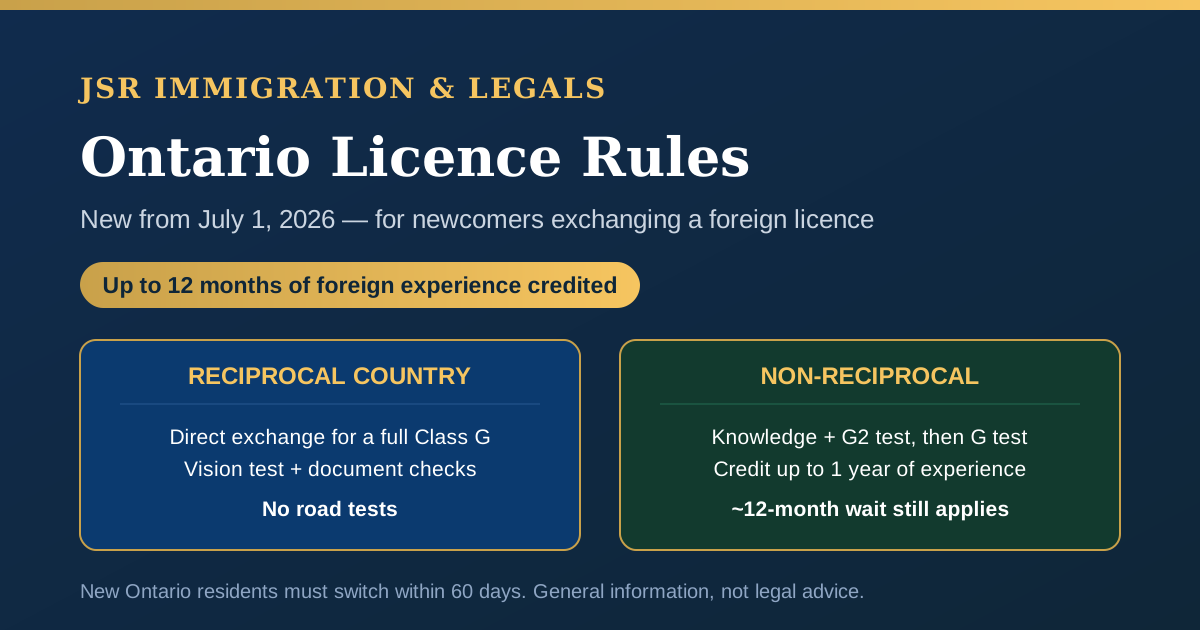
For most newcomers, getting an Ontario driver's licence is one of the first practical hurdles after arriving — you need it for work, for the school run, and for daily life outside the big-city transit zones. A change that took effect on July 1, 2026 makes that process a little friendlier for drivers coming from many countries. Here's a plain-language look at how the licence exchange works now, and what actually changed.
First, the 60-day rule
If you're a new resident of Ontario, you can keep driving on your valid out-of-province or foreign licence for 60 days after you settle. After that, you're expected to hold an Ontario licence. So the clock starts sooner than many people realise — don't leave it until your foreign licence is about to expire.
Two very different paths, depending on your country
Ontario sorts drivers into two groups, and which group you fall into changes everything.
Reciprocal (exchange-agreement) countries. If your licence is from a jurisdiction Ontario has a reciprocal agreement with, you can usually exchange it directly for a full Class G licence — no road tests, just a vision test and document checks. This list includes all Canadian provinces and territories, U.S. states, and a set of other countries such as Australia, Austria, Belgium, France, Germany, Great Britain, Ireland, Japan, New Zealand, South Korea, Switzerland, and Taiwan, among others. The exact list is updated from time to time, so confirm your country on Ontario's official page before you go.
Non-reciprocal jurisdictions. If Ontario doesn't have an agreement with the place that issued your licence, you can't simply swap it. You'll need to pass a vision test, a knowledge (written) test, and the road tests to earn your Ontario licence — the same graduated licensing structure Ontario uses for new drivers.
What changed on July 1, 2026
This is the part worth knowing. Effective July 1, 2026, drivers from non-reciprocal jurisdictions can get credit for up to one year (12 months) of verified foreign driving experience. That experience credit matters because Ontario's graduated system normally makes you wait between licence stages.
In practice, if you can prove your foreign driving history, you can move through the process faster than a brand-new driver who has never held a licence. You still complete the G2 road test and, later, the G road test — but the credited experience helps you meet the requirements sooner. Note one important limit the province spells out: the experience credit generally cannot shorten the mandatory waiting period between the G2 and G road tests, which remains about 12 months. So the credit helps you qualify and get on the road, but it doesn't erase the built-in gap before the final test.
Proving your experience — the documents
To claim experience credit you can't just say how long you've been driving. You need to back it up. Typically that means:
- Your valid, original foreign driver's licence;
- An official authentication letter from the issuing government, embassy,
consulate, or high commission, confirming the licence is genuine and stating your driving history — issued recently (generally within the last six months);
- Documents written in English or French, or accompanied by a certified
translation;
- Your accepted identity documents.
Applications are made in person at a DriveTest centre (or the ServiceOntario Bay and College location in Toronto). Bring originals, not photocopies.
for up to 60 days] B --> C{Is your country a
reciprocal exchange partner?} C -- Yes --> D[Exchange directly for a full
Class G — vision test + documents] C -- No --> E[Vision + knowledge test,
then G2 road test] E --> F[Claim up to 12 months of
verified foreign experience
with an authentication letter] F --> G[Wait the mandatory ~12 months,
then take the G road test] G --> H[Full Class G licence]
Why this matters for newcomers
For families arriving from countries without an exchange agreement, the old system could feel like starting from zero — years of safe driving abroad counted for nothing. The July 2026 change recognises that experience, letting eligible drivers reach a full licence more quickly and, in many cases, avoid the longest waiting periods that apply to first-time drivers. That can also help with car insurance conversations, where a fuller licence and documented history usually work in your favour.
A few honest caveats: rules, country lists, and fees change, and your exact requirements depend on your specific licence and documents. Always confirm the current details on Ontario's official page — Exchange an out-of-province driver's licence — before booking anything.
If you're settling in Ontario on a work permit, study permit, or as a new permanent resident and want help understanding how the pieces of newcomer life fit together, get in touch with JSR Immigration & Legals — we're glad to point you in the right direction.
This article is general information, not legal advice. For guidance on your own situation, please consult a qualified professional and confirm current requirements with official sources.

Immigration & paralegal practitioner at JSR Immigration & Legals, helping newcomers and Ontario residents with their cases.
This post is general information about Canadian immigration and Ontario paralegal matters and is not legal advice. Rules change and every case is different — confirm current requirements for your own situation.