Court of Appeal Backs Municipal Power Over Short-Term Rentals: The Tiny Township Ruling
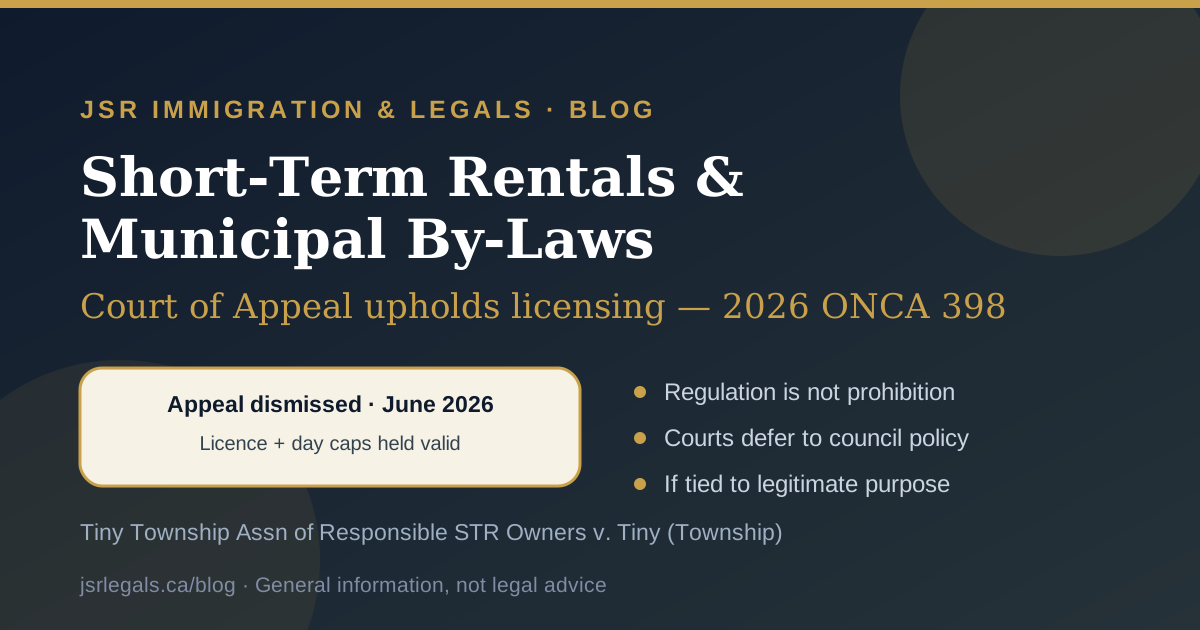
If you own a cottage you rent out on Airbnb, live next door to one, or sit on a municipal council wrestling with the issue, a recent decision from Ontario's highest court is worth your attention. In June 2026, the Court of Appeal for Ontario released its decision in Tiny Township Association of Responsible STR Owners v. Tiny (Township), 2026 ONCA 398, and dismissed the appeal — confirming that a municipality can use its licensing powers to regulate, cap and restrict short-term rentals (STRs). It's a significant signal for the hundreds of Ontario communities now writing or defending similar by-laws.
What the case was about
The Township of Tiny, on Georgian Bay, passed a by-law requiring short-term rental operators to obtain an annual licence and follow a set of rules — limits on how many days a year a property can be rented, minimum stay lengths, occupancy caps, a demerit-point system with fines, and an overall cap on the total number of STR licences in the township. A group of owners challenged the by-law, asking the court to quash it under the Municipal Act.
Their arguments, in plain terms, were that the township had overstepped: that the licensing scheme was really a disguised zoning by-law, that it was passed in bad faith, and that it was an attempt to regulate STRs out of existence. They also raised privacy and Charter freedom-of-expression arguments. The application judge rejected all of this in 2025, and in June 2026 the Court of Appeal agreed.
What the court actually decided
The Court of Appeal held that the by-law was within the township's power (intra vires) under its licensing authority. Two threads run through the reasoning:
- Regulation is not prohibition. Caps, day limits and licence conditions are
"inherent to any by-law scheme." Restricting how an activity is carried on — even significantly — is not the same as banning it outright.
- Courts don't second-guess policy. The job of a court is not to decide
whether the by-law is wise, but whether it is rationally connected to legitimate municipal objectives. Here those objectives — protecting affordable housing, reducing community disruption, and balancing competing interests — were clearly on the record. The township's licence cap was described as "a compromise" between residents who wanted a complete ban and those who wanted no rules at all.
The court also noted that the absence of a stated purpose in the text of a by-law doesn't sink it, so long as the record shows a proper purpose motivated it.
as ultra vires?} B -- Yes --> C{Is the by-law rationally connected
to a legitimate municipal purpose?} C -- Yes --> D[By-law upheld
Tiny: 2026 ONCA 398] C -- No / bad faith / disguised zoning --> E[By-law may be quashed] D --> F[Courts defer to council's
policy choices]
Why this matters beyond Tiny
Short-term rentals have become one of the most contested local issues in Ontario, especially in cottage country and tourist towns. Councils argue STRs strain housing supply, parking and neighbourhood peace; owners argue rentals are a legitimate and important source of income. This ruling doesn't end that debate — but it makes clear that, when a municipality builds a careful record and ties its rules to recognized goals like housing and community well-being, the courts will generally defer to those choices.
A few practical takeaways:
- For STR owners and hosts: a municipal licence requirement, day caps and
occupancy limits are likely enforceable. If your township has an STR by-law, treat the licensing rules as real obligations — operating without a required licence can carry fines and, under demerit-style schemes, loss of the licence itself.
- For neighbours and residents: municipalities have a confirmed tool to address
problem rentals. Complaints and enforcement run through the municipality's by-law process, not the Landlord and Tenant Board — STRs are generally a commercial/ licensing matter, not a residential tenancy.
- For councils: the decision is a roadmap. By-laws that are well-documented,
consultative, and tied to legitimate objectives stand a strong chance of surviving a challenge. Rules that look like a back-door ban, or that lack any supporting rationale, remain vulnerable.
A word of caution
Every municipality's by-law is different, and the line between valid regulation and an unlawful disguised prohibition still depends on the specific facts and the record a council builds. A ruling that upholds one township's scheme does not automatically validate another's. If you're an owner facing enforcement, or a resident trying to understand what your town can and can't do, the details of your local by-law are what govern — start with your municipality's STR or licensing page.
You can read the Court of Appeal's decisions through the Court of Appeal for Ontario and find the full judgment on CanLII, which publishes Ontario court and tribunal decisions for free.
Get in touch
Court rulings like this one quietly reshape what municipalities, property owners and neighbours can expect from each other. If you're dealing with a by-law enforcement notice, a small-claims dispute with a tenant or guest, or need a document commissioned or a statutory declaration prepared, JSR Legals is happy to point you in the right direction. Reach us at info@jsrlegals.ca.
This article is general information about a recent Ontario court decision, current as of June 2026, and is not legal advice for any specific situation. Municipal by-laws and their enforcement vary by community — confirm the rules that apply to your property and, where it matters, get advice on your own circumstances.

Immigration & paralegal practitioner at JSR Immigration & Legals, helping newcomers and Ontario residents with their cases.
This post is general information about Canadian immigration and Ontario paralegal matters and is not legal advice. Rules change and every case is different — confirm current requirements for your own situation.