Changing Schools in Canada? IRCC's June 2026 Update on Unauthorized DLI Transfers
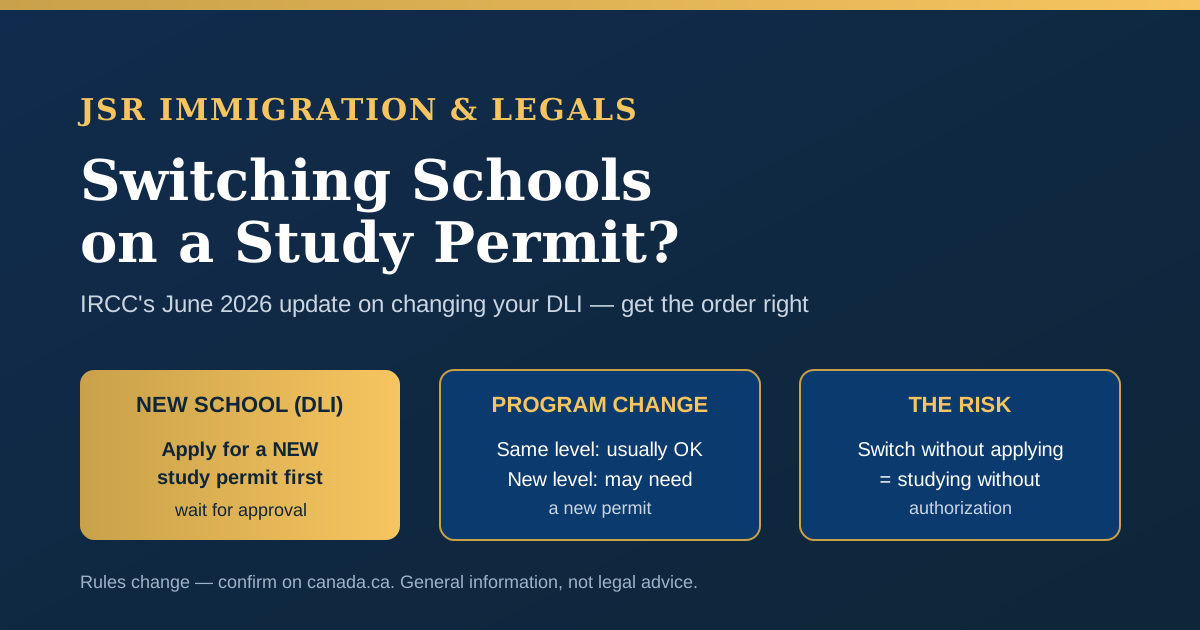
If you're an international student thinking about transferring to a different college or university — or even switching programs at your current school — there is a step that's now easy to get wrong, and the consequences are serious. On June 18, 2026, Immigration, Refugees and Citizenship Canada (IRCC) updated the internal instructions its officers use to assess whether a study permit holder is meeting the conditions of their permit. The headline addition is a new section on students who change their Designated Learning Institution (DLI) without authorization.
The update doesn't invent a new law. The underlying rule has been in force since November 8, 2024. But the refreshed guidance makes the enforcement consequences much clearer — and they're stricter than many students assume.
The rule: apply for a new study permit before you switch schools
Your study permit names a specific DLI. Under section R217.1 of the Immigration and Refugee Protection Regulations, if you want to move to a different DLI, you must apply for a new study permit first — and wait for it to be approved before you start at the new school.
What the June 2026 guidance clarifies is what happens if you don't:
- If you change to a new DLI without first applying for a new study permit,
your existing permit can be treated as no longer valid.
- You would then be considered to be studying without authorization at the
new institution — a breach of your study-permit conditions.
This is the part that catches people off guard. Getting an acceptance letter from a new school, or even formally enrolling there, is not the same as having IRCC's permission to study there. The permission comes from the study permit, and the permit is tied to the DLI named on it.
than the one on your permit?} B -- No, same DLI --> C{Changing program?} B -- Yes, new DLI --> D[Apply for a NEW study permit
and wait for approval] D --> E[Start at the new DLI only
after approval] C -- Same level of study --> F[Generally no new permit needed
keep records of the change] C -- Different credential level --> G[A new study permit
may be required] B -- Switch without applying --> H[Old permit can be invalid
= studying without authorization]
What about changing programs at the same school?
The update also touches program changes within the same DLI. As a general rule:
- Switching to a different program at the same level of study within your
current DLI usually does not require a new study permit (though you should keep your own records of the change).
- Moving between credential levels — for example, from a diploma to a degree,
or to a different level of study — may require a new study permit. Don't assume; check before you commit.
Because the line between "same level" and "different level" isn't always obvious, this is exactly the kind of detail worth confirming for your specific program before you enrol.
Why this matters: status, work rights, and your PGWP
A misstep here doesn't just create paperwork — it can cascade:
- Your status. Being found to study without authorization is a breach of your
study-permit conditions, which can affect your ability to stay or to extend.
- Your right to work. On- and off-campus work authorization depends on
maintaining valid student status. If your status is in question, your work rights can be too.
- Your post-graduation work permit (PGWP). A PGWP generally depends on having
studied on a valid permit and stayed compliant throughout. A gap where you were studying without authorization can put a future PGWP at risk.
Because so much rides on it, transferring schools is a moment to slow down and get the sequence right rather than rushing to start classes.
How to transfer the right way
- Check what's on your permit. Look at the DLI named on your current study
permit. If your new school is a different DLI, plan for a new study permit application.
- Apply before you move. Submit the new study permit application and, ideally,
wait for approval before you begin studying at the new institution.
- For a program change at the same school, confirm whether you're staying at
the same level of study, and whether a new permit is needed.
- Keep your documents. Save acceptance letters, enrolment records, and your
application confirmation in case you ever need to show you stayed compliant.
- Mind the timing. New permit applications take time to process, so factor
that into your start date rather than assuming a smooth, instant switch.
Where to confirm the current rules
Guidance like this can be updated quietly, so always check the official source before you act:
- IRCC's page on changing your school or program.
- IRCC's page on your conditions as a study permit holder.
If something you read elsewhere doesn't match canada.ca, trust the official page.
Talk to us
Whether a school or program change requires a new study permit, how to time the application, and what it could mean for your work rights or a future PGWP all depend on your specific situation. If you'd like help getting the sequence right before you transfer, the team at JSR Immigration & Legals is happy to talk it through — get in touch.
This post is general information only and reflects what was publicly known as of June 25, 2026. It is not legal advice. Immigration rules and guidance change, so confirm current requirements with IRCC or a qualified professional before acting.

Immigration & paralegal practitioner at JSR Immigration & Legals, helping newcomers and Ontario residents with their cases.
This post is general information about Canadian immigration and Ontario paralegal matters and is not legal advice. Rules change and every case is different — confirm current requirements for your own situation.