One Bad Clause Cost CIBC: Ontario Court of Appeal Voids Bank Termination Provision in Ghazvini
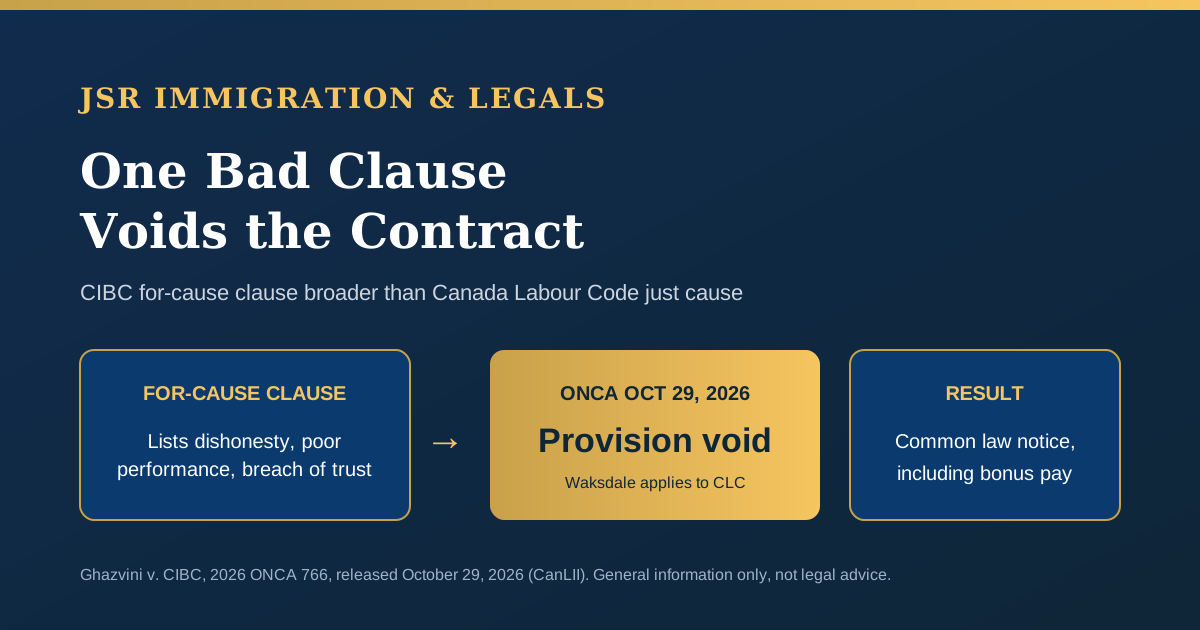
Banks, telecom companies, airlines, and interprovincial transport operators are federally regulated. Their employees fall under the Canada Labour Code, not Ontario's Employment Standards Act. On October 29, 2026, the Court of Appeal for Ontario released Ghazvini v. Canadian Imperial Bank of Commerce, 2026 ONCA 766, and unanimously affirmed the Superior Court decision in 2025 ONSC 5218. The ruling confirms that one overly broad for-cause clause can erase an employer's entire termination provision, and that the rule applies just as strongly to federally regulated workplaces.
What happened
The employees signed employment agreements with CIBC containing identical termination provisions. The clause allowed the bank to end employment without notice or pay in lieu of notice for reasons including dishonesty, fraud, breach of trust, unsatisfactory performance, and breaches of employment conditions. They were later terminated without cause, and they sued for wrongful dismissal, arguing the termination provision was unenforceable and that they were owed common law reasonable notice.
What the courts decided
Both courts agreed with the employees, and the Court of Appeal dismissed CIBC's appeal with costs.
The trial judge found that the contract's definition of cause went beyond the statutory standard of just cause under the Canada Labour Code. Conduct such as dishonesty does not necessarily amount to just cause for dismissal, so a clause that withholds all notice and pay for a broader list of reasons fails to meet the minimum standard.
The Court applied Waksdale v. Swegon North America Inc., 2020 ONCA 391, the leading Ontario case holding that if a termination provision fails to comply with minimum employment standards, in whole or in part, the entire provision is unenforceable. CIBC argued that Waksdale applied only to provincially regulated agreements under the Employment Standards Act. The Court of Appeal rejected that argument, finding no principled reason the rule should not apply to agreements governed by the Canada Labour Code.
The Court distinguished Baker v. Van Dolder's Home Team Inc., 2026 ONCA 568, because the termination provision in that case preserved minimum statutory entitlements. CIBC's clause contained no comparable language.
Two further points matter for everyday readers. First, on mitigation, the Court found no basis to interfere with the trial judge's conclusion that the employees acted reasonably in rejecting alternative positions that were not comparable to their previous employment. Second, on damages, the Court upheld the inclusion of variable incentive pay and annual bonus payments in the notice calculation, because CIBC had not clearly and unambiguously excluded those components from common law damages.
The practical rules to take away
- One defective for-cause clause may void the entire termination provision, not just the offending sentence. After Ghazvini, this applies to federally regulated employers under the Canada Labour Code as well as to provincially regulated employers.
- A contract cannot define "cause" more broadly than the statutory standard. Clauses listing vague grounds such as unsatisfactory performance or breach of employment conditions are high-risk.
- Reasonable notice may include bonus and incentive pay unless the contract clearly and unambiguously excludes it. Vague savings language is not enough.
- A terminated employee does not automatically fail the duty to mitigate by declining a job that is not comparable to the position lost. The comparison is with the previous employment, not with any available work.
- An employer that cannot enforce its termination provision may owe common law reasonable notice, which is often far more than the statutory minimum.
What this means for you
If you work for a bank, telecom, airline, railway, shipping company, or the federal public sector, your contract is governed by the Canada Labour Code, and Ghazvini confirms you get the same protection against defective termination clauses as provincially regulated workers. If you were terminated without cause, your real entitlements may be higher than the minimums in your contract, and you may have a claim for common law reasonable notice, including bonus and incentive components.
If you are an employer, the message is to review termination templates before relying on them. A clause that tries to take away all notice for a broad list of perceived faults may cost the protection of the entire provision.
No outcome is guaranteed in a different case. Every dispute turns on its own facts, the exact contract wording, and the governing statute.
If you were terminated without cause, or you are an employer reviewing your contracts, JSR Immigration and Legals can assess your situation. See our employment law services page, or contact us at (647) 286-4266 or info@jsrlegals.ca.
This post is general information, not legal advice, as of November 7, 2026. For advice on a specific matter, please contact JSR Legals.
Sources
- Ghazvini v. Canadian Imperial Bank of Commerce, 2026 ONCA 766 (CanLII): https://www.canlii.org/en/on/onca/doc/2026/2026onca766/2026onca766.html
- Ghazvini v. Canadian Imperial Bank of Commerce, 2025 ONSC 5218 (CanLII): https://www.canlii.org/en/on/onsc/doc/2025/2025onsc5218/2025onsc5218.html
- Waksdale v. Swegon North America Inc., 2020 ONCA 391 (CanLII): https://www.canlii.org/en/on/onca/doc/2020/2020onca391/2020onca391.html
- Canada Labour Code: https://laws-lois.justice.gc.ca/eng/acts/l-2/
JSR Legals / JSR Immigration Ltd. 9300 Goreway Drive, Suite 205, Brampton, ON L6P 4N1 (647) 286-4266 info@jsrlegals.ca

Immigration & paralegal practitioner at JSR Immigration & Legals, helping newcomers and Ontario residents with their cases.
This post is general information about Canadian immigration and Ontario paralegal matters and is not legal advice. Rules change and every case is different — confirm current requirements for your own situation.