WSIB Closed the SIEF: What Ontario Employers Need to Know About the End of Cost Relief
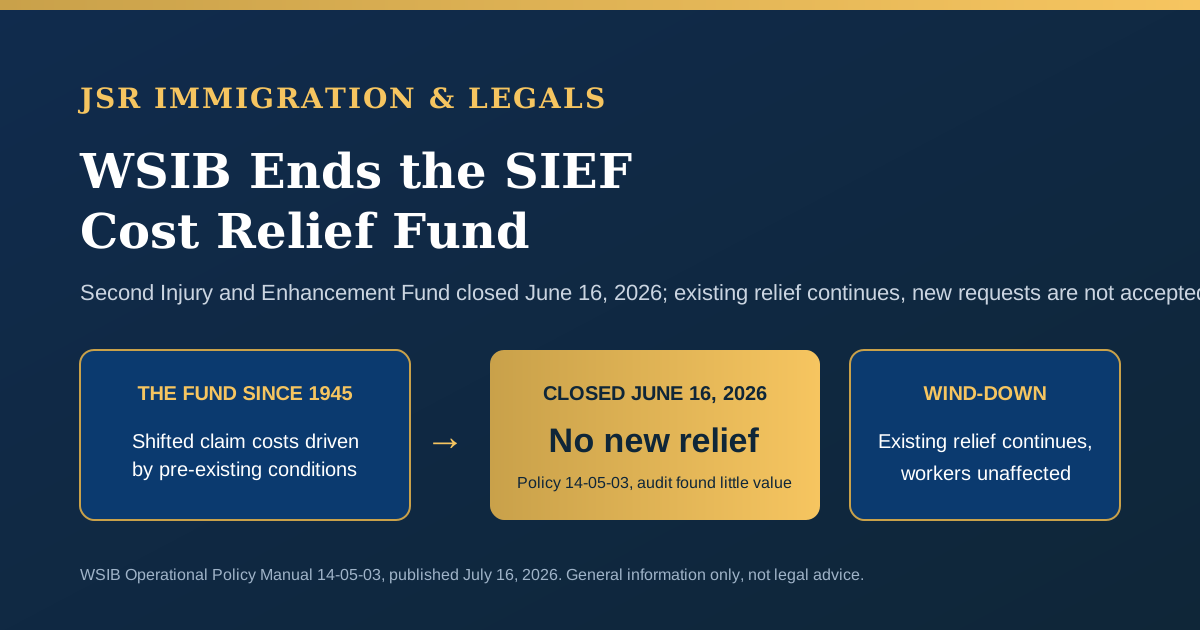
Ontario employers lost a decades-old form of workers compensation cost relief this year, and the Workplace Safety and Insurance Board (WSIB) has now made clear the decision will not be reversed. Effective June 16, 2026, the WSIB closed the Second Injury and Enhancement Fund (SIEF), a collective fund that could transfer part of a claim's cost away from the employer whose worker was injured when a pre-existing disability or medical condition caused the accident or prolonged the disability. The closure follows a value-for-money audit required under the Workplace Safety and Insurance Act, 1997 (WSIA), and it is now drawing organized pushback from construction employer groups, which the WSIB says will not change the outcome.
What the SIEF was
The SIEF dated back to 1945, when it was created to help wounded war veterans find work. Under WSIB operational policy 14-05-03, if a prior disability caused or contributed to a compensable accident, or if a pre-existing condition prolonged or enhanced the resulting disability, all or part of the compensation and health care costs could be transferred from the accident employer in Schedule 1 to the SIEF. Both physical and psychological conditions qualified. Where an aggravation of a pre-existing condition enhanced the disability, 50% of the claim cost could be charged to the fund, and in defined situations, such as where a prior non-work-related condition caused the accident, relief could reach 100%.
Why the WSIB closed it
A value-for-money audit, whose full report was released in April 2026, concluded the program delivers "no or little value". The WSIB's audit page, updated October 8, 2026, sets out the reasons:
- The program no longer served its purpose of removing employment barriers for people with pre-existing disabilities, and the audit found no link between SIEF decisions and employment outcomes.
- The premium rate model put in place in 2020 is decoupled from SIEF decisions, so few businesses saw any actual relief on their premium rate. Only about 2,400 businesses had SIEF cost relief in 2024, roughly 0.75% of the more than 318,000 businesses covered by the WSIB.
- The program had not been meaningfully updated since 1945. Earlier reviews, including the Harry Arthurs Funding Fairness report, had already recommended the WSIB abolish the SIEF.
- The WSIB ran 12 consultations with over 200 invited stakeholders between October 22 and December 12, 2025, during the audit.
The wind-down rules
The amended SIEF policy (14-05-03, published July 16, 2026, approved by the President and CEO on June 11, 2026) applies to all decisions made on or after June 16, 2026, for all accidents. The key rules:
- No new relief. Cost relief under SIEF will not be provided in claims where it has not already been provided, and existing relief amounts will not be adjusted, except under the wind-down rules or as a result of an appeal.
- Requests received before July 16, 2026 are still processed. The WSIB accepted new SIEF requests only if submitted before July 16, 2026, and will decide all requests received before that date, including requests received before June 16, 2026, under a streamlined process.
- No appeal for late requests. If a request was denied because it was submitted on or after July 16, 2026, there is no option to appeal that denial.
- Existing relief continues. Businesses already receiving SIEF relief continue to receive it for the duration of their existing applicable claims, and relief provided as of June 16, 2026 continues to be taken into account when determining risk-adjusted premium rates.
- Workers are not affected. The WSIB confirms there is no relation between SIEF cost relief and the care and support an injured worker receives. Benefits, health care, and return-to-work planning continue under the standard claims process. Schedule 1 businesses pay assessed premium rates, not individual claim costs.
Employer pushback, and what the WSIB says now
In November 2026, the Construction Employers Coalition (CEC), through chair Andrew Pariser, wrote to WSIB president and CEO Jeffery Lang and the Minister of Labour, Immigration, Training and Skills Development, David Piccini, asking the WSIB to "vacate its decision" and run a full stakeholder consultation. The coalition argues there was no proper employer consultation and that without the fund, individual employers absorb claim costs inflated by pre-existing conditions unrelated to the workplace. Counsel for the coalition has predicted the closure will drive more appeals and litigation.
The WSIB's position is that the decision is final. The board has said applications already in its system as of July 16, 2026 continue to be processed, and claims with an existing SIEF award keep that treatment for the life of the claim, but the closure itself will not be reconsidered. The WSIB is holding information sessions for employers, including a webinar on November 26, 2026.
What this means for your business
If your business carried claims with SIEF relief, that relief is preserved on those claims. For injuries occurring now, assume the full cost of claims with a pre-existing-condition component stays on your account, and focus on what still moves your premium rate: workplace health and safety programs, timely return-to-work planning, and accurate classification. If you dispute how a claim's medical cause is adjudicated, an objection may be filed with the WSIB, and appeal routes to the Workplace Safety and Insurance Appeals Tribunal remain open for claim decisions.
JSR Immigration and Legals assists Ontario workers and employers with WSIB claims and appeals, and with WSIB matters and employment law issues. Contact us at (647) 286-4266 or info@jsrlegals.ca.
This post is general information, not legal advice, as of November 13, 2026. For advice on a specific matter, please contact JSR Legals.
Sources
- WSIB, Second Injury and Enhancement Fund (SIEF), Operational Policy Manual 14-05-03 (published July 16, 2026): https://www.wsib.ca/en/operational-policy-manual/second-injury-and-enhancement-fund-sief
- WSIB, Second Injury and Enhancement Fund value-for-money audit (page updated October 8, 2026): https://www.wsib.ca/en/second-injury-and-enhancement-fund-value-money-audit
- WSIB, Policy updates and clarifications: https://www.wsib.ca/en/policy/policy-updates-and-clarifications
- RESCON, WSIB stands firm on SIEF closure despite employer pushback (November 2026): https://www.rescon.com/news/wsib-stands-firm-on-sief-closure-despite-employer-pushback
- Ontario Construction News, WSIB decision to end SIEF expected to drive employer appeals, litigation: https://ontarioconstructionnews.com/wsib-decision-to-end-sief-expected-to-drive-employer-appeals-litigation
JSR Legals / JSR Immigration Ltd. 9300 Goreway Drive, Suite 205, Brampton, ON L6P 4N1 (647) 286-4266 info@jsrlegals.ca

Immigration & paralegal practitioner at JSR Immigration & Legals, helping newcomers and Ontario residents with their cases.
This post is general information about Canadian immigration and Ontario paralegal matters and is not legal advice. Rules change and every case is different — confirm current requirements for your own situation.