No Leave Needed: Ontario Court of Appeal Clears the Way for Negligence Claims Against Crown Officers
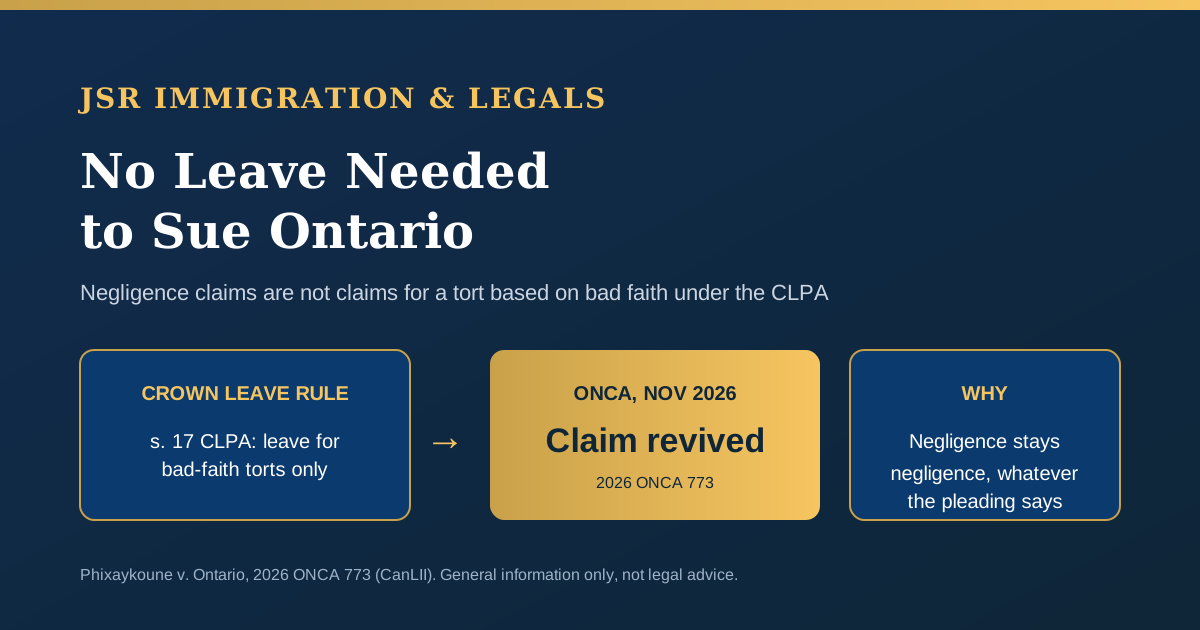
If you are injured because a provincial employee was careless on the job, Ontario's Crown Liability and Proceedings Act, 2019 (CLPA) generally lets you sue the Crown as if it were any other person. But the Act also contains a gatekeeping rule: a proceeding that includes a claim for misfeasance in public office or "a tort based on bad faith" is automatically stayed until a judge grants leave. In Phixaykoune v. Ontario, 2026 ONCA 773, released in the first week of November 2026, the Court of Appeal for Ontario clarified how narrow that gate really is, and in doing so it revived a severely injured man's negligence claims against correctional officers.
What happened
The appellant was an inmate at the Maplehurst Correctional Complex when fellow inmates assaulted him and his head hit the concrete ground with substantial force. Surveillance video showed that several correctional officers had left the unit shortly before the assault and did not come to his aid while it occurred. Almost an hour and 40 minutes after leaving, the officers returned and took him out of the unit. He needed an emergency craniectomy for a brain bleed, spent 11 days on life support, and was left with lasting impairments.
He sued the Crown, his attackers, his healthcare providers, and the correctional officers. Because he did not initially know the officers' identities, his statement of claim named officers "A", "B" and "C"; after learning their names, he moved to amend. On July 5, 2024, the Superior Court of Justice permitted the amendment. His amended pleading blamed the assault on a complete lack of supervision of the unit and claimed damages for negligence, gross negligence, recklessness and breach of fiduciary duty, and it alleged bad faith, a pattern of ongoing non-supervision, and delayed access to medical care that worsened his injuries.
The leave problem at Superior Court
The Crown argued that s. 17 of the CLPA applied. That section requires leave of the court for a proceeding that includes a claim for a tort of misfeasance in public office or a tort based on bad faith, automatically stays the proceeding until leave is granted (s. 17(2)), and sets a two-part test for leave (s. 17(7)): the proceeding must be brought in good faith and have a reasonable possibility of resolving in the claimant's favour.
The motion judge found s. 17 engaged. She accepted that the appellant had acted in good faith but held there was no reasonable possibility of success. At their highest, the allegations showed the officers were negligent, and under s. 12(1) of the Ministry of Correctional Services Act, R.S.O. 1990, c. M.22, correctional officers are immune from actions for acts done in good faith in the execution of their duties. She denied leave and stayed the claims against the officers.
What the Court of Appeal decided
The Court of Appeal allowed the appeal and granted costs of $5,400, all in. Associate Chief Justice Michal Fairburn wrote that the motion judge erred in two related ways.
First, s. 17(1) does not catch every pleading that mentions bad faith. It applies to proceedings in connection with torts based on bad faith. A claim framed in negligence that contains factual allegations of bad faith is still a negligence claim, not a claim in respect of a tort based on bad faith. "The elements of a negligence claim do not change in the face of a statutory immunity clause," the Court wrote. "The purpose of the allegation of bad faith is rather to fend off good faith statutory immunity."
Second, on that narrower interpretation, which the Court held aligns with the English and French texts alike, s. 17 did not apply to this claim at all. No leave was needed, so the stay falls away. If the legislature had wanted s. 17 to capture every bad-faith allegation made in employment-related tort claims against the Crown or its officers, it could have said so clearly.
The decision says nothing about whether the officers were actually negligent. That question now returns to the Superior Court to be decided on the merits.
The practical rules to take away
- A negligence claim against Ontario or its employees may proceed without leave, even if the pleading also alleges bad faith.
- Leave is still required for genuine claims of misfeasance in public office or a tort that is itself based on bad faith. Those claims remain automatically stayed until a judge grants leave.
- Good-faith statutory immunity remains a defence the officers may raise. Bad-faith allegations in a negligence claim may answer that defence at trial; they do not trigger the leave gate.
- Suing the Crown carries its own procedural steps. The CLPA may require notice of a claim for damages within 60 days, served on the Crown Law Office (Civil) of the Ministry of the Attorney General, and limitation periods still apply. Missing a procedural step may affect the claim.
- Winning the appeal is not winning the case. The officers may still defeat the claim on the merits, and no outcome is guaranteed.
officers absent about 1h40m"] --> B["Claim: negligence, gross
negligence, bad faith alleged"] B --> C["Crown position: s. 17 CLPA
leave required, claim stayed"] C --> D["Motion judge:
leave denied"] D --> E["ONCA, 2026 ONCA 773:
negligence is not a tort
based on bad faith"] E --> F["Leave not required,
claim proceeds on merits"]
What this means for you
If you believe a provincial employee's carelessness caused your injury, in custody, in a provincial institution, or elsewhere, Phixaykoune removes one procedural obstacle: a claimant should not be forced to obtain leave simply because a negligence pleading alleges bad faith. But the CLPA's notice deadlines, limitation periods, and immunity defences all still apply, and a court may decide any of them against a claimant. Every case turns on its own facts.
Claims within the monetary limit can be pursued through our Small Claims Court services. Insurance-related injury disputes go through our LAT services. For Superior Court claims against the Crown, JSR Immigration and Legals can assess whether your deadlines are intact and what your pleading should say. Contact us at (647) 286-4266 or info@jsrlegals.ca.
This post is general information, not legal advice, as of November 11, 2026. For advice on a specific matter, please contact JSR Legals.
Sources
- Phixaykoune v. Ontario, 2026 ONCA 773 (CanLII): https://www.canlii.org/en/on/onca/doc/2026/2026onca773/2026onca773.html
- Crown Liability and Proceedings Act, 2019, S.O. 2019, c. 7, Sched. 17 (CanLII): https://www.canlii.org/en/on/laws/stat/so-2019-c-7-sch-17/latest/so-2019-c-7-sch-17.html
- Ministry of Correctional Services Act, R.S.O. 1990, c. M.22, s. 12(1) (e-Laws): https://www.ontario.ca/laws/statute/90m22
- Law Times, "OCA grants appeal from denial of leave in inmate injury case" (November 9, 2026): https://www.lawtimesnews.com/practice-areas/personal-injury/oca-grants-appeal-from-denial-of-leave-in-inmate-injury-case/393566
- Blaney McMurtry, Court of Appeal summaries, week of November 2, 2026: https://www.blaneysappeals.com/2026/11/07/court-of-appeal-summaries-november-2-november-6/
JSR Legals / JSR Immigration Ltd. 9300 Goreway Drive, Suite 205, Brampton, ON L6P 4N1 (647) 286-4266 info@jsrlegals.ca

Immigration & paralegal practitioner at JSR Immigration & Legals, helping newcomers and Ontario residents with their cases.
This post is general information about Canadian immigration and Ontario paralegal matters and is not legal advice. Rules change and every case is different — confirm current requirements for your own situation.