Ontario's New Free Credit Freeze: A Simple Way to Lock Out Identity Thieves
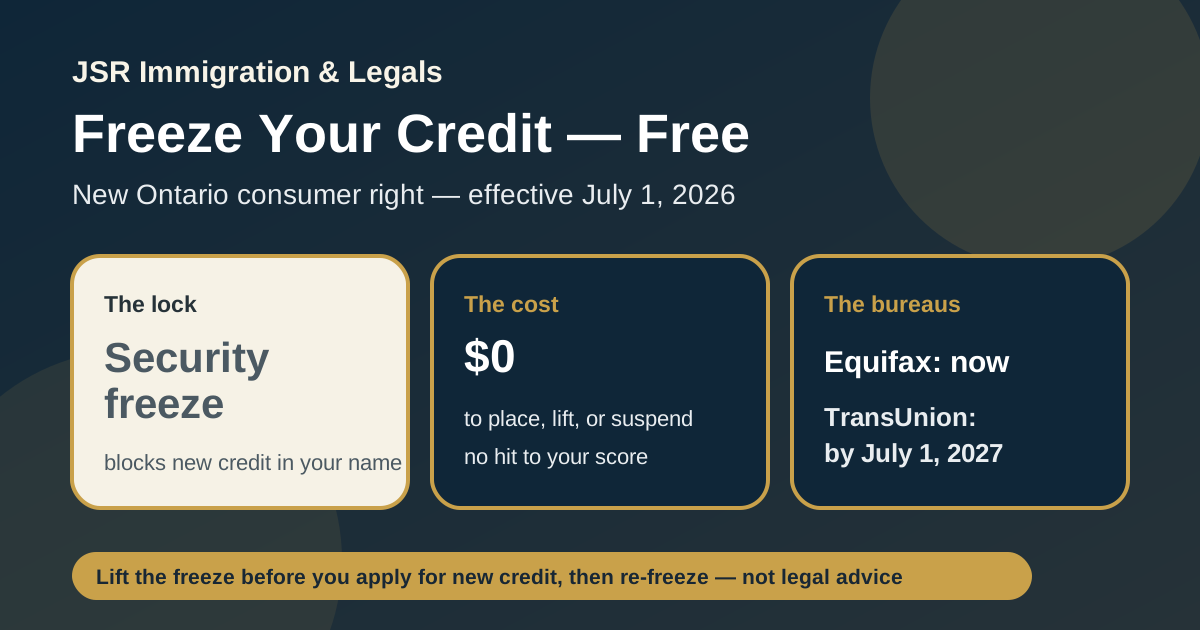
If someone steals your identity, the damage usually starts the same way: a fraudster uses your personal details to open a credit card, loan, or line of credit in your name. As of July 1, 2026, Ontario gives you a free tool to slam that door shut before it happens — the right to place a security freeze (also marketed as a "credit lock") on your credit file at no cost. It is one of the more practical, everyday-life changes in the province's consumer-protection reforms, and most people have never heard of it.
What actually changed
The new rights come from amendments to Ontario's Consumer Reporting Act, part of the province's broader Better for Consumers, Better for Businesses Act, 2023 package. The reforms require the big credit bureaus to give Ontario residents several protections for free, including the headline one: the ability to freeze — and later unfreeze — your credit report on demand.
Equifax Canada launched its free Credit Lock for Ontarians on July 1, 2026. Ontario's law applies to TransUnion as well, but TransUnion has been given extra time — until July 1, 2027 — to fully meet the security-freeze requirements. So for now, if you want the fullest protection, plan to freeze both files as each bureau's service becomes available.
What a security freeze does
A security freeze puts a "digital deadbolt" on your credit report. While the freeze is active, lenders generally cannot access your file — and if a lender can't pull your credit, it usually won't approve a new account. That is what stops a thief from opening credit in your name, because most lenders check your report before saying yes.
Two important points people get wrong:
- It is free, and it does not hurt your credit score. Placing, lifting, or
temporarily suspending the freeze costs nothing and has no effect on your score calculations.
- It does not touch your existing accounts. A freeze blocks new credit
applications. Your current cards, loans, and bank accounts keep working normally, and you can still use them.
Freeze vs. the other free rights
The freeze is the centrepiece, but the reforms come with more no-cost rights worth knowing:
- A free electronic copy of your consumer report — you can request one from
each bureau on a regular basis to check for anything you don't recognize.
- Your credit score at no charge alongside that report.
- The right to add a short consumer statement to your file — a brief note
giving your side of the story on a disputed or negative item.
Together, these let you both watch your file and lock it — a monitoring habit plus a hard stop.
How to use it
The mechanics are simple, but there is one trade-off to plan around: when the freeze is on, you are also blocked from getting new credit until you lift it.
TransUnion by July 1, 2027] B --> C[Verify your identity
online, by phone, or by mail] C --> D[Place the free security freeze / credit lock] D --> E{Applying for new credit
e.g. mortgage, car loan, card?} E -- "Yes" --> F[Temporarily lift or suspend
the freeze before you apply] F --> G[Re-freeze once approved] E -- "No" --> H[Leave the freeze on
as your default protection]
So if you are about to apply for a mortgage, car loan, or new credit card, you temporarily lift or suspend the freeze so the lender can pull your report, then re-freeze it afterward. Because lifting and re-placing the freeze are both free, this is meant to be quick and repeatable.
Who this matters most for
A freeze is especially worth considering if you:
- have been told your data was exposed in a data breach;
- are not planning to apply for new credit soon (the freeze just sits there,
protecting you);
- want to protect a family member — for example, an elderly parent or a young
adult — who is a target for fraud; or
- have already been a victim of identity theft and want to stop repeat
attempts.
What a freeze does not do
Be realistic about the limits. A credit freeze is powerful, but it is not a force field:
- It won't stop fraud on accounts that already exist — you still need to watch
your statements for unauthorized charges.
- It won't block everyone. Some parties (for example, existing creditors or
certain government and collection uses) may still access your file.
- It won't fix an existing fraud — if you have already been hit, you may also
need to report it, dispute the fraudulent accounts, and possibly involve police.
Used together with regular report checks and good password habits, though, a freeze removes the single easiest path a thief has to your credit.
Where to confirm the details
- Ontario's Consumer Reporting Act on e-Laws:
ontario.ca/laws/statute/90c33.
- Equifax Canada's announcement of free Credit Lock for Ontarians:
- The bureaus themselves — Equifax and TransUnion — set out the exact
steps to verify your identity and place or lift a freeze on their websites.
Get in touch
Whether you are worried about identity theft, dealing with the aftermath of a data breach, or facing a debt or credit dispute that has landed in Small Claims Court, knowing your rights is the first step. JSR Legals can help you understand where you stand. Reach us at info@jsrlegals.ca.
This article is general information about Ontario law, current as of July 2026, and is not legal advice for any specific situation. Programs, in-force dates, and bureau procedures can change — confirm the current requirements with the credit bureaus or a licensed professional before you act.

Immigration & paralegal practitioner at JSR Immigration & Legals, helping newcomers and Ontario residents with their cases.
This post is general information about Canadian immigration and Ontario paralegal matters and is not legal advice. Rules change and every case is different — confirm current requirements for your own situation.