The Month's Rent Your Landlord Owes You in an Own-Use (N12) Eviction — and Ontario's New Exception
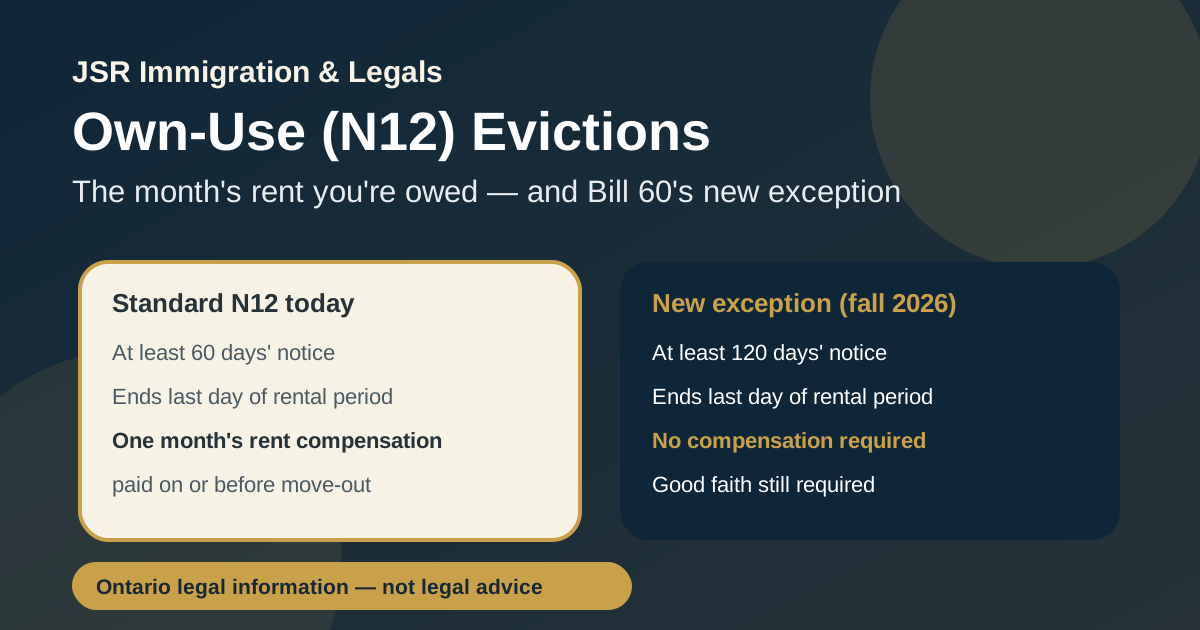
If a landlord in Ontario ends your tenancy because they — or a close family member — want to move in, that is an N12 notice, and it normally comes with something many tenants do not realize they are owed: one month's rent in compensation. With Ontario's Bill 60 now rolling out, that compensation rule is one of the pieces set to change in the fall of 2026. Here is a plain-language look at how the money works today, what the new exception does, and what a tenant should still check before packing a single box.
What an N12 is — and the compensation attached to it
An N12 is the notice a landlord uses for a "landlord's own use" eviction. It can be used when the landlord, the landlord's spouse, a child or parent of the landlord or their spouse, or a caregiver for one of those people genuinely intends to move into the unit and live there for at least one year. It also covers a purchaser who is buying the home and wants it for their own use.
Two things have long been true about a valid N12:
- The notice period. The landlord must give at least 60 days' notice, and
the termination date has to fall on the last day of a rental period (or the end of a fixed-term lease).
- The compensation. The landlord must pay the tenant one month's rent (or
offer another acceptable unit) on or before the termination date. If that compensation is not paid, the notice is not valid and the eviction generally cannot proceed.
That one month's rent is not a favour — it is a requirement built into the Residential Tenancies Act, and it is one of the strongest protections a tenant has in an own-use situation.
What Bill 60 changes
Bill 60's first wave of rental rules took effect on July 1, 2026, and Tribunals Ontario has confirmed a second wave for the fall. Widely reported as taking effect around September 21, 2026 — though the government's own notice says only "September 2026," so confirm the exact date with the LTB — one of those changes touches N12 compensation directly.
The new rule adds an exception: if a landlord gives at least 120 days' notice and times the termination to the last day of a rental period or fixed term, the usual one month's compensation is no longer required. In plain terms, a landlord who plans far enough ahead can avoid paying the month's rent that a standard 60-day N12 would cost them.
for own use] --> B{How much notice,
and when does it end?} B -- "At least 60 days, ends on
last day of a rental period" --> C[Standard N12:
one month's rent compensation owed] B -- "At least 120 days, ends on
last day of a rental period
(from fall 2026)" --> D[New exception:
no compensation required] C --> E{Is the move-in genuine
and in good faith?} D --> E E -- "Yes" --> F[Eviction can proceed] E -- "No / not carried out" --> G[Tenant may file a T5 with the LTB
within one year — remedies possible]
What has not changed: good faith
The exception is about timing and money, not about lowering the bar for the eviction itself. Everything else about a valid own-use eviction still applies:
- The person moving in must actually qualify (landlord, spouse, their child or
parent, or a caregiver) and must genuinely intend to occupy the unit for at least a year.
- The intention has to be real. An N12 used as a pretext — to flip the unit to
a new tenant at a higher rent, for example — is a bad-faith eviction.
If a landlord uses an N12 in bad faith, or does not follow through on the stated use, the tenant can file a T5 application with the Landlord and Tenant Board, generally within one year of moving out. The Board can order remedies that may include several months' rent and other costs. Those penalties are deliberately serious, which is exactly why the good-faith requirement is not something the new compensation exception waters down.
What this means for you
If you are a tenant and you receive an N12: read it the day it arrives. Check the notice period, check that the termination date lands on the last day of your rental period, and — for a standard 60-day notice — make sure the one month's compensation is actually paid. If you receive a longer, 120-day-plus notice after the fall changes, understand that you may not be owed that month's rent under the new exception, but you are still owed a genuine own-use move. You do not have to move out simply because a notice arrives; you can dispute an N12 at the LTB, and the burden is on the landlord to prove good faith.
If you are a small landlord, the exception is a real planning tool — but only if the paperwork is perfect. The right form, the right number of days, and a termination date on the last day of the rental period all still matter, and a mistake sends you back to the start.
Where to confirm the current rules
- Tribunals Ontario — Landlord and Tenant Board (forms, rules, and the Bill 60
operational update): tribunalsontario.ca/ltb and the LTB legislative-changes update.
- The Residential Tenancies Act, 2006 on Ontario's e-Laws:
ontario.ca/laws/statute/06r17.
- Bill 60 — full text and status:
Get in touch
Own-use evictions turn on details — the notice period, the compensation, and above all whether the move-in is genuine. If you have received an N12, or you are a landlord trying to serve one correctly as the rules change, JSR Legals can help you understand your options and act in time. Reach us at info@jsrlegals.ca.
This article is general information about Ontario law, current as of July 2026, and is not legal advice for any specific situation. Effective dates, forms and rules can change — confirm the current requirements with the LTB or a licensed professional before you act.

Immigration & paralegal practitioner at JSR Immigration & Legals, helping newcomers and Ontario residents with their cases.
This post is general information about Canadian immigration and Ontario paralegal matters and is not legal advice. Rules change and every case is different — confirm current requirements for your own situation.