Workplace Harassment in Ontario: What the Law Says and What Your Employer Must Do
Workplace harassment is one of the most common employment problems Ontario workers face, and one of the most misunderstood. Many people believe there is a general law against a "toxic workplace." There is not, exactly. What Ontario law does is define a specific kind of behaviour, put clear duties on every employer to deal with it, and give workers ways to respond when those duties are ignored. Here is how it works.
What counts as workplace harassment
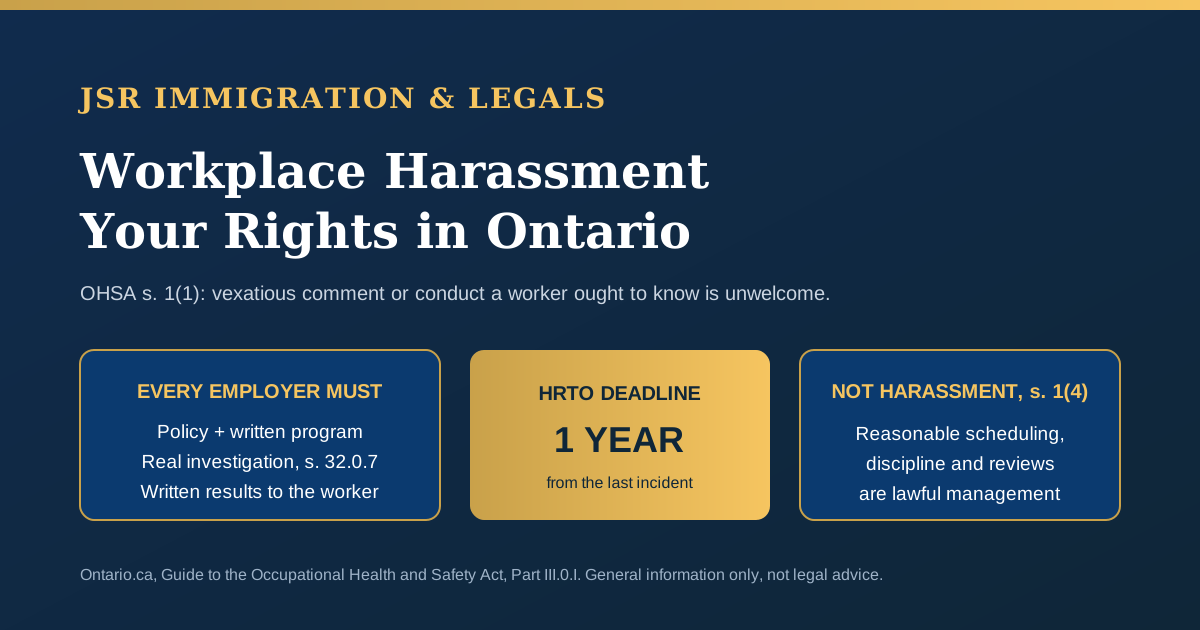
The Occupational Health and Safety Act (OHSA) defines workplace harassment as "engaging in a course of vexatious comment or conduct against a worker in a workplace, including virtually through the use of information and communications technology, that is known or ought reasonably to be known to be unwelcome" [subsection 1(1)]. The definition expressly includes workplace sexual harassment, and it covers online conduct, not just what happens in the physical workplace.
In practice, harassment can include remarks, jokes or innuendos that demean or intimidate, circulating offensive pictures or materials, bullying, and repeated intimidating calls or emails. The comments usually happen more than once, but a single serious incident, such as an unwelcome sexual solicitation from a supervisor, can be enough. Sexual harassment includes conduct because of sex, sexual orientation, gender identity or gender expression, and advances from anyone with power to grant or deny a benefit or advancement.
What is not harassment matters just as much. The OHSA excludes "a reasonable action taken by an employer or supervisor relating to the management and direction of workers or the workplace" [subsection 1(4)]. Scheduling, performance evaluations, discipline and workplace inspections are lawful when exercised reasonably and fairly. The same actions taken unreasonably, or for a discriminatory reason, may cross the line. Ordinary disagreements between co-workers are not harassment either.
What every employer must do
The OHSA imposes duties on all employers, regardless of size:
- A harassment policy. Every employer must prepare a workplace harassment policy and review it at least once a year [subsection 32.0.1(1)]. Where six or more workers are regularly employed, the policy must be in writing and posted where workers will see it, or made available in a readily accessible electronic format [subsections 32.0.1(2) and (3)].
- A harassment program. Employers must set up and maintain a program to implement the policy [subsection 32.0.6]. It must be in writing and set out how workers report incidents, including how to report when the alleged harasser is the employer or supervisor, how complaints will be investigated and dealt with, how information stays confidential, and how workers will be told of results.
- A real investigation. When an incident or complaint is made, the employer must ensure an investigation that is appropriate in the circumstances [section 32.0.7]. The worker who complained and the alleged harasser, if a worker of the same employer, must be informed in writing of the results and of any corrective action.
- Training. Workers and supervisors must be given information and instruction on the policy and program [subsections 32.0.5(2) and 32.0.8].
These are minimum standards, enforced by Ministry of Labour, Immigration, Training and Skills Development health and safety inspectors.
Two other routes to know about
The OHSA deals with process and safety. Two other laws may apply to the same facts:
- The Human Rights Code. Harassment tied to a Code ground such as race, sex, disability or religion is discrimination. A worker may apply to the Human Rights Tribunal of Ontario (HRTO). The general deadline is one year from the last incident, and late applications are rarely accepted. Punishing a worker for raising a rights issue is reprisal, a separate violation, as we explained in our post on HRTO reprisal.
- The criminal law. Threats, stalking and violence are Criminal Code matters. The police should be contacted. Domestic violence that follows a worker to work is treated as workplace violence under the OHSA.
What a worker can actually do
- Report the incident in writing to the employer or supervisor, using the program's reporting procedure. Keep a copy.
- Keep records: dates, what was said or done, who was present, emails or messages.
- Wait for the written outcome of the investigation. The employer owes it under section 32.0.7.
- If the employer does nothing, the policy or program is missing, or the response is inadequate, a complaint may be made to the Ministry of Labour.
- If the harassment relates to a personal characteristic protected by the Code, an HRTO application may be an option, but the one-year deadline governs.
- If the experience causes a mental injury, a WSIB claim may also be possible.
or online] --> B[Report in writing under the
employer harassment program] B --> C[Employer must investigate
appropriately, s. 32.0.7] C --> D[Written results to worker
and alleged harasser] D --> E{Adequate response?} E -- No --> F[Complaint to the Ministry of Labour] E -- Tied to a Code ground? --> G[HRTO application
within one year] F --> H[Also consider:
WSIB claim for mental injury] G --> H
The bottom line
Ontario law does not promise a pleasant workplace, and it does not outlaw every rude or unfair boss. What it does require is that every employer take harassment seriously on paper and in practice: a policy, a program, a real investigation, and written results. Workers who document what happened and use the reporting procedure put themselves in the strongest position, whatever route they later take. A tribunal may order remedies such as compensation, but outcomes always depend on the facts and are never guaranteed.
If you are dealing with harassment at work, or you are an employer who needs compliant policies and programs, JSR Immigration and Legals can help. See our employment services page and HRTO services page, or contact us at (647) 286-4266 or info@jsrlegals.ca.
This post is general information, not legal advice, as of October 30, 2026. For advice on a specific matter, please contact JSR Legals.
Sources
- Ontario Ministry of Labour, Immigration, Training and Skills Development, Understand the law on workplace violence and harassment: https://www.ontario.ca/page/understand-law-workplace-violence-and-harassment
- Guide to the Occupational Health and Safety Act, Part III.0.I: Workplace violence and workplace harassment: https://www.ontario.ca/document/guide-occupational-health-and-safety-act/part-iii0i-workplace-violence-and-workplace-harassment
- Steps to Justice, How do I make a claim to the Human Rights Tribunal of Ontario? (reviewed June 12, 2025): https://stepstojustice.ca/questions/human-rights/how-do-i-make-claim-human-rights-tribunal-ontario/
JSR Legals / JSR Immigration Ltd. 9300 Goreway Drive, Suite 205, Brampton, ON L6P 4N1 (647) 286-4266 info@jsrlegals.ca

Immigration & paralegal practitioner at JSR Immigration & Legals, helping newcomers and Ontario residents with their cases.
This post is general information about Canadian immigration and Ontario paralegal matters and is not legal advice. Rules change and every case is different — confirm current requirements for your own situation.