PGWP Eligibility in 2026: What Students Must Know Before Graduating
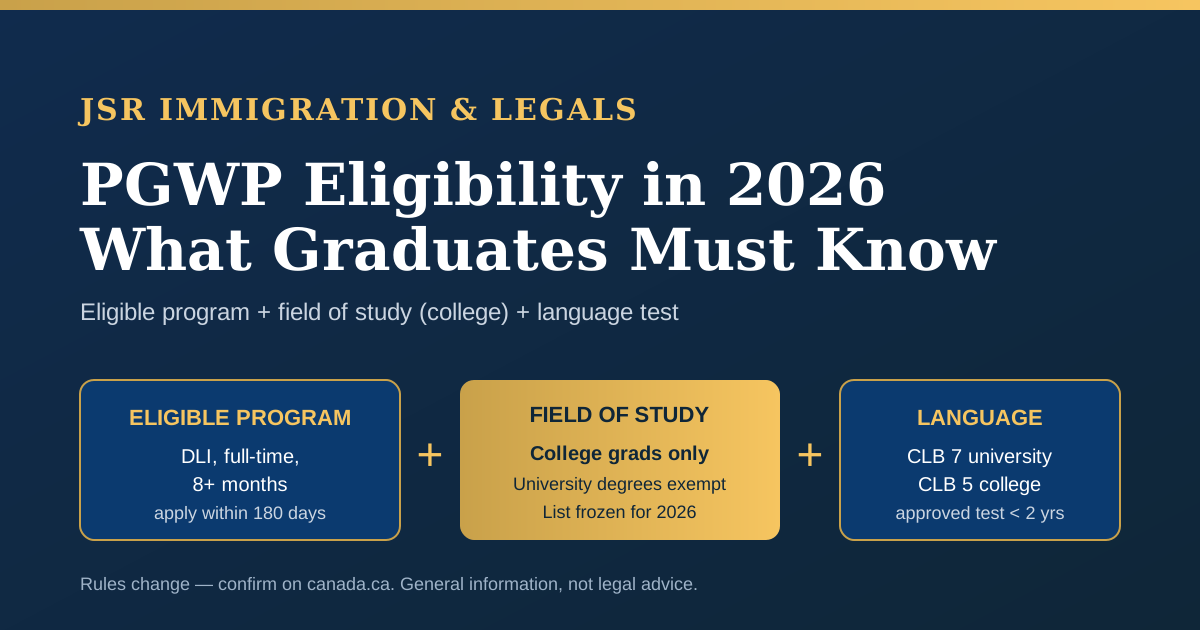
For many international students, the post-graduation work permit (PGWP) is the whole point of studying in Canada — it's the open work permit that lets you gain Canadian work experience and, often, build toward permanent residence. But the PGWP is no longer the near-automatic reward it once was. Over the past two years Immigration, Refugees and Citizenship Canada (IRCC) has added a language requirement and, for many graduates, a field-of-study requirement. With convocation season here, this is the moment to confirm you'll actually qualify — before you apply.
Here's a plain-language guide to PGWP eligibility in 2026: the core rules everyone must meet, the two newer requirements that trip people up, and where to confirm the current details.
The core rules that haven't changed
To be eligible for a PGWP, you generally must have:
- Graduated from an eligible Designated Learning Institution (DLI). Not every DLI's programs lead to a PGWP — check your school's status.
- Completed a program of at least eight months that led to a degree, diploma, or certificate.
- Studied full-time during each academic session (with limited, defined exceptions such as your final term, or an authorized leave).
- Maintained valid status while studying.
- Applied within the deadline after you finish — generally 180 days of receiving confirmation that you completed your program, and your study permit must still be valid (or you must apply in a way that keeps you eligible).
The PGWP is issued once in a lifetime, and its length is tied to the length of your program — up to a maximum of three years. A program shorter than eight months does not qualify on its own.
The newer rule #1: a language requirement
Since late 2024, PGWP applicants must prove a minimum level of English or French. The required level depends on the type of credential:
- University graduates (bachelor's, master's, doctoral): Canadian Language Benchmark (CLB) 7 — or NCLC 7 in French — in all four abilities (reading, writing, listening, speaking).
- College and other non-university graduates (diplomas, certificates): CLB 5 / NCLC 5 in all four abilities.
A few practical points: you must submit results from an approved test, and those results generally must be less than two years old on the day you apply. Build test prep and booking into your timeline — a missing or expired language result is an avoidable reason to be turned down.
The newer rule #2: field of study (for many, not all)
This is the requirement that surprises people most. Whether it applies depends on your credential:
- University degree graduates (bachelor's, master's, doctoral) are exempt from the field-of-study requirement. Your program of study does not have to be on any list.
- College and other non-degree graduates generally must have studied in an eligible field of study — one IRCC links to long-term labour-market needs — to qualify for a PGWP.
bachelor's / master's / doctoral} B -- Yes --> D[No field-of-study restriction] B -- No --> C{Program in an eligible
field of study?} C -- No --> E[Not eligible on this basis
get advice on options] C -- Yes --> D D --> F{Meet language requirement?
CLB 7 university / CLB 5 college} F -- No --> G[Sit an approved test first] F -- Yes --> H[Apply within 180 days,
valid status]
There's one piece of good news for 2026 planning: on January 15, 2026, IRCC confirmed it would freeze the list of PGWP-eligible fields of study for the whole year — no fields added or removed in 2026. That means a college student who confirmed their program was eligible when they enrolled has more certainty that it still counts. Even so, the safest move is to verify your specific program against the current list before you apply, because eligibility is tied to the field (and the program's CIP code), not just the school's name.
What to do before you graduate
- Check your program now, not after convocation. Confirm your DLI and program lead to a PGWP, and — if you're a non-degree graduate — that your field of study is eligible.
- Book your language test early and confirm it'll still be valid (under two years old) when you apply.
- Watch the 180-day clock. It starts when you get confirmation you completed your program (for example, a final transcript or completion letter), not at the convocation ceremony.
- Keep your status valid in the meantime — don't let your study permit lapse while you wait to apply.
Meeting these requirements doesn't change the fact that the PGWP is a one-time benefit, so it's worth getting the application right the first time.
Where to confirm the current rules
PGWP requirements have changed more than once recently, so always check the official source before you act:
- IRCC's Post-graduation work permit: Who can apply page on canada.ca.
- IRCC's notice on the field of study requirement for post-graduation work permits.
If a detail you read elsewhere doesn't match canada.ca, trust the official page.
Talk to us
Whether your specific program and credential qualify, which language test to take, and how to time your application around the 180-day window all depend on your situation. If you'd like help confirming your PGWP eligibility or putting your application together, the team at JSR Immigration & Legals is happy to talk it through — get in touch.
This post is general information only and reflects what was publicly known as of June 19, 2026. It is not legal advice. Program rules and eligible-field lists change, so confirm current requirements with IRCC or a qualified professional before acting.

Immigration & paralegal practitioner at JSR Immigration & Legals, helping newcomers and Ontario residents with their cases.
This post is general information about Canadian immigration and Ontario paralegal matters and is not legal advice. Rules change and every case is different — confirm current requirements for your own situation.