RABC Permits Expire November 30, 2026: Remote Northern Ontario Crossings Switch to Mandatory Reporting
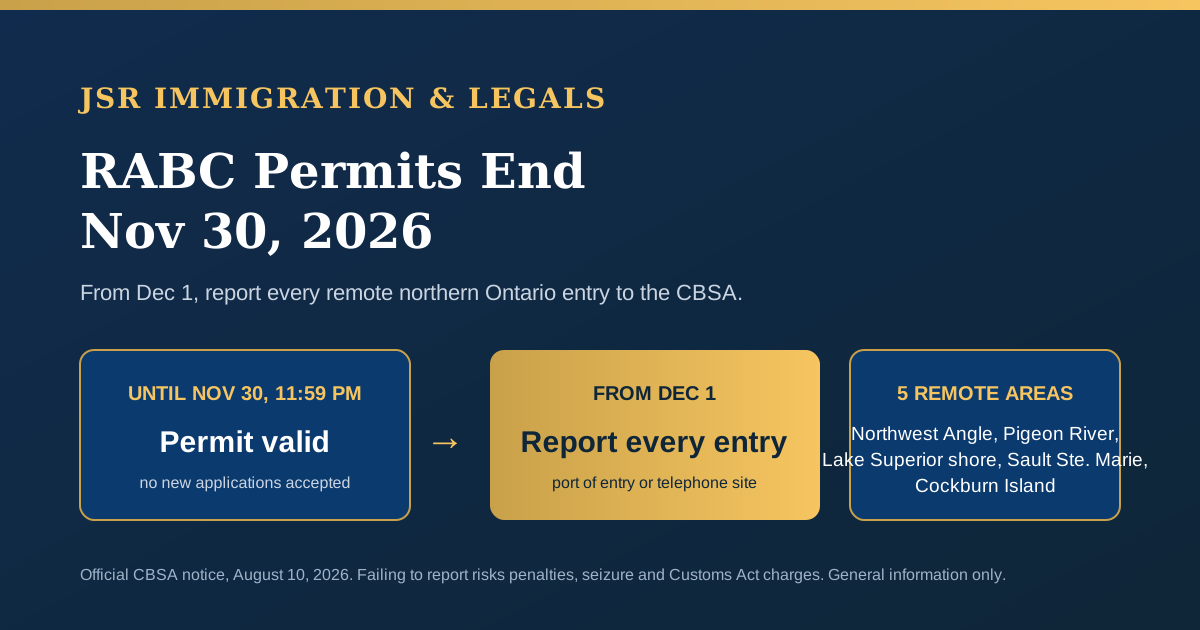
The Remote Area Border Crossing (RABC) permit has let cottagers, anglers, boaters and border-community residents enter Canada through remote stretches of northern Ontario without stopping at a staffed port of entry since the 1990s. That system ends this month. The Canada Border Services Agency (CBSA) confirmed in its August 10, 2026 news release that the RABC Program closes on December 1, 2026, and that existing permits remain valid only until 11:59 p.m. on November 30, 2026. New permit applications are no longer being accepted.
From December 1, everyone entering Canada through remote areas of northern Ontario, or from the Northwest Angle into southern Manitoba, must report to the CBSA either in person at a port of entry or at a designated telephone reporting site. That reporting duty applies on every entry. This is a change to how you report at the border, not to your immigration status, but failing to report carries consequences that can reach into later immigration and customs matters.
What changes and when
| Date | What happens |
|---|---|
| August 10, 2026 | CBSA announces the program closure and the permit extension |
| November 30, 2026, 11:59 p.m. | All existing RABC permits expire |
| December 1, 2026 | RABC Program closes. Reporting at a port of entry or telephone reporting site becomes mandatory on every entry |
The five affected areas
The telephone reporting requirement covers the areas the RABC Program used to serve:
- Northwest Angle Area
- Pigeon River through to and including Lake of the Woods
- Canadian shore of Lake Superior
- Sault Ste. Marie (upper lock system)
- Cockburn Island
If your usual route runs through any of these areas, the permit in your glovebox stops working on December 1.
Who this affects
RABC permits were available only to Canadian and U.S. citizens and permanent residents. CBSA's release states there have historically been about 11,000 RABC members per year, roughly 90% of them American. In practice the change touches Canadian and mixed-status families on both sides of the border: seasonal property owners, people who cross for work, and permanent residents whose entry records matter later.
Permanent residents and temporary residents should take particular care. An entry that is not properly reported can resurface as a travel-history problem in a PR card renewal, a residency-obligation review, or a future application, even where the entry itself was otherwise lawful.
How telephone reporting will work
CBSA is replacing the permit with designated telephone reporting sites, built on the process in its Memorandum D2-5-12 for general aviation, private boats and other non-commercial passenger conveyances. At a site, you provide identifying information, outline your travel details and answer the officer's questions. The officer may still require in-person screening, so a phone call is not always the last step.
The locations of the new telephone reporting sites will be decided in the coming months in consultation with Indigenous communities, local businesses and law enforcement partners. That list is not final, so the safe fallback until sites are announced is a staffed port of entry.
Why non-compliance is serious
CBSA's quick facts are direct: failure to report can lead to enforcement action, including monetary penalties, seizure of goods or vehicles and possible criminal charges under the Customs Act. Under the old program, permit holders still had to declare all goods they brought into Canada. That duty never went away. What changes on December 1 is that the reporting step itself becomes mandatory for everyone, every time.
What to do before November 30
- Use your current permit while it lasts. Active permits are valid through 11:59 p.m. on November 30, 2026. Expired permits did not get the extension.
- Plan a fallback route. Until the telephone site locations are announced, a staffed port of entry is the only guaranteed compliant option.
- Watch for the site announcements. CBSA will publish the designated telephone reporting site locations as consultations finish.
- Keep declaring everything. Goods, including anything requiring a permit, must be declared on every entry.
- If you cross to work in Canada, hold a valid work permit. RABC permit holders entering for work needed a valid work permit before, and that requirement continues.
The bottom line
A valid permit bought a crossing without a stop at a staffed port. After December 1, no permit, card or membership replaces the duty to report. Build the reporting step into your routine before the deadline rather than after a missed entry.
If you cross regularly through these remote corridors, or if a past unreported entry is complicating a PR card renewal, citizenship application or admissibility question, contact JSR Immigration & Legals through our consultation page or the services overview.
This article is general information current to November 3, 2026, and is not legal or immigration advice. Confirm the live rules and site locations on the CBSA and Canada.ca pages before you travel.

Immigration & paralegal practitioner at JSR Immigration & Legals, helping newcomers and Ontario residents with their cases.
This post is general information about Canadian immigration and Ontario paralegal matters and is not legal advice. Rules change and every case is different — confirm current requirements for your own situation.