September 22, 2026: IRCC Clarifies Custodianship for Minor Study Permits
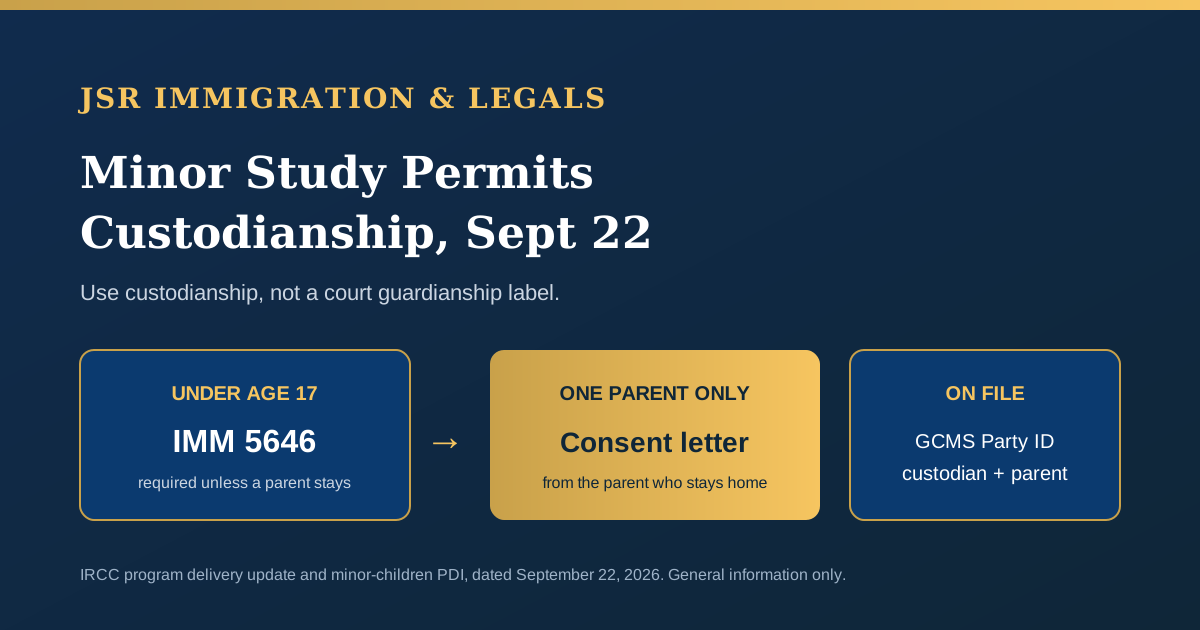
On September 22, 2026, IRCC published a program delivery update to its officer instructions on study permits for minor children. The page details date is 2026-09-22. The same date appears on the updated guidelines on minor children.
This is not a new statute. It is officer guidance. Three things changed in the written instructions: IRCC tells officers to use the word custodianship, not legal guardianship; officers must record the custodian and accompanying parent in GCMS on the Party ID tab from form IMM 5646; and if only one parent travels with the child for the full study period, officers are to request a signed Parent Consent Letter or Travel Authorization Form from the parent who stays behind.
The public Studying in Canada as a minor page still carries a 2025-12-18 modified stamp. Use the September 22 officer page for what changed this week. Use the public page for the applicant-facing checklist.
Who counts as a minor
A person under the age of majority at arrival is a minor child. Age of majority is set by the province or territory of study, not by the child's passport country.
| Age of majority | Provinces and territories |
|---|---|
| 18 | Alberta, Manitoba, Ontario, Prince Edward Island, Quebec, Saskatchewan |
| 19 | British Columbia, New Brunswick, Newfoundland and Labrador, Nova Scotia, Northwest Territories, Nunavut, Yukon |
Ontario's line is 18. A 17-year-old in a Brampton high school is still a minor.
Custodianship is not a court guardianship order
IRCC now states, in the officer instructions:
For the purposes of a study permit application, the term "custodianship" should be used rather than the legal term "guardianship", as guardianship involves an individual being legally appointed to manage a person's affairs as opposed to being deemed to have custody of the student.
A custodian on the public page is a responsible adult who is a Canadian citizen or a permanent resident and who will take care of and support the child. That arrangement is documented on the two-page Custodianship Declaration (IMM 5646). Page one is signed by the custodian and notarized in Canada. Page two is signed by the parent or legal guardian and notarized in the home country.
A foreign court guardianship order does not replace IMM 5646.
Age 17 is the hard line on the form
The September 22 instructions keep two tracks. The test is age at the time of application.
Under 17. A custodian in Canada is still required unless at least one parent accompanies the child for the duration of the studies. The file must include a notarized declaration from the parent or legal guardian in the country of origin and a matching notarized declaration from the custodian in Canada.
From 17 to the provincial age of majority. Custodianship is assessed case by case. Officers may ask for more documents or an interview. The instructions list the factors they should weigh:
- Level of study. A student still in secondary school should normally need a custodian.
- Level of independence, including whether earlier studies were completed away from the family home.
- Financial capacity outside the parents, for example a scholarship or government sponsorship.
- Travel experience, including exchange programs.
- How easy it is for a school or hospital to reach a parent in an emergency.
- Informal care arrangements that fall short of a full custodianship declaration.
- Risk indicators for irregular child migration, exploitation, or trafficking.
A 17-year-old in Grade 12 in Ontario should still expect a request.
One parent coming is not a blank cheque
A custodianship declaration is not required when the child is accompanied for the duration of their studies by at least one parent. That is the new written exception.
The next sentence is the one families miss. If only one parent comes, officers are to request, if it is not already on the file, a signed Parent Consent Letter or Travel Authorization Form from the non-accompanying parent. A one-parent household should document why the second signature cannot be obtained. Do not leave that gap for the officer to invent.
Officers must also enter the accompanying parent on the GCMS Party ID tab. The custodian, when there is one, must be entered from IMM 5646 on the same tab if no Party ID already exists. IRCC calls that a mandatory requirement so the name is on the file later.
Outside Canada, a minor who intends to study is processed as a student, not a visitor, even when a parent holds a work or study permit, unless an R188 exemption applies. When the child reaches the age of majority, a study permit is required to keep studying. File before the birthday.
This update does not change proof-of-funds tables, PAL or TAL rules, or the 2026 student arrival target. We covered the September 1 living-cost table in the proof-of-funds post.
If you are preparing a minor's study permit, a parent companion permit, or a notarial IMM 5646 package, contact JSR Immigration & Legals through our consultation page or the study permit service page. Notarial work can be booked on the notary page.
This article is general information current to September 26, 2026, and is not legal or immigration advice. Confirm the live officer instructions and the public minor-children page on Canada.ca before you file.

Immigration & paralegal practitioner at JSR Immigration & Legals, helping newcomers and Ontario residents with their cases.
This post is general information about Canadian immigration and Ontario paralegal matters and is not legal advice. Rules change and every case is different — confirm current requirements for your own situation.