What to Do After an IRCC Refusal: Reconsideration, Reapply or Judicial Review
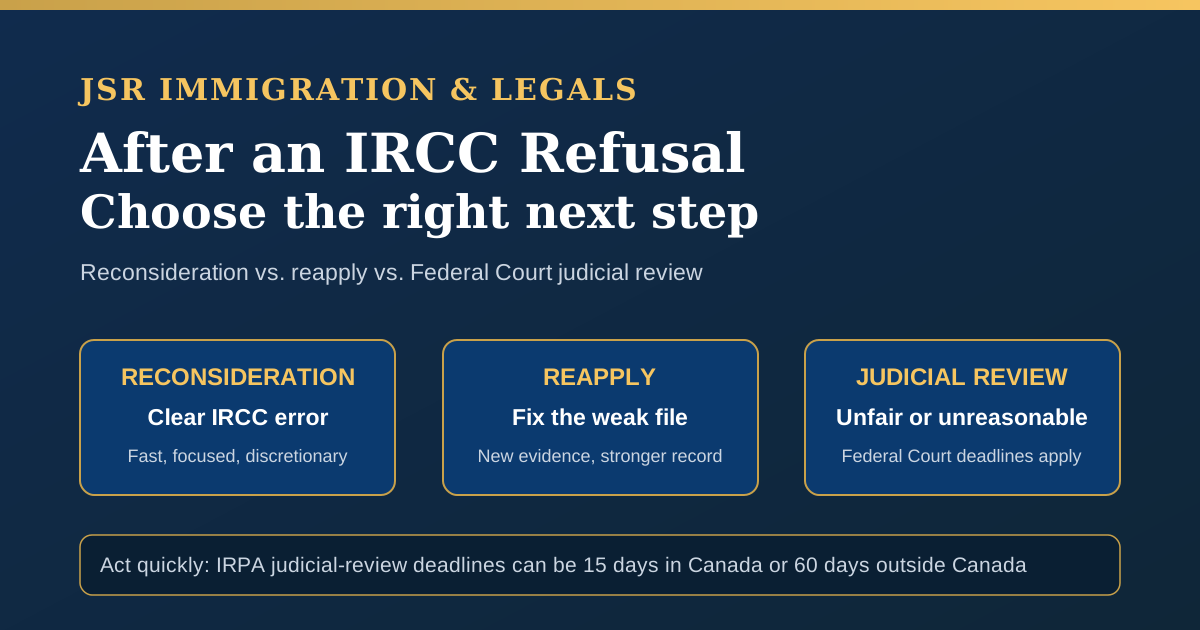
An IRCC refusal does not always mean the case is finished. It means you need to choose the next step carefully. After a visitor visa refusal, study permit refusal, work permit refusal, sponsorship refusal, permanent residence refusal, or other immigration decision, the right option usually falls into one of three paths: request reconsideration, submit a stronger new application, or start judicial review at the Federal Court.
The mistake many applicants make is reacting too quickly without understanding what each path is meant to do. A reconsideration request is not the same as a new application. A new application is not the same as judicial review. And judicial review is not a second chance to add every document that was missing from the first file. Each option has a different purpose, deadline, cost, risk, and evidence strategy.
First, read the refusal letter properly
Start with the refusal letter, but do not stop there. The letter may use standard wording such as purpose of visit, finances, family ties, employment, immigration history, program eligibility, missing evidence, or failure to satisfy the officer. Those phrases matter, but they often do not explain the full reasoning.
Before deciding what to do, identify:
- the exact date you received the decision;
- the application type and location of processing;
- the legal or policy requirement IRCC says was not met;
- whether the issue is missing evidence, weak evidence, credibility, eligibility, admissibility, or officer error;
- whether you have a statutory appeal route, such as some sponsorship appeals, before judicial review; and
- whether a Federal Court deadline is already running.
If the refusal is serious or unclear, consider requesting GCMS notes or the officer's reasons. For urgent judicial review deadlines, do not wait for notes if waiting would put the filing deadline at risk.
The three main options after an IRCC refusal
| Option | Best used when | Main advantage | Main risk |
|---|---|---|---|
| Reconsideration | IRCC made a clear error or overlooked evidence already in the file | Fast and focused | Discretionary, no guaranteed response, does not stop court deadlines |
| Reapply | The first file was weak, incomplete, or circumstances changed | Lets you fix the record with stronger evidence | Repeating the same application can lead to another refusal |
| Judicial review | The decision appears unreasonable, procedurally unfair, or legally flawed | Puts the decision before the Federal Court | Strict deadlines and usually no new evidence on the merits |
Option 1: Request reconsideration
A reconsideration request asks IRCC to reopen or revisit the refused application because something went wrong in the decision-making process. It is usually most effective when the problem is narrow and provable.
Good reconsideration cases often involve:
- the officer saying a document was missing even though it was uploaded before the deadline;
- the officer relying on the wrong fact, wrong date, wrong family member, or wrong application history;
- a clear misunderstanding of the program requirement;
- a decision issued before IRCC considered a timely webform update; or
- a refusal that appears inconsistent with the evidence already submitted.
Reconsideration is usually weaker when the real problem is that the original application did not have enough evidence. For example, if a visitor visa was refused because the applicant did not prove financial capacity, and the applicant now wants to add new bank statements, a new application may be better than asking the same officer to reopen the old one.
What to include in a reconsideration request
Keep it focused. A strong reconsideration request should include:
- the applicant's full name, UCI, application number, and decision date;
- a short explanation of the exact error;
- references to the document or evidence already before IRCC;
- a concise request to reopen and reconsider the decision; and
- only the documents needed to prove the error.
Do not turn reconsideration into a large new application. If you need to rebuild the entire file, that usually points toward reapplying.
Important warning about deadlines
A reconsideration request does not automatically extend or pause the Federal Court judicial review deadline. If the refusal may need judicial review, calendar the court deadline immediately and preserve that option while you decide whether reconsideration is realistic.
Option 2: Reapply with a stronger application
IRCC's Help Centre states that if an application to come to Canada is refused, a person can generally apply again at any time unless the decision letter says they cannot. IRCC also says the person should only apply again if they can include information that was not included before. That is the key point: a reapplication must be better than the refused application.
Reapplying often makes sense when:
- the refusal was caused by missing or weak documents;
- your financial, employment, family, travel, school, or business evidence has improved;
- the application purpose can be explained more clearly;
- you can address the officer's concerns directly;
- the program criteria are still met; and
- there is no urgent need to challenge the old decision in court.
For temporary resident applications, a strong reapplication should not simply say, "Please approve me." It should explain what changed, answer the refusal reasons, and organize the evidence so the officer can see why the new application is different.
Common reapplication mistakes
The most common mistake is resubmitting the same file with a longer cover letter. If the evidence problem remains, the second application may be refused for the same reason.
Other mistakes include:
- failing to disclose the previous refusal;
- ignoring the exact refusal reasons;
- submitting large documents without an index or explanation;
- relying on generic invitation letters;
- showing funds without explaining source and availability;
- using inconsistent dates or employment details; and
- applying again while out of status or after missing a restoration deadline.
For in-Canada applicants, status issues need immediate attention. Losing worker, student, or visitor status can change the available strategy and may create a short restoration window. Read the decision letter carefully.
Option 3: Judicial review at the Federal Court
Judicial review is a court challenge to the legality, fairness, or reasonableness of the IRCC decision. It is not a normal appeal and it is not a fresh immigration application.
Under section 72 of the Immigration and Refugee Protection Act, judicial review is started by applying for leave to the Federal Court. The deadline is generally:
- 15 days after notification or awareness of the matter, if the matter arose in Canada; or
- 60 days after notification or awareness of the matter, if the matter arose outside Canada.
Those deadlines are strict. The Court may extend time for special reasons, but an extension should not be treated as automatic.
What the Federal Court looks at
The Court usually asks whether the decision was reasonable and whether the process was fair. A judicial review may be appropriate where:
- the officer ignored central evidence;
- the reasons do not justify the result;
- the officer applied the wrong test;
- the decision is internally inconsistent;
- the applicant was not given required procedural fairness; or
- the refusal rests on a serious factual misunderstanding.
Judicial review is usually not the best tool if the only issue is that the applicant forgot to provide documents that were clearly required. In that situation, a reapplication may be more practical unless the refusal also contains a legal or fairness problem.
What happens if judicial review succeeds
In most immigration judicial reviews, the Federal Court does not issue the visa, permit, or permanent residence approval itself. If the applicant succeeds, the usual result is that the refusal is set aside and the matter is sent back to IRCC for redetermination by another officer, guided by the Court's reasons.
This can be powerful, but it is not the same as guaranteed approval. The file must still be strong enough to succeed when IRCC reviews it again.
How to choose the right path
Use this practical decision tree:
using evidence already filed?} C -- Yes --> D[Consider reconsideration
and preserve court deadline] C -- No --> E{Was the file weak or missing evidence?} E -- Yes --> F[Prepare a stronger reapplication] E -- No --> G{Does the decision look unreasonable
or procedurally unfair?} G -- Yes --> H[Assess Federal Court judicial review] G -- No --> I[Get reasons, identify gaps,
then decide whether to reapply]
As a general rule:
- choose reconsideration when the refusal appears to contain a clear, narrow, provable error;
- choose reapply when the problem can be fixed with better facts, better evidence, or changed circumstances;
- choose judicial review when the decision itself appears legally flawed, unfair, or unreasonable; and
- consider more than one path only when the timing and strategy support it.
What to do in the first 48 hours
After a refusal, move quickly but carefully.
- Save the refusal letter, submission confirmation, payment receipts, webform confirmations, and all documents submitted.
- Write down the exact date and time the refusal was received.
- Identify whether the application was processed inside or outside Canada for Federal Court timing.
- Check whether the decision letter limits reapplication or mentions status/restoration issues.
- Compare the refusal reasons against the documents that were actually submitted.
- Decide whether the problem is officer error, weak evidence, or a possible legal/fairness issue.
- Calendar the 15-day or 60-day judicial review deadline if it may apply.
Documents that help after a refusal
For most refusal reviews, these records are useful:
- refusal letter;
- full copy of the submitted application;
- document checklist and upload confirmations;
- proof of webforms or correspondence sent before the decision;
- GCMS notes or detailed officer reasons, if available;
- passport and immigration history;
- evidence of funds, employment, school, family ties, travel history, or sponsorship relationship;
- status documents if the applicant is in Canada; and
- any deadline-sensitive notices.
The goal is not to collect paper for its own sake. The goal is to identify why the refusal happened and choose the path that actually answers that problem.
The bottom line
After an IRCC refusal, do not guess. A reconsideration request is for clear IRCC error. A reapplication is for a stronger, corrected file. Judicial review is for a decision that may be unreasonable, unfair, or legally flawed. The best choice depends on the refusal reasons, the evidence already submitted, the applicant's current circumstances, and the deadline.
If you received an IRCC refusal for a visitor visa, study permit, work permit, sponsorship, permanent residence application, or other immigration matter, contact JSR Immigration & Legals. We can review the refusal, identify the strongest path, and prepare the next step before important deadlines are missed.
Official sources
- IRCC Help Centre: If my immigration application is refused, do I have to wait before I apply again?
- Immigration and Refugee Protection Act, section 72: Judicial review by the Federal Court
- Federal Courts Citizenship, Immigration and Refugee Protection Rules: Application for Leave and for Judicial Review

Immigration & paralegal practitioner at JSR Immigration & Legals, helping newcomers and Ontario residents with their cases.
This post is general information about Canadian immigration and Ontario paralegal matters and is not legal advice. Rules change and every case is different — confirm current requirements for your own situation.