Wrongful Dismissal vs Termination with Notice in Ontario: The Difference That Decides What You're Owed
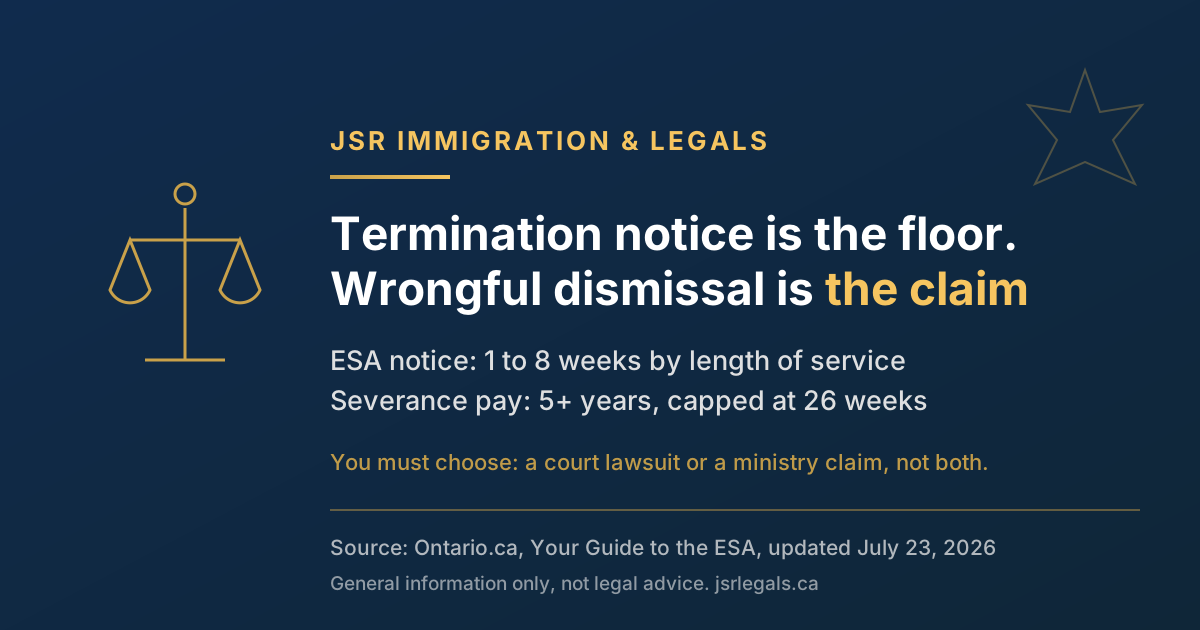
When an employer ends your job in Ontario, two different systems can apply at the same time, and people constantly mix them up. One is the minimum-entitlement system under the Employment Standards Act, 2000 (ESA): written notice of termination or termination pay. The other is the court claim people call "wrongful dismissal": a lawsuit for reasonable notice at common law, which is often worth far more than the ESA minimum. Ontario's official ESA guide, updated July 23, 2026, spells out the difference, and the distinction decides what a dismissed worker may recover.
Termination with notice: the ESA floor
Under the ESA, an employer who ends the employment of someone continuously employed for at least three months must give either written notice of termination, termination pay in lieu of notice, or a combination that adds up to the required notice. The required amount depends on the period of employment, straight from the official chart:
- Less than 1 year: 1 week
- 1 year but less than 3 years: 2 weeks
- 3 years but less than 4 years: 3 weeks
- 4 years but less than 5 years: 4 weeks
- 5 years but less than 6 years: 5 weeks
- 6 years but less than 7 years: 6 weeks
- 7 years but less than 8 years: 7 weeks
- 8 years or more: 8 weeks
During the statutory notice period, the employer may not cut the employee's wage rate or change other terms of employment, must keep contributing to benefit plans, and must pay at least the employee's regular wages for a regular work week each week. Employees with less than three months of continuous employment, and employees fired for wilful misconduct, disobedience or wilful neglect of duty that is not trivial and has not been condoned, are not entitled to this notice at all.
Separate from termination pay, severance pay under the ESA may be owed to an employee whose employment is "severed" and who has worked five or more years, if the employer has a global payroll of $2.5 million or more or severed 50 or more employees within six months because all or part of the business permanently closed. Severance pay equals one week of regular wages per completed year of service (with partial months prorated), capped at 26 weeks, and must be paid no later than seven days after the employment ends or on the next regular pay day, whichever is later.
Wrongful dismissal: the court claim
These ESA amounts are minimums, not ceilings. An employee dismissed without just cause may have greater rights under the common law, and may sue the employer in court for "wrongful dismissal" to recover pay for a reasonable notice period that can stretch to many months, depending on factors such as age, length of service, the character of the position and the availability of comparable work. A valid termination clause in an employment contract can limit these common-law rights, but only if the clause meets or beats the ESA minimums; if it fails, the full common-law entitlement may revive.
The Ontario.ca guide states the critical strategic rule plainly: an employee cannot sue an employer for wrongful dismissal and also file a ministry claim for termination pay or severance pay for the same termination. You must choose one route or the other, and the guide recommends obtaining advice before choosing. Court claims are also generally subject to a two-year limitation period.
The newest moving piece: longer temporary lay-offs
The same updated guide reflects a recent change worth knowing because it affects when a layoff legally becomes a termination. As of November 27, 2025, a temporary lay-off may extend to less than 52 weeks in any 78-week period if the employer and employee agree in writing, the agreement disclosed the latest intended recall date before signing, and, for periods past the regular limits, the Director of Employment Standards approves the extension. Once a lay-off exceeds what the rules allow, the employment is deemed terminated and termination pay may be owed.
How the pieces fit together
or termination pay in lieu] F --> G{5+ years and payroll $2.5M+
or mass closure of 50+?} G -- Yes --> H[ESA severance pay, up to 26 weeks] G -- No --> I[No statutory severance] H --> J{Common-law rights may exceed ESA minimums} I --> J J --> K[Choose one route: court lawsuit for wrongful dismissal
OR ministry claim for termination and severance pay,
not both for the same termination]
What to actually do
- Before signing a release, compare the offer against the ESA chart and severance rules, and consider the common-law alternative; the first offer is often the minimum.
- Read the termination clause, if any, in your written contract. Defective clauses may be unenforceable.
- Pick the forum deliberately. Ministry claims cost nothing and recover ESA minimums; wrongful dismissal lawsuits can recover more, but you cannot pursue both for the same termination and deadlines apply.
If you have been let go and want the difference between these routes explained for your situation, JSR Immigration and Legals can help. See our employment services page or contact us at (647) 286-4266 or info@jsrlegals.ca.
This post is general information, not legal advice, as of November 21, 2026. For advice on a specific termination, please contact JSR Legals.
Sources
- Ontario.ca, Your guide to the Employment Standards Act, Termination of employment (updated July 23, 2026): https://www.ontario.ca/document/your-guide-employment-standards-act-0/termination-employment
- Ontario.ca, Your guide to the Employment Standards Act, Severance pay: https://www.ontario.ca/document/your-guide-employment-standards-act-0/severance-pay
JSR Legals / JSR Immigration Ltd. 9300 Goreway Drive, Suite 205, Brampton, ON L6P 4N1 (647) 286-4266 info@jsrlegals.ca

Immigration & paralegal practitioner at JSR Immigration & Legals, helping newcomers and Ontario residents with their cases.
This post is general information about Canadian immigration and Ontario paralegal matters and is not legal advice. Rules change and every case is different — confirm current requirements for your own situation.