CBSA Charges Five After 243 Fraudulent Visa Applications: What Applicants Should Learn
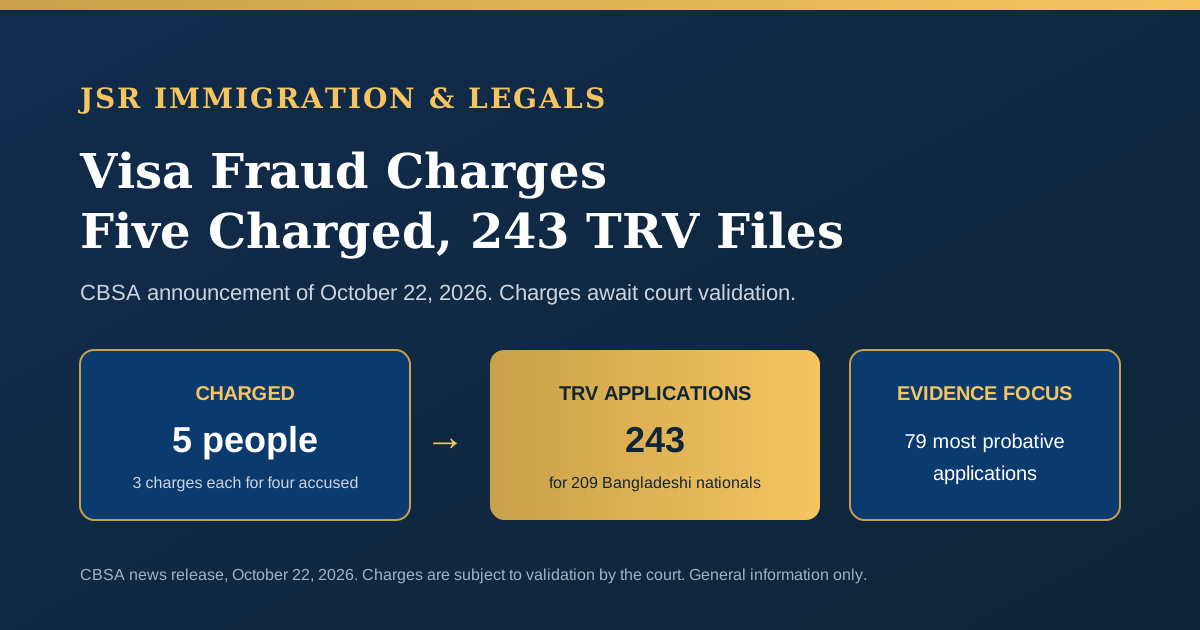
On October 22, 2026, the Canada Border Services Agency announced that five individuals have been charged in connection with an immigration fraud scheme built around temporary resident visa (TRV) applications. Four of the accused appeared at the Valleyfield courthouse in Quebec that day. A warrant has been issued for the fifth, who is reported to be in Bangladesh. The CBSA set out the case in its news release of October 22, 2026.
The numbers are large. Investigators identified 209 Bangladeshi nationals for whom 243 TRV applications had been submitted, on the basis of fraudulent documents and false statements, so that the applicants could visit Canada using Canadian citizens presented as hosts. Given the scale of the scheme, the CBSA focused its formal evidence on the 79 most probative applications.
The charges are subject to validation by the court. Nothing has been proven yet. Even so, the release is a useful warning for anyone filing a visa application through a third party.
How the case unfolded
The CBSA timeline in the release runs as follows:
- July 3, 2024: officers, with the Town of Mercier police and fire departments, conducted a compliance and control check on the occupants of a private residence in Mercier, Quebec, and noted several indications of non-compliance with the Immigration and Refugee Protection Act (IRPA).
- August 2024: the CBSA opened its investigation into the activities of the accused.
- June 3, 2025: investigators executed four search warrants in Quebec and Ontario, seizing documents and computer equipment that linked five individuals to the alleged scheme.
- October 22, 2026: four accused appeared at the Valleyfield courthouse. Three charges were laid against each of them and the fifth accused.
The three charges listed in the release are conspiracy to organize or facilitate entry into Canada contrary to subsection 117(1) of the IRPA, knowingly inducing, aiding or abetting persons to misrepresent or hide material facts relating to immigration applications contrary to section 126, and knowingly inducing, aiding or abetting persons to contravene the IRPA contrary to section 131.
The enforcement picture behind the case
The release also gives the CBSA's enforcement numbers:
| CBSA criminal investigations into suspected IRPA offences | Count |
|---|---|
| Opened in 2025 | 191 |
| Opened January 1 to June 30, 2026 | 55 |
The agency states that people who violate Canada's immigration laws face serious consequences, including administrative actions and criminal charges that can lead to fines, probation or imprisonment, and a criminal record.
What this means for you as an applicant
The alleged scheme worked through applications for genuine people, supported by false host arrangements and fraudulent documents. That is the pattern applicants should guard against, whether the file is a visitor visa, a study permit, or a work permit.
- Know what is in your application. You are responsible for the representations made in your file, even when someone else prepared it. A finding of misrepresentation under section 40 of the IRPA makes a person inadmissible to Canada, normally for five years after the final determination.
- Use an authorized representative. Check that your consultant is licensed by the College of Immigration and Citizenship Consultants, or that your legal representative is licensed by their law society, before paying anyone to prepare a TRV file.
- Read every document before you sign it. Do not sign blank forms. Keep copies of every form, letter and bank statement submitted on your behalf.
- Question a guaranteed result. No representative can promise a visa. A promise of approval is itself a warning sign.
- Report suspected fraud. The CBSA Border Watch line at 1-888-502-9060 operates Monday to Friday from 9:00 a.m. to 9:00 p.m. ET, and the agency also accepts reports through its secure web form. Reports are confidential and you do not need to give your name.
If a host, employer or consultant arranged parts of your file for you and you are unsure what was submitted, the safest step is to find out what is on record before you apply again, not after a refusal or a fairness letter.
Where JSR Immigration and Legals can help
If you have received a procedural fairness letter, been refused for misrepresentation, or want a file prepared or reviewed by a licensed professional, contact JSR Immigration & Legals through our consultation page or the visitor visa service page. If a refusal is already on your record, our immigration appeals page explains the options that may still be open.
This article is general information current to October 24, 2026, and is not legal or immigration advice. The charges described are subject to validation by the court. Confirm the live CBSA release and the IRPA before you act.

Immigration & paralegal practitioner at JSR Immigration & Legals, helping newcomers and Ontario residents with their cases.
This post is general information about Canadian immigration and Ontario paralegal matters and is not legal advice. Rules change and every case is different — confirm current requirements for your own situation.