Express Entry Category-Based Draws: Which Categories Are Active Now in 2026
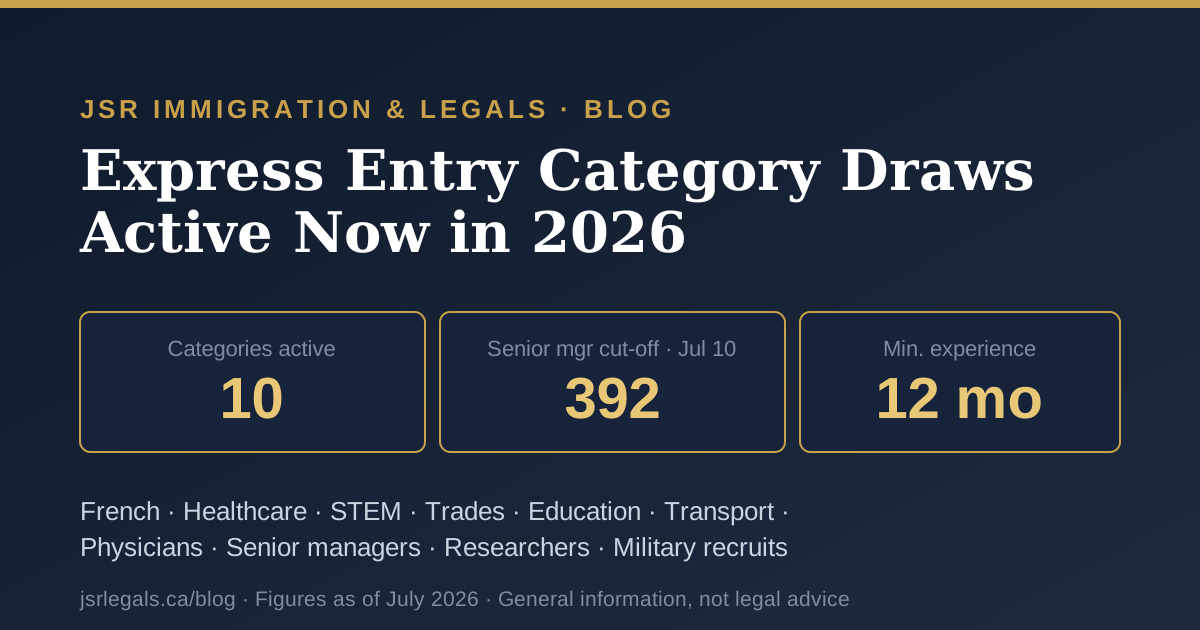
If you have been watching Express Entry this month, you have seen it in action: on July 9, 2026 IRCC invited 5,000 candidates in a French-language draw, and on July 10, 2026 it held only its second-ever draw for senior managers with Canadian work experience, issuing 500 invitations at a Comprehensive Ranking System (CRS) cutoff of just 392 — far below the scores a general round demands. Both are examples of category-based selection, the system that lets Immigration, Refugees and Citizenship Canada (IRCC) invite people by occupation or language rather than by CRS score alone.
For a lot of candidates sitting in the Express Entry pool, understanding these categories is the difference between waiting indefinitely and getting a realistic path to an invitation. Here is a plain-language guide to what is active in 2026.
What "category-based" actually means
In a general Express Entry draw, IRCC simply invites the highest-scoring candidates in the pool, whatever their background. In a category-based draw, IRCC first picks a category — say, healthcare or French — and then invites the highest-scoring candidates who meet that category's requirements. Because the category shrinks the eligible group, the cutoff can land well below a general round. That is exactly why the July 10 senior-managers cutoff of 392 was possible.
category-based round} B --> C{Do you meet the
category requirements?} C -- No --> D[Not eligible this round
· wait for a general or
matching category draw] C -- Yes --> E{Is your CRS at or above
the category cutoff?} E -- No --> F[Stay in pool · raise score
or target a PNP nomination] E -- Yes --> G[Receive an ITA in that
category round]
The 10 categories active in 2026
For 2026, IRCC confirmed ten category-based streams. Five carried over from previous years, and several were added or refreshed to target labour shortages and candidates with strong Canadian ties:
- French-language proficiency — generally NCLC 7 or higher in all four French
abilities. These draws are large, frequent, and often the lowest-cutoff route for those who qualify.
- Healthcare and social services occupations
- Science, Technology, Engineering and Math (STEM) occupations
- Trade occupations
- Education occupations
- Transport occupations
- Physicians with Canadian work experience — a newer stream for eligible
general practitioners, family physicians, and specialists.
- Senior managers with Canadian work experience — covering the senior
management NOC codes in areas like construction, transportation, health, education, and business services.
- Researchers with Canadian work experience
- Skilled military recruits — a specialized category with its own service and
arranged-employment requirements.
IRCC selects which categories to draw from throughout the year, so not every category is invited in every cycle. The official list and each category's detailed instructions live on IRCC's category-based selection page.
The eligibility detail that trips people up
For most occupation-based categories, you generally need at least 12 months of full-time (or equivalent part-time) work experience in the last three years in one of the category's eligible occupations. This is worth flagging because IRCC raised the minimum from six months to one year for the renewed 2026 categories — so experience that qualified you in an earlier year may no longer be enough. Several categories (physicians, senior managers, researchers) also require that experience to be Canadian.
A few practical points:
- Your occupation is judged by NOC code, not job title. Two people with
similar-sounding jobs can fall under different NOC codes and different categories. Confirm your code carefully.
- Meeting the category is separate from meeting your CRS. You still need a
competitive score within that category's pool; the category just changes which pool you are compared against.
- You do not apply to a category. If your Express Entry profile shows the
right occupation, language, and experience, IRCC considers you automatically when it runs that category's round.
How to use this if you're in the pool
Look honestly at where you fit. If you work in healthcare, a skilled trade, STEM, transport, or education — or you have strong French — a category draw may reach you at a score a general round never would. If you don't fit any category, your strongest levers are usually a higher language test result or a Provincial Nominee Program (PNP) nomination, which adds 600 CRS points and effectively guarantees an invitation.
You can review every 2026 round — including the July 9 French and July 10 senior-managers draws — on IRCC's official rounds of invitations page.
The bottom line
Category-based selection is one of the most important shifts in how Express Entry works, and in 2026 it spans ten distinct streams from French to skilled military recruits. Knowing which category — if any — fits your profile is often the key to turning a stalled score into a real invitation.
If you'd like help figuring out which category or provincial stream you may qualify for — and how to position your profile — contact JSR Immigration & Legals and we'll review your options together.
This article is general information only, current to July 2026, and is not legal advice. Category lists, eligibility rules, and CRS cutoffs change frequently — always confirm the current requirements with IRCC or a licensed representative before making decisions.

Immigration & paralegal practitioner at JSR Immigration & Legals, helping newcomers and Ontario residents with their cases.
This post is general information about Canadian immigration and Ontario paralegal matters and is not legal advice. Rules change and every case is different — confirm current requirements for your own situation.