November 3, 2026: Express Entry Adds a 150-Point Factor and Drops the LMIA for Job Offers
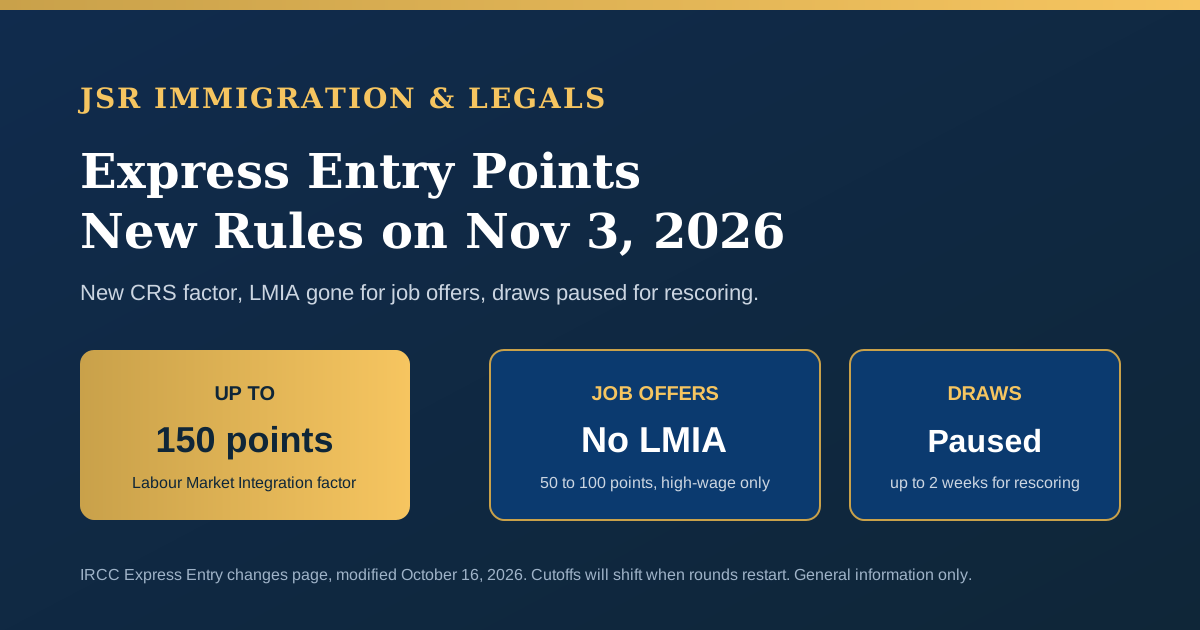
Express Entry changed on November 3, 2026. On its 2026 changes to points for Canadian work experience and job offers page, last modified October 16, 2026, IRCC confirms the new Comprehensive Ranking System (CRS) rules are in force and that it is recalculating every profile already in the pool, which could take up to two weeks. Invitation rounds are paused until that is done.
This is an implementation date, not an announcement. The direction was signalled earlier. What is new is the published point grid, the end of the LMIA for job offers, and a pause in draws that affects anyone waiting for an invitation.
The new Labour Market Integration factor
The Labour Market Integration factor is the biggest change to the CRS. It awards points for either:
- Canadian work experience, based on how long you worked, with extra points for work in eligible high-wage occupations, or
- a qualifying job offer in an eligible high-wage occupation.
You get points for one or the other, never both. IRCC compares the two and awards whichever gives you more points. The maximum is 150 points without a spouse or common-law partner and 140 points with one.
What counts as a high-wage occupation
Under Express Entry, a job is high-wage if the median wage of everyone in Canada performing that job is at least 1.3 times the average median wage of the overall Canadian work force. The test is based on the National Occupational Classification (NOC) code, not on your specific position or salary. High-wage occupations are grouped into three levels, and points follow the level.
The official point tables
Work-length points (unchanged eligibility, existing TEER 0 to 3 requirements)
| Length of Canadian work experience | With spouse (max 70) | Without spouse (max 80) |
|---|---|---|
| None or less than a year | 0 | 0 |
| 1 year | 35 | 40 |
| 2 years | 46 | 53 |
| 3 years | 56 | 64 |
| 4 years | 63 | 72 |
| 5 years or more | 70 | 80 |
High-wage occupation points, added on top of work-length points. You need at least 12 months (1,560 hours) of qualifying Canadian work experience in eligible high-wage occupations.
| Qualifying Canadian work experience | Points |
|---|---|
| 12 or more months in high-wage occupations with median wages at least 2 times the average | 70 |
| Otherwise, 12 or more months in high-wage occupations at 1.5 times or more | 40 |
| Otherwise, 12 or more months in high-wage occupations at 1.3 times or more | 20 |
| Less than 12 months in high-wage occupations | 0 |
Job offer points
| Job offer category | Points |
|---|---|
| High-wage occupation at 2 times the average median wage or more | 100 |
| High-wage occupation at 1.5 to 2 times | 70 |
| High-wage occupation at 1.3 to 1.5 times | 50 |
| Not a high-wage occupation | 0 |
The LMIA is gone for job offers
As of November 3, 2026:
- You do not need a Labour Market Impact Assessment for a job offer to count for program eligibility or CRS points.
- Having an LMIA gives you no extra points and no priority.
- Offers can be for an existing or new position, with your current or a new employer.
- Officers still assess whether the offer is genuine: the employer must be active, able to fulfil the terms, and following employment and recruitment laws, and you must be qualified and likely to take the job.
One practical trap: IRCC's online system does not yet reflect the change. In your profile you must still answer that you have a positive LMIA. IRCC's instructions say to select Yes, enter LMIA number 00000, issuance date 2026-01-01, and expiry date 2029-01-01.
For the Federal Skilled Worker and Federal Skilled Trades Programs, job offers that qualify for eligibility are not limited to high-wage occupations. An offer can make you eligible but earn zero CRS points. The two tests are separate.
What this means if you are in the pool
Rounds are paused, so there is nothing to wait for this week beyond the recalculation. When draws restart, cutoffs will move because every profile is being rescored under a different grid. Pre-November 3 cutoffs, including the October 28, 2026 round, are a weak guide.
The scores that rise fastest belong to candidates with 12 or more months of Canadian work experience in high-wage occupations, and candidates holding high-wage offers that no longer need an LMIA. If neither describes you, a provincial nomination still adds 600 points.
If you want your profile assessed against the new grid, contact JSR Immigration & Legals through our consultation page or the Express Entry service page.
This article is general information current to November 15, 2026, and is not legal or immigration advice. Confirm the live tables and instructions on Canada.ca before you rely on them.

Immigration & paralegal practitioner at JSR Immigration & Legals, helping newcomers and Ontario residents with their cases.
This post is general information about Canadian immigration and Ontario paralegal matters and is not legal advice. Rules change and every case is different — confirm current requirements for your own situation.