Express Entry Now Counts Stipends and Grants: What Changes for Researchers on November 18, 2026
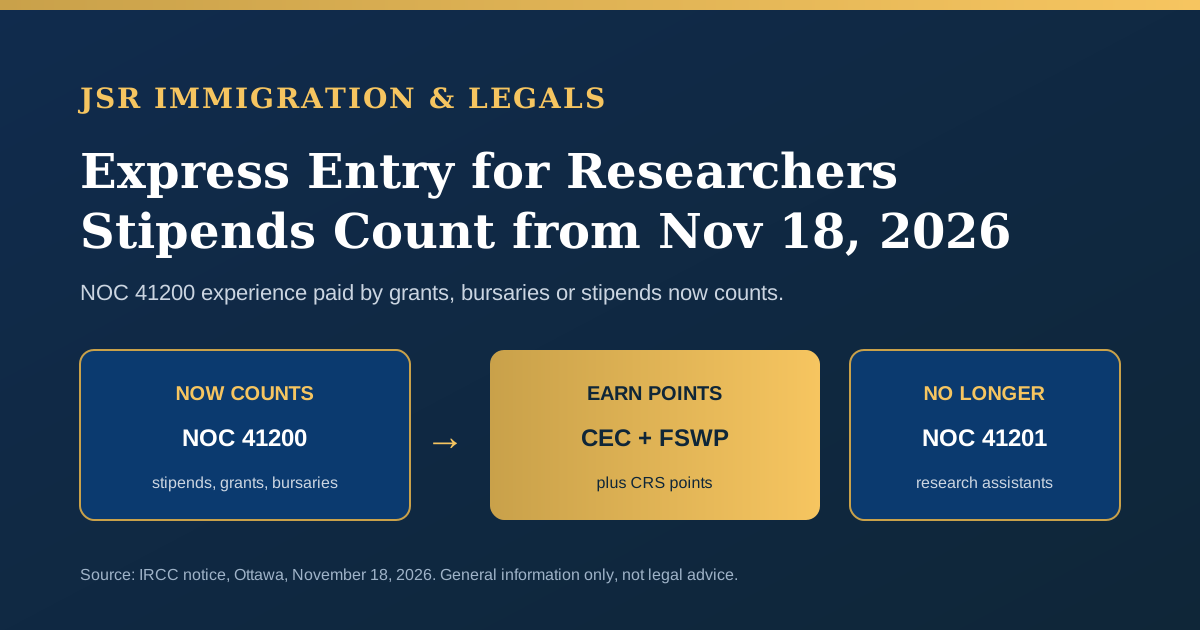
On November 18, 2026, IRCC published a notice updating the eligibility criteria for the researchers with Canadian work experience category in Express Entry. Under the new rules, IRCC will now recognize Canadian work experience and job offers from university professors and lecturers (NOC 41200) who are paid by Canadian entities through stipends, grants, bursaries or scholarships. That experience can now be counted toward the work experience requirements of the Canadian Experience Class and the Federal Skilled Worker Program, and qualifying work experience or job offers will also earn Comprehensive Ranking System (CRS) points.
This matters because many researchers are not paid a conventional salary. A post-doctoral fellow funded by a research grant, or a lecturer paid through a stipend, previously risked having that experience treated as if it were not work at all. IRCC’s update, published on its notice page and dated November 18, 2026, fixes that gap for the research category it announced earlier this year.
There is a second, narrower change in the same notice, and it works in the opposite direction: work experience in NOC 41201 (post-secondary teaching and research assistants) will no longer be eligible for the researchers category. IRCC says this keeps the category focused on candidates with experience in university-level academic and research roles, including professors, lecturers and post-doctoral researchers.
What the update actually says
Taking the notice point by point:
- Who benefits: university professors and lecturers in NOC 41200 whose Canadian academic work was paid through stipends, grants, bursaries or scholarships, rather than a wage.
- What counts now: eligible Canadian experience paid in this way can be counted toward the work experience requirements of the Canadian Experience Class (CEC) and the Federal Skilled Worker Program (FSWP).
- Points: candidates with qualifying work experience or job offers will also receive CRS points under this update.
- Who loses ground: experience as a post-secondary teaching or research assistant (NOC 41201) no longer qualifies for the researchers category.
- Action required: IRCC’s notice says candidates with qualifying Canadian experience should update their Express Entry profile to reflect it.
Why this arrived now
The update follows the wider Express Entry overhaul that took effect on November 3, 2026, which rewrote how job offers and Canadian work experience earn points under the new Labour Market Integration factor. We covered that grid in our November 3 Express Entry changes explainer. The researchers update extends the same logic: recognize real academic compensation structures instead of forcing researchers into a wage-based framework that never fit them.
Filing dates, program dates, and what to do first
This is an eligibility-criteria update to a category-based Express Entry category, not a new fee or deadline change. The date that matters is when IRCC starts applying the updated criteria to profiles and future invitation rounds for the researchers category. Unlike the study permit living-cost table, there is no separate filing-date rule here: the change operates through how IRCC assesses work experience and job offers against the updated criteria.
If any part of your Canadian academic record was paid through a stipend, grant, bursary or scholarship, the single most useful step is to update your Express Entry profile now, exactly as the notice instructs. A stale profile understates your experience, and you cannot rely on IRCC inferring it.
What this does not do
Be precise about the limits:
- It does not create a new stream, a new draw, or a guaranteed invitation.
- It does not make every academic stipend count; the role must be within NOC 41200 and paid by Canadian entities.
- It does not restore eligibility for NOC 41201 experience in the researchers category; that experience is excluded going forward.
- It does not override the rest of the November 3, 2026 CRS grid, including the high-wage occupation points and the end of the LMIA requirement for job offers.
What this means if you are a researcher in the pool
If you are a professor, lecturer or post-doctoral researcher with Canadian experience that was previously invisible because of how you were paid, this update can materially change your CRS score and your eligibility under CEC and FSWP. Update your profile, gather the payment records, grant agreements or scholarship letters that show the source and duration of the compensation, and check how the November 3 grid treats your experience.
If you want your academic profile assessed against the updated category, contact JSR Immigration & Legals through our consultation page or the Express Entry service page.
This article is general information current to November 20, 2026, and is not legal or immigration advice. Confirm the live notice and category instructions on Canada.ca before you rely on them.

Immigration & paralegal practitioner at JSR Immigration & Legals, helping newcomers and Ontario residents with their cases.
This post is general information about Canadian immigration and Ontario paralegal matters and is not legal advice. Rules change and every case is different — confirm current requirements for your own situation.