Express Entry Proof of Funds in 2026: How Much You Need and Who's Exempt
If you're in the Express Entry pool, one of the quietest ways to lose a permanent-residence application is to get the proof of funds wrong. It isn't about your skills or your CRS score — it's a simple eligibility gate, and Immigration, Refugees and Citizenship Canada (IRCC) updated the settlement-fund table again for 2026. If the numbers in your profile are out of date, you can be found ineligible even after receiving an invitation.
This post is a plain-language guide to what "proof of funds" means in 2026, how much you need, who's exempt, and the most common mistakes that turn an otherwise strong application into a refusal. It's general information, not legal advice — always confirm the current figures on the official IRCC proof-of-funds page before you act.
What "proof of funds" actually is
Proof of funds is money you must show you can access to settle in Canada — to cover living costs while you get established. It is separate from your application fees and travel costs, and it has nothing to do with the value of your house or car back home. IRCC wants to see liquid, available money: cash in the bank, or assets you can readily convert to cash.
The required amount is tied to family size and is recalculated periodically based on 50% of Canada's Low Income Cut-Off (LICO). Because LICO shifts, the table changes — which is why a number you entered a year ago may no longer be valid.
The 2026 amounts
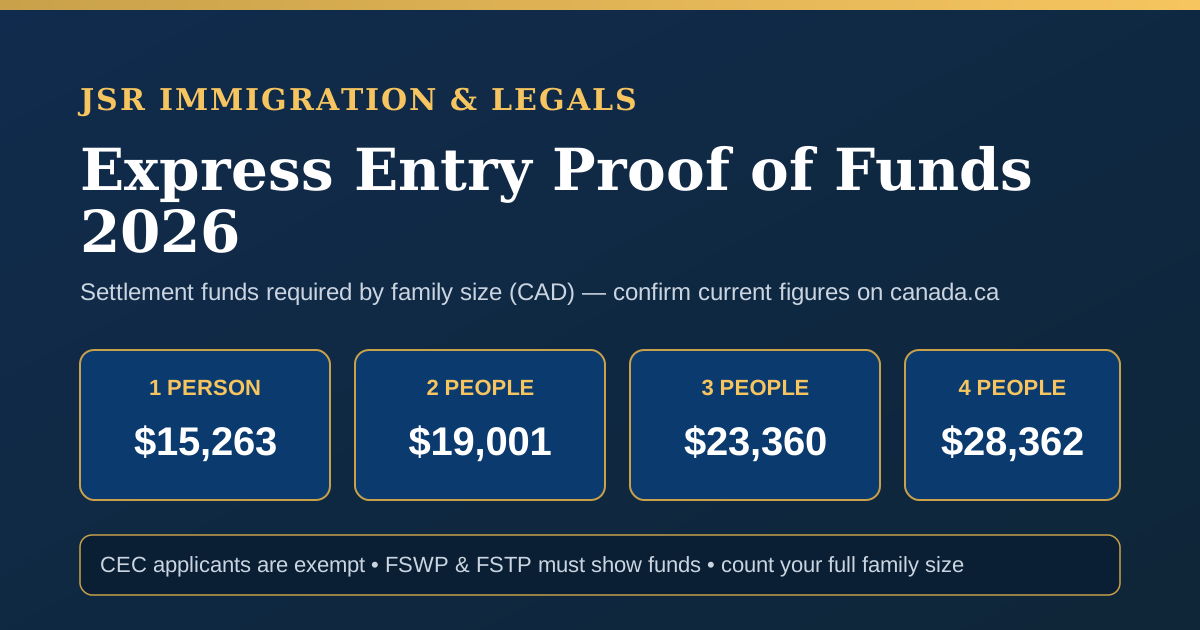
Below are the settlement-fund amounts reflected in IRCC's most recent 2026 update. Treat these as a guide and verify the live figures on canada.ca, because IRCC can revise them without much notice.
| Family size | Funds required (CAD) |
|---|---|
| 1 | $15,263 |
| 2 | $19,001 |
| 3 | $23,360 |
| 4 | $28,362 |
| 5 | $32,168 |
| 6 | $36,280 |
| 7 | $40,392 |
| Each additional member | + $4,112 |
A crucial detail: your family size includes your spouse and all dependent children — even if they are not coming with you to Canada, and even if they are already Canadian citizens or permanent residents. People routinely under-count here and fall short.
Who needs to show it — and who doesn't
This is where many applicants get tripped up. Proof of funds depends on which program your invitation comes under, not on which programs you might qualify for.
- Federal Skilled Worker Program (FSWP) — must show proof of funds.
- Federal Skilled Trades Program (FSTP) — must show proof of funds.
- Canadian Experience Class (CEC) — exempt.
- FSWP/FSTP applicants who are already authorized to work in Canada and have a valid job offer — generally exempt.
AND valid job offer?} D -- Yes --> C D -- No --> E[Must show settlement funds
for your full family size] E --> F[Use a bank letter on letterhead
showing balances and any debts]
The catch: if you qualify for both CEC and FSWP, the program named on your Invitation to Apply (ITA) is what governs. An FSWP invitation requires proof of funds even if you have Canadian work experience that would otherwise have made you CEC-eligible. Read your ITA carefully.
How to document it properly
IRCC doesn't want a screenshot of your banking app. The gold standard is an official letter from your financial institution, printed on its letterhead, that includes:
- the bank's contact information,
- your account numbers and the date each was opened,
- the current balance, and
- the average balance over the past six months, plus any outstanding debts (loans, lines of credit, credit-card balances).
That last point matters because the funds must be yours, available, and unencumbered. Money you've borrowed doesn't count, and a large unexplained deposit days before you apply invites questions. Officers look for stable, genuinely available funds — not money parked temporarily to hit the threshold.
The common refusal traps
A few patterns account for most proof-of-funds problems:
- Stale numbers in the profile. You entered the right amount in 2025, the table rose in 2026, and you never updated it. Update your settlement-fund figure in your profile whenever the table changes — before an invitation, if you can.
- Under-counting family size. Forgetting a non-accompanying spouse or child puts you below the line.
- Borrowed or temporary funds. Last-minute transfers and undocumented "gifts" raise red flags.
- Wrong assumption about CEC. Some applicants assume they're exempt, then get an FSWP invitation and scramble.
If your funds genuinely sit just below the line, the fix is usually time and documentation, not a quick deposit — build a six-month history that comfortably clears the requirement for your family size.
The bottom line
Proof of funds is one of the few parts of Express Entry entirely within your control. Confirm whether your program even requires it, count your full family size, use a proper bank letter, and keep your numbers current as IRCC updates the table through 2026. Getting this right is far cheaper than a refusal and a fresh application.
If you'd like help confirming whether the proof-of-funds rule applies to your situation, or reviewing your settlement-fund documents before you submit, get in touch with JSR Immigration & Legals — we're happy to walk you through it.
This article is general information about Canadian immigration, not legal advice. Rules and figures change; confirm current requirements with IRCC or a licensed representative for your specific situation.

Immigration & paralegal practitioner at JSR Immigration & Legals, helping newcomers and Ontario residents with their cases.
This post is general information about Canadian immigration and Ontario paralegal matters and is not legal advice. Rules change and every case is different — confirm current requirements for your own situation.