October 20, 2026: Federal Equal Treatment Pay Rules Are Now in Force
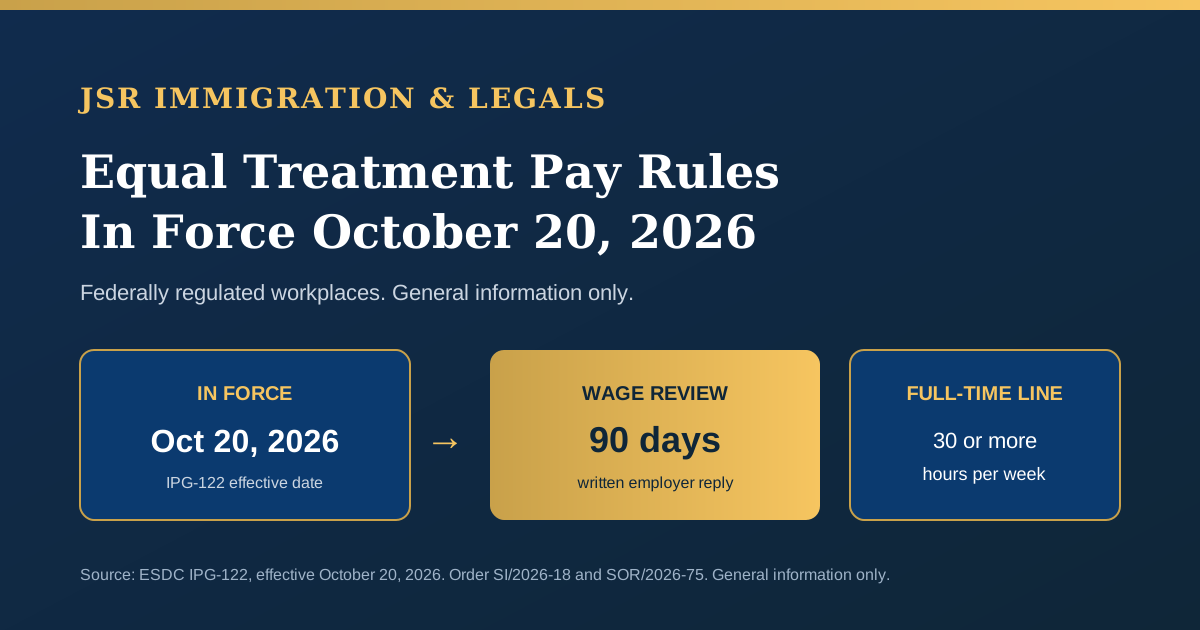
On October 20, 2026, a federal equal treatment rule took effect for wages. Equal Treatment, IPG-122 states that date on the page. A federally regulated employer is prohibited from paying one employee a lower rate of wages than another because of employment status, when the employees do substantially the same work, in the same industrial establishment, with substantially the same skill, effort, and responsibility, under similar working conditions.
Order SI/2026-18 was made on April 23, 2026 (P.C. 2026-380) and registered on May 6, 2026. It fixes the in-force day as the 180th day after April 23, 2026. That day is October 20, 2026. The Order brings in the Code amendments, including sections 182.1 to 182.4. SOR/2026-75, registered April 23, 2026, comes into force on the same day.
Who this covers
Part III of the Canada Labour Code sets hours, wages, vacations, and holidays. The Order's explanatory note lists railways, shipping, interprovincial trucking and buses, airports and airlines, ports, telecommunications and broadcasting, banks, grain handling, uranium mining, and First Nations band councils. Part III does not apply to the federal public service. Other workplaces, over 90% of the Canadian workforce, are under provincial or territorial jurisdiction.
Check the list of federally regulated industries before you treat a job as covered. An Ontario restaurant, shop, or most local offices follow the Employment Standards Act, 2000. Ontario's equal pay guide, updated July 8, 2024, frames the ESA rule as equal pay on the basis of sex.
Employment status, in the regulation
Section 11.3 of SOR/2026-75 treats every branch in the same Employment Insurance economic region as one industrial establishment. Section 11.5 limits the comparison to one type of rate: time, mileage, piece, per load, or commission. Section 11.2 defines the four statuses.
| Term | Rule in section 11.2 |
|---|---|
| Full-time | The collective agreement, or else the contract. If neither addresses it, a communicated employer policy. Otherwise, usually 30 or more hours a week, or an average of 30 or more on an averaging plan or modified schedule. |
| Part-time | Not full-time. |
| Permanent | An indeterminate period. |
| Temporary | A fixed term, or seasonal, casual, or irregular work. |
IPG-122 says "employees" includes interns. Student interns are outside these provisions.
Exceptions, then the 90-day review
A gap can stand when a system based on seniority, merit, or quantity or quality of production explains it, or when section 11.6 does. The system must cover every comparable employee, and the particulars must be in writing or readily available. Section 11.6 allows a maintained rate after a reclassification or demotion until the new rate catches up, a higher rate during a skilled-worker shortage, and differences tied to geography or travel status.
The employer may not cut a rate to comply. The lower rate moves up.
An employee may ask for a wage review. The employer has 90 days to reply in writing: either the current rate complies, with reasons, or the rate has been increased. A Labour Program complaint waits for that reply or for day 90. The Order's note on subsection 251.01(2.1) then allows six months to complain, from the earlier of the reply and the end of the 90 days. With no review request, the six months run from when the employee knew, or ought to have known, of the circumstances. That time can be extended.
Section 501 limits a payment order to the period back to the earlier of the complaint and the review request. October 20, 2026 is when the prohibition applies. The order's start date is the request or the complaint, whichever comes first.
Section 518 gives collective agreements already in effect, where they allow status-based wage differences, up to two years before the new rule prevails.
What to do with a pay gap now
- Confirm jurisdiction. Federal workplaces use IPG-122 and SOR/2026-75. Ontario workplaces under the ESA use the July 8, 2024 equal pay guide.
- Date the review request. Both the 90-day reply and the payment-order look-back use it.
- Ask for the pay system in writing. An unshared seniority or merit system misses section 11.2(3).
- The lower rate is the one that rises. IPG-122 bars a cut to the higher rate.
- If a current collective agreement allows the gap, read section 518 before treating that clause as spent on October 20.
For help sorting a federal workplace from an Ontario ESA workplace, contact JSR Immigration & Legals through the consultation page or the employment service page.
This article is general information current to October 26, 2026, and is not legal advice. Confirm IPG-122, Order SI/2026-18, and SOR/2026-75 before you act.

Immigration & paralegal practitioner at JSR Immigration & Legals, helping newcomers and Ontario residents with their cases.
This post is general information about Canadian immigration and Ontario paralegal matters and is not legal advice. Rules change and every case is different — confirm current requirements for your own situation.