Canada's New Representative Penalties Are in Force: Fines Up to $1.5 Million
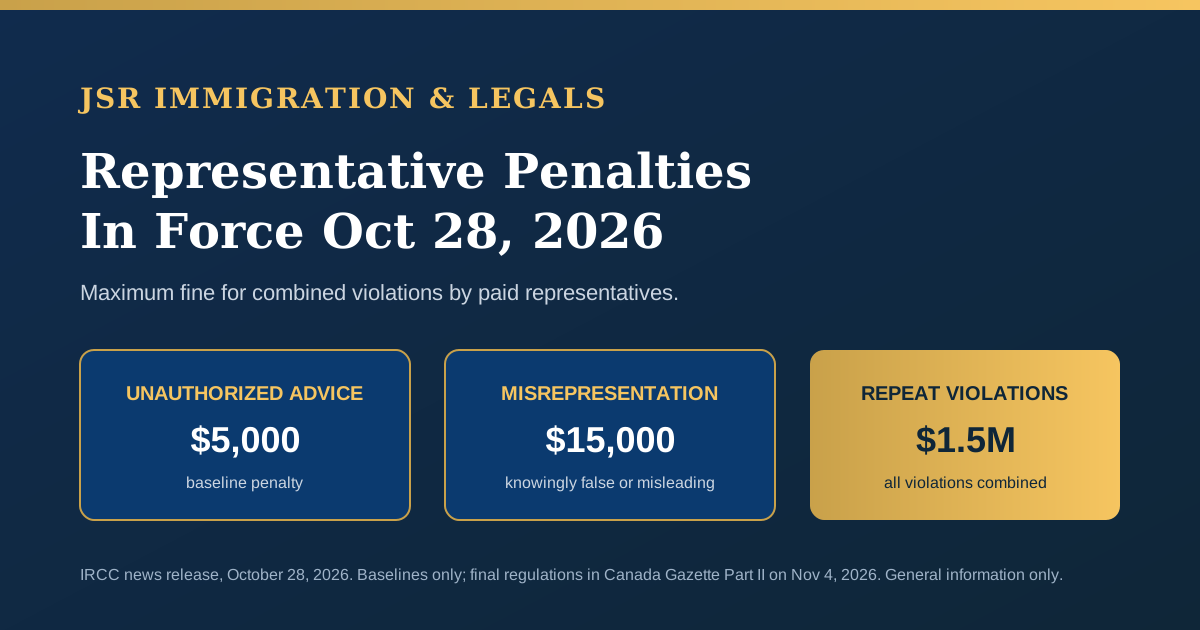
Paid immigration and citizenship representatives in Canada now face a new kind of consequence. On October 28, 2026, Immigration, Refugees and Citizenship Canada (IRCC) confirmed that new monetary penalties of up to $1.5 million are in force for anyone who breaks the law when providing paid immigration or citizenship advice or representation.
The announcement, published as an IRCC news release dated October 28, 2026, is aimed squarely at representative misconduct. It does not create a new program, a new pathway, or a new deadline for applicants. What it changes is the price of dishonesty for the people applicants pay to help them.
What changed on October 28, 2026
Starting October 28, 2026, the government can impose monetary penalties including:
- $5,000 for providing paid advice or representation without authorization
- $15,000 for knowingly providing false or misleading information on an applicant's behalf, or helping an applicant do so
Additional penalties may apply if an application is approved based on false or misleading information. Penalties also increase for repeat violations, up to a maximum of $1.5 million for all violations combined.
The rules apply to paid representatives of every kind. That includes licensed immigration consultants, lawyers and other authorized representatives, and people who provide paid immigration or citizenship advice or representation without any authorization at all. IRCC's position is that location does not matter: an agent outside Canada who charges for immigration advice falls within the same scope.
This is a conduct rule, not a filing rule. It applies to what a representative does, not to when you submit your own application. For applicants, the filing-date logic that matters is different: the regulations reach only misconduct occurring after they came into force, so past conduct is not retroactively penalized under this system.
The official penalty figures
| Violation | Baseline penalty |
|---|---|
| Providing paid advice or representation without authorization | $5,000 |
| Knowingly providing false or misleading information on an applicant's behalf, or helping an applicant do so | $15,000 |
| Failing to provide documents required during a compliance inspection (per IRCC guidance) | $10,000 |
The figures in the news release are baseline amounts, not automatic flat fines. IRCC's detailed guidance sets out a calculation that adds impact and financial advantage to the baseline, then applies a multiplier based on the representative's history of violations. Profit from a violation is added on top. That is how repeated misconduct can climb toward the $1.5 million ceiling per notice.
How the enforcement process works
IRCC's guidance describes a structured process before any final penalty:
allegations and proposed penalty] E --> F[30 days to respond in writing
or request an extension] F --> G{Breach established on
balance of probabilities?} G -- Yes --> H[Notice of violation with penalty] G -- No --> I[No penalty] H --> J[30 days to request review of the finding,
the amount, or both] J --> K[Reviewer confirms, reduces,
or cancels the penalty]
The system is administrative. It sits alongside professional discipline by regulators such as the College of Immigration and Citizenship Consultants and the law societies, and alongside criminal investigation by the Canada Border Services Agency and the RCMP for offences such as fraud and counselling misrepresentation. A penalty under these regulations does not replace those processes.
A public registry is coming in 2027
As penalties are issued, IRCC will publish the names of those penalized and the details of their violations on its website. The online registry is expected to launch in 2027, following the administration of the first penalties. Planned disclosures include the representative's name, business or employer, the type of violation, the penalty amount, and payment status.
The department also notes that if someone believes they are being incorrectly penalized, they can submit a request to have the penalty reviewed through a formal process.
Two regulatory milestones are worth noting. The draft regulations were published in the Canada Gazette, Part I, on December 21, 2024. The final regulations will be posted in the Canada Gazette, Part II, on November 4, 2026.
What this means if you are an applicant
The rule change does not shift your legal obligations, but it does sharpen the practical ones:
- Verify before you pay. Only RCICs in good standing with the College of Immigration and Citizenship Consultants, lawyers and Ontario paralegals in good standing with their law society, and Quebec notaries may charge for immigration advice. IRCC's choose a representative page links to every register.
- Read what is filed in your name. You remain responsible for your application. If a representative inserts false or misleading information, misrepresentation findings against the applicant, including refusals and multi-year bans, remain a separate and serious risk. We covered that five-year ban risk in our July 2026 consultant rules post.
- Report misconduct. IRCC maintains a process to file a complaint against a representative. With penalties now in force, complaints have real teeth behind them.
If you are preparing an Express Entry profile, a work permit, or a study permit, and you want your file reviewed by an authorized representative, contact JSR Immigration & Legals through our consultation page or the work permit service page. Jugraj Singh Randhawa is a Regulated Canadian Immigration Consultant and a Law Society of Ontario licensed paralegal, and every file is handled in-house.
This article is general information current to October 29, 2026, and is not legal or immigration advice. Confirm the live rules on Canada.ca before you act.

Immigration & paralegal practitioner at JSR Immigration & Legals, helping newcomers and Ontario residents with their cases.
This post is general information about Canadian immigration and Ontario paralegal matters and is not legal advice. Rules change and every case is different — confirm current requirements for your own situation.