IRCC Rescinds the C20 'Already Employed Abroad' Rule: Reciprocal Work Permits Are Open to New Hires Again
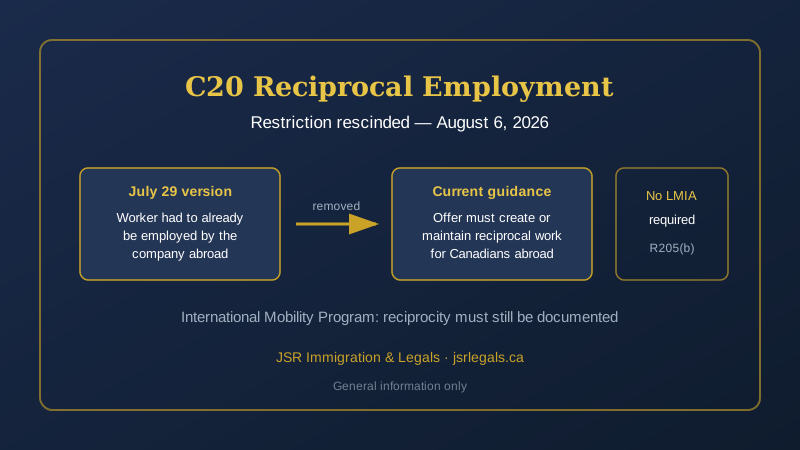
If your employer was told in late July that a reciprocal employment work permit was suddenly off the table for a new hire, the rule that caused that problem is no longer in the official guidance. IRCC's reciprocal employment general guidelines for C20 now carry a page date of August 6, 2026, and the sentence requiring a foreign national to already be employed by the company abroad is gone.
We wrote about the restrictive July 29 version in our earlier post on the C20 changes. That post described the guidance as it stood at the time. This post updates it: the requirement described there is not in the current instructions.
What the current guidance actually says
C20 is an administrative code under paragraph R205(b) of the Immigration and Refugee Protection Regulations. It allows an employer-specific work permit without a Labour Market Impact Assessment where the Canadian job creates or maintains reciprocal employment for Canadian citizens or permanent residents in other countries.
The eligibility section on the current page says only that the applicant must have an offer of employment that would create or maintain that reciprocal employment. Two points in the guidance matter for multinational employers:
- Reciprocity does not have to be directly between two countries. The guidance uses a multinational company as its example: it can show it creates or maintains similar opportunities for Canadians at different offices around the world.
- Officers must be satisfied that eligibility requirements are met at the time of the decision on the work permit application.
There is no longer any text stating that employment beginning only on arrival in Canada disqualifies the application.
Why the rule disappeared
IRCC has not published a news release explaining the reversal. According to reporting by CIC News, a departmental statement circulated among immigration lawyers said the July 29 text "was posted in error due to a version control issue and does not reflect the intended policy," and the corrected version went up on August 6. Several immigration law firms published client alerts to the same effect.
Because there is no public IRCC statement, treat the reason as reported rather than officially confirmed. What can be verified directly is the guidance page: the restrictive language is not there, and the page carries an August 6, 2026 date.
How reciprocity is assessed
Removing the "employed abroad" rule does not make C20 easy. Reciprocity still has to be documented. The guidance tells officers to look for evidence such as an exchange agreement, a letter from the receiving Canadian institution, the offer of employment itself where it shows reciprocity, or — for cultural agreements — a letter from the appropriate governing body.
On the numbers, exact one-for-one exchange is not required, but the general order of magnitude should be reasonably similar on an annual basis. The guidance gives an illustration: for exchanges involving more than about 25 foreign nationals, officers could require a higher minimum proportion of Canadians employed abroad — such as at least 75 percent. Where an organization has no history of reciprocal exchanges with Canada, it is reasonable to limit permits initially to a small number of people and issue more only once reciprocity has been demonstrated. Established programs get more flexibility year to year, provided the exchanges balance out over a reasonable period, such as five years. A company's HR plan or international mobility policy is named as a useful starting point for showing a genuine exchange program exists.
reciprocal work for Canadians abroad?} B -- No --> C[C20 not available
consider LMIA or another IMP code] B -- Yes --> D[Document reciprocity
agreement, HR policy, letters] D --> E{Officer satisfied at
time of decision?} E -- No --> F[Refusal, or notice that
an LMIA is required] E -- Yes --> G[C20 work permit issued
LMIA-exempt]
Practical points for employers and applicants
- Pending applications. Files are being assessed under the restored guidance. The fact that the worker is not currently employed by the organization outside Canada should not, on its own, drive a negative assessment.
- Plans changed in early August. If an assignment was restructured or moved to an LMIA route only because of the July 29 text, it is worth re-examining whether C20 fits again.
- A refusal in that window. If a C20 application was refused on the basis of the withdrawn language, the options available depend heavily on the wording of the decision and the timelines that apply. That is a situation to review with a licensed professional promptly, because remedies are time-limited.
- Fees. The guidance lists a work permit processing fee of $155, an employer compliance fee of $230, and an $85 biometric fee where applicable. Cultural agreement applications are noted as fee-exempt.
- Family members. Spouses and common-law partners of workers in high-skilled occupations may be eligible for an open work permit under a separate code, C41.
- Coaches and athletes. In the example dealing with professional and semi-professional coaches and athletes, the guidance refers to that group's code as "C20 (now C26)," so confirm the correct code for those files.
The wider lesson is procedural. Program delivery instructions are officer guidance, not regulations, and they can be edited without notice. If a filing strategy depends on a specific sentence in an IRCC manual, save a dated copy of the page you relied on.
If you are assessing whether a transfer or new hire fits the reciprocal employment category, or you received a decision during the late-July window, contact JSR Immigration & Legals to review the file.
This article is general information, not legal or immigration advice. Officer guidance, fees, and codes change. Confirm the current requirements on the official Government of Canada pages before you apply.

Immigration & paralegal practitioner at JSR Immigration & Legals, helping newcomers and Ontario residents with their cases.
This post is general information about Canadian immigration and Ontario paralegal matters and is not legal advice. Rules change and every case is different — confirm current requirements for your own situation.