Ontario's Move Over Law Expands to Work Vehicles January 1, 2027: What Drivers Must Do
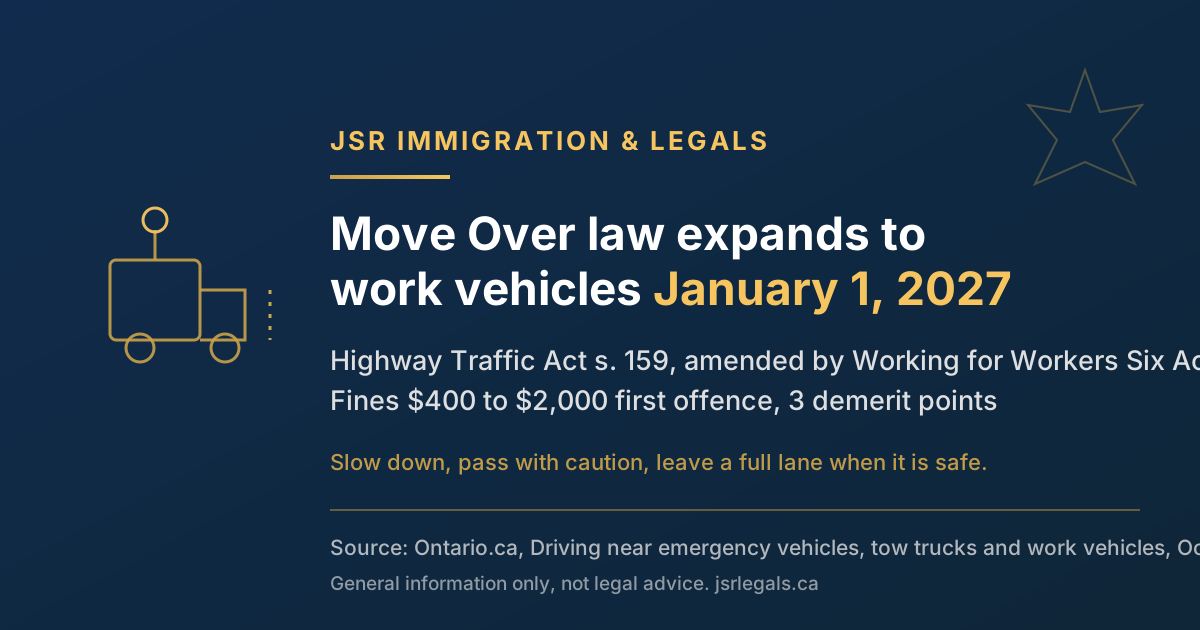
Ontario's Slow Down, Move Over rule is about to cover far more vehicles than most drivers realize. Starting January 1, 2027, drivers must slow down and move over for certain stopped work vehicles with flashing amber lights, the same way the law already requires for police cars, fire trucks, ambulances and tow trucks. The change comes from an amendment to section 159 of the Highway Traffic Act made by the Working for Workers Six Act, 2024, which has been proclaimed and comes into force on January 1, 2027.
Ontario's Ministry of Transportation updated its official guidance page on October 15, 2026, and a November 15, 2026 road safety campaign led by CAA together with the Ministry, the OPP and police partners is now telling drivers what the expanded law means in practice.
Which vehicles are covered
The expansion covers stopped work vehicles displaying flashing amber lights, including:
- highway maintenance vehicles
- public utility vehicles, such as electricity, water, natural gas and telecommunications
- waste collection vehicles, including garbage, recycling and organic waste trucks
- roadside assistance vehicles, like CAA or other providers
Until the end of 2026, the move over duty applies to emergency vehicles and tow trucks. From January 1, 2027, a garbage truck collecting on a residential street, a utility crew repairing a hydro line or a roadside assistance vehicle helping a stranded driver can all trigger the same legal duty.
What drivers must do
The requirement is the same as for emergency vehicles and tow trucks. When approaching a stopped work vehicle with flashing amber lights:
- Slow down.
- Pass with caution.
- If the road has two or more lanes travelling in your direction, you must leave a full lane of space between you and the stopped vehicle, if you can do so safely.
If moving over is not safe, for example in heavy traffic or on a narrow single-lane road, the duty is to slow down and pass with caution. The law does not require an unsafe lane change; it requires you to give roadside workers room when you safely can.
Penalties
The penalties for failing to slow down, move over or allow an emergency vehicle to pass already exist, and Ontario has confirmed they apply to stopped work vehicles with flashing amber lights as of January 1, 2027.
First offence:
- fines ranging from $400 to $2,000
- 3 demerit points if convicted
- possible suspension of your driver's licence for up to 2 years
Subsequent offences within 5 years:
- fines ranging from $1,000 to $4,000
- 3 demerit points if convicted
- possible jail time of up to 6 months
- possible suspension of your driver's licence for up to 2 years
A fine is only part of the cost. A conviction may also affect insurance premiums, and demerit points stay on your record for the purposes insurers and the Ministry consider. Charges under the Highway Traffic Act are prosecuted under the Provincial Offences Act, and a driver may dispute a ticket, but outcomes are never guaranteed and depend on the facts of each case.
A timeline of the change
What this means in practice
For everyday drivers, the practical rule from January 1, 2027 is simple: flashing amber lights at the roadside mean slow down, and move over a full lane when it is safe. The most common situations will be waste collection trucks on collection day, utility and telecom crews, and roadside assistance vehicles, not just police and tow trucks.
For people who drive for a living, delivery drivers and commuters on multi-lane roads, the lane-change duty is the part most likely to be missed. A charge for failing to move over may be laid after a single pass, and the fine range and licence suspension risk are serious for anyone who depends on driving.
If you have been charged with failing to slow down or move over, or any Highway Traffic Act offence, JSR Immigration and Legals can review your ticket and explain your options. See our traffic ticket services page or contact us at (647) 286-4266 or info@jsrlegals.ca.
This post is general information, not legal advice, as of November 16, 2026. For advice on a specific matter, please contact JSR Legals.
Sources
- Ontario Ministry of Transportation, Driving near emergency vehicles, tow trucks and work vehicles, updated October 15, 2026: https://www.ontario.ca/page/driving-near-emergency-vehicles-tow-trucks-and-work-vehicles
- Working for Workers Six Act, 2024, S.O. 2024, c. 41 (Highway Traffic Act amendment, s. 159), in force January 1, 2027
- CAA South Central Ontario and Ministry of Transportation news release, November 15, 2026: https://www.newswire.ca/news-releases/caa-brings-road-safety-partners-and-first-responders-together-to-urge-drivers-to-slow-down-and-move-over-838554294.html
JSR Legals / JSR Immigration Ltd. 9300 Goreway Drive, Suite 205, Brampton, ON L6P 4N1 (647) 286-4266 info@jsrlegals.ca

Immigration & paralegal practitioner at JSR Immigration & Legals, helping newcomers and Ontario residents with their cases.
This post is general information about Canadian immigration and Ontario paralegal matters and is not legal advice. Rules change and every case is different — confirm current requirements for your own situation.