Canada Proposes Extending the Foreign Buyer Ban on Existing Homes to January 1, 2029
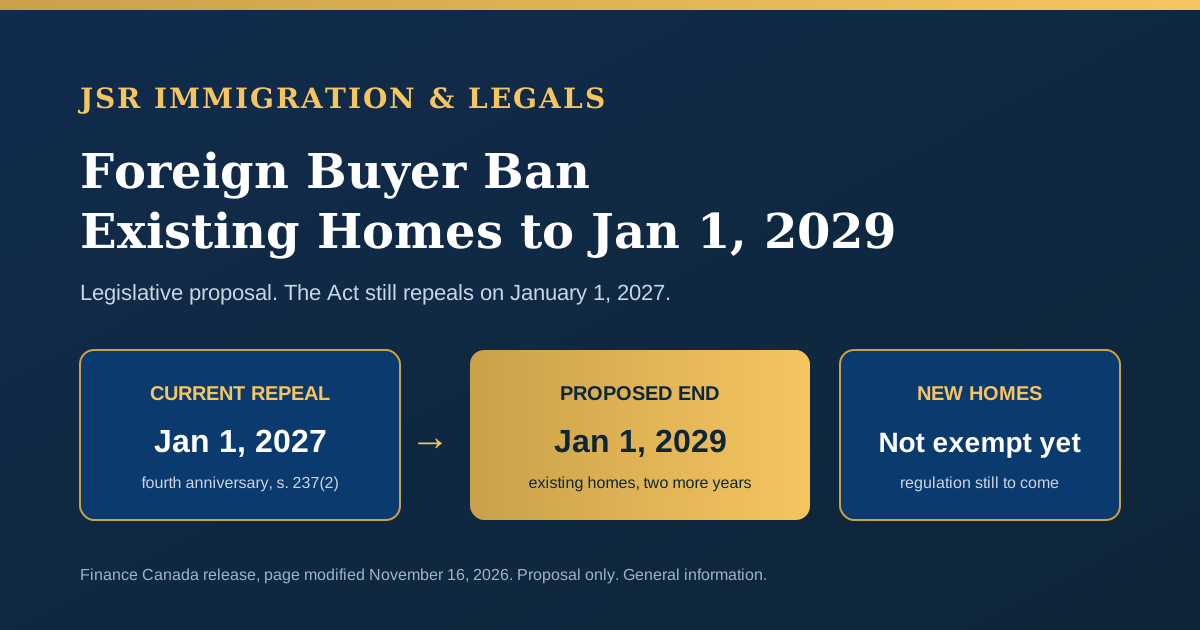
On November 16, 2026, the Department of Finance Canada published a news release stating that the government has moved legislative proposals that would extend the ban on foreign purchases of existing residential properties for two years, to January 1, 2029. The same release says the government will launch a regulatory process to exempt new residential properties. The page metadata lists the release as issued and modified on 2026-11-16.
That date is the announcement. The Prohibition on the Purchase of Residential Property by Non-Canadians Act is still in force. Section 235 of the Budget Implementation Act, 2022, No. 1 came into force on January 1, 2023. Section 236, which repeals the prohibition Act, is marked not in force. Section 237(2) says that repeal comes into force on the fourth anniversary of that day, which is January 1, 2027. Justice Laws lists the Act as current to 2026-10-29. January 1, 2029 replaces January 1, 2027 only if Parliament amends the statute.
What the November 16 release says
- Existing homes. The ban on foreign purchases of existing residential properties would run for another two years, to January 1, 2029.
- New homes. The government will launch a regulatory process "in short order" to exempt new residential properties. No such regulation is on the Justice Laws consolidation. A pre-construction purchase is still read against the Act and the regulations in force today.
Four dates, four jobs
| Date | What it is |
|---|---|
| November 16, 2026 | The day Finance Canada issued the release. The page metadata was modified the same day. The statute is unchanged. |
| January 1, 2023 | The day section 235 brought the Act into force. |
| January 1, 2027 | The current repeal date: the fourth anniversary in section 237(2). |
| January 1, 2029 | The end date in the November 16 proposal for existing residential properties. It is not yet the law. |
The regulations treat the acquisition, with or without conditions, of a legal or equitable interest or a real right in a residential property as a purchase. Section 5 uses the date of purchase, and for students the year in which the purchase was made. Use the statute in force on that date.
Who the Act treats as a non-Canadian
Section 2 includes an individual who is neither a Canadian citizen, nor a person registered as an Indian under the Indian Act, nor a permanent resident. Certain corporations and prescribed entities are included as well.
Section 4(1) prohibits a non-Canadian from purchasing, directly or indirectly, any residential property. Section 4(2) lists exceptions: a temporary resident who satisfies the prescribed conditions; a protected person; a non-Canadian who buys with a spouse or common-law partner who is a Canadian citizen, a person registered under the Indian Act, a permanent resident, or a person in one of the first two groups; and a person in a prescribed class.
Section 6 makes a contravention a summary conviction offence with a fine of not more than $10,000. That ceiling can also apply to a person who counsels, induces, aids, or abets a prohibited purchase while knowing the buyer is prohibited. After a conviction, section 7 allows a court, on the Minister's application, to order the property sold.
Temporary residents: the numbers that still apply
Those prescribed conditions are in section 5 of the regulations, SOR/2022-250. Justice Laws lists them as current to 2026-10-29 and last amended on 2023-03-27. The November 16 proposal does not amend this section.
| Route | What section 5 requires |
|---|---|
| Enrolled in authorized study at a designated learning institution | All required income tax returns for each of the five taxation years before the purchase year; physically present in Canada for at least 244 days in each of the five calendar years before the purchase year; purchase price does not exceed $500,000; has not purchased more than one residential property |
| Holds a work permit, or is authorized to work under section 186 of the Immigration and Refugee Protection Regulations | 183 days or more of validity remaining on the work permit or work authorization on the date of purchase; has not purchased more than one residential property |
The 244-day test has to be met in each of five calendar years, and a work permit needs 183 days left on the purchase date. Status questions sit on the study permit page and the work permit page.
What is already outside the ban
Regulation section 3(1) excludes a property that is not within a census agglomeration or a census metropolitan area, using the definitions in the regulations. The November 16 release does not publish a city list.
Regulation section 4(2) says some transactions are not a purchase. Renting a dwelling unit to a tenant for occupation is one. Acquiring residential property for development is another. A lease is a tenancy. Ontario tenancy disputes go to the Landlord and Tenant Board under a different statute. See the Landlord and Tenant Board page.
The development exclusion is already in the regulations. The new-home exemption described on November 16 is not. Until that regulation is made and in force, a new home remains inside the current definition.
What to check before you sign
- Permanent residents and citizens. Section 2 does not treat you, as an individual, as a non-Canadian. A corporation can still fall inside the definition. Read section 2 before a company buys.
- New construction. Treat the purchase as covered unless a current exception applies. The January 1, 2029 date and the new-home exemption are proposals.
If you want these dates read against a work permit, a study permit, or an agreement you are about to sign, contact JSR Immigration & Legals through the consultation page.
This article is general information current to November 21, 2026, and is not legal or immigration advice. The January 1, 2029 date is a proposal. Confirm the Act, the regulations, and the November 16, 2026 Finance Canada release before you sign an agreement of purchase and sale.

Immigration & paralegal practitioner at JSR Immigration & Legals, helping newcomers and Ontario residents with their cases.
This post is general information about Canadian immigration and Ontario paralegal matters and is not legal advice. Rules change and every case is different — confirm current requirements for your own situation.