Laid Off Is Not Fired: Ontario Court of Appeal Upholds Temporary Layoff Clauses in Taylor v. Salytics
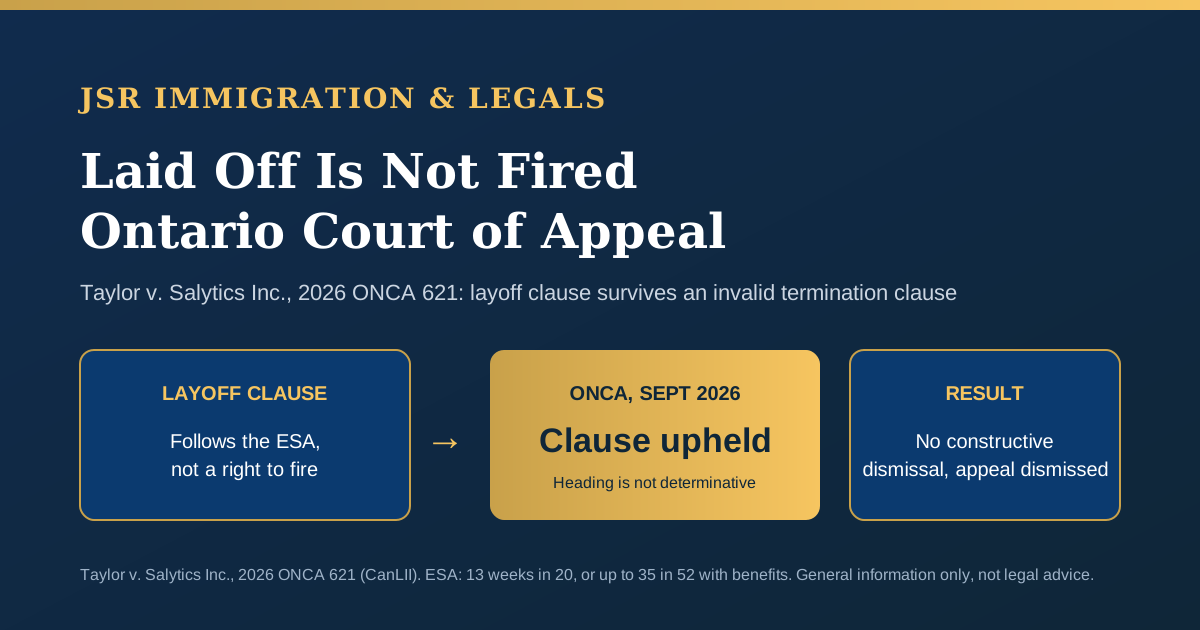
Most Ontario workers know that being fired triggers notice or pay in lieu of notice. Far fewer know where they stand when the employer says the job is only paused, and the layoff language sits in the same section of the contract as the termination wording. In Taylor v. Salytics Inc., 2026 ONCA 621, released in early September 2026, the Court of Appeal for Ontario clarified that question. The court held that a temporary layoff clause that expressly follows the Employment Standards Act, 2000 is not a termination clause, even when it appears under a "Termination" heading, and even when another clause in the same section is unenforceable.
What happened
Barry Taylor had worked for Salytics Inc., an Ontario technology company, for roughly 11 years under an employment agreement signed in 2013. The agreement expressly permitted Salytics to temporarily lay him off in accordance with the ESA.
In early 2024 the company hit financial trouble. Taylor first agreed to a temporary 20 percent reduction in his hours and pay. Shortly after, Salytics placed him on a temporary layoff effective April 1, 2024. He received no income during the layoff, but his benefits continued. He was recalled to his full-time position effective September 30, 2024. Before returning, he sued, claiming the layoff was a constructive dismissal and seeking damages equal to 12 months of reasonable notice.
An application judge dismissed the claim in Taylor v. Salytics Inc., 2025 ONSC 3461. Taylor appealed.
What the Court of Appeal decided
The appeal turned on Waksdale v. Swegon North America Inc., 2020 ONCA 391, the leading rule that if one termination provision in a contract violates minimum employment standards, the entire termination provision may be unenforceable. Salytics conceded that its "for cause" termination clause was invalid. Taylor argued the layoff clause, sitting under the same "Termination" heading, should fall with it.
The Court of Appeal disagreed and dismissed the appeal. It focused on what the clause does, not where it sits. The temporary layoff clause did not give the employer a right to end the employment relationship. It gave a right to pause it within the ESA framework. The ESA itself distinguishes a temporary layoff from a termination of employment, so as a matter of legislative policy the two are not the same thing. The heading was not determinative, and the invalid for-cause clause did not taint the separate layoff clause. The court ordered Taylor to pay $10,000 in costs, an amount the parties had agreed to in advance.
The ESA timing rules that decided the case
Under Ontario's ESA guide to termination of employment (updated July 23, 2026), a layoff counts as "temporary" if it lasts:
- not more than 13 weeks of layoff in any period of 20 consecutive weeks; or
- more than 13 weeks but less than 35 weeks of layoff in any period of 52 consecutive weeks, where a qualifying condition is met, such as the employer continuing payments under a group insurance or benefit plan, or the employee receiving supplementary unemployment benefits.
Taylor's layoff ran about 26 weeks, so it only stayed "temporary" because Salytics kept his benefits going. A layoff that exceeds the applicable window is treated as a termination, and the employer may then owe notice, termination pay, and possibly severance pay.
The practical rules to take away
- A clearly drafted temporary layoff clause, expressly tied to the ESA, may let an employer pause a job without triggering a dismissal. What a tribunal or court may order in a different case depends on the exact wording.
- A layoff clause is not automatically invalid just because it sits under a "Termination" heading, and one bad clause in that section does not necessarily sink a separate, properly drafted layoff clause.
- Without an express or implied contractual right to lay off, a unilateral layoff may still amount to constructive dismissal, as the Court of Appeal reaffirmed in Pham v. Qualified Metal Fabricators Ltd., 2023 ONCA 255.
- Employers who want the layoff option should keep the clause, keep benefits flowing where the longer window is needed, and fix invalid termination language. Employees should read both clauses carefully before assuming a layoff is a firing.
- The ESA sets the outer limits of a temporary layoff. Crossing them may convert the layoff into a termination with pay obligations.
layoff right in the contract?"} B -- No --> F["May amount to constructive
dismissal at common law"] B -- Yes --> C{"Within ESA window?
13 weeks in 20, or up to 35 in 52
with benefits or SUB payments"} C -- No --> D["Treated as a termination:
notice or termination pay may be owed"] C -- Yes --> E["Employment pauses,
no dismissal in Taylor v. Salytics"]
What this means for you
If your employer hands you a layoff notice, the first document to read is your employment agreement, not the notice itself. A valid layoff clause tied to the ESA may mean the job is paused, not ended. If there is no such clause, or the layoff runs past the ESA window, you may have a constructive dismissal claim and be entitled to far more than the statutory minimums. These deadlines are unforgiving, so get the contract reviewed early.
If you are an employer, Taylor confirms that a properly drafted layoff clause can survive defects elsewhere in the termination section. It does not create a general right to lay people off. The clause must exist and the ESA limits must be respected.
If you have been laid off, or you are an employer reviewing layoff language, JSR Immigration and Legals can assess your situation. See our employment law services page, or contact us at (647) 286-4266 or info@jsrlegals.ca.
This post is general information, not legal advice, as of November 15, 2026. For advice on a specific matter, please contact JSR Legals.
Sources
- Taylor v. Salytics Inc., 2026 ONCA 621 (CanLII): https://www.canlii.org/en/on/onca/doc/2026/2026onca621/2026onca621.html
- Taylor v. Salytics Inc., 2025 ONSC 3461 (CanLII): https://www.canlii.org/en/on/onsc/doc/2025/2025onsc3461/2025onsc3461.html
- Waksdale v. Swegon North America Inc., 2020 ONCA 391 (CanLII): https://www.canlii.org/en/on/onca/doc/2020/2020onca391/2020onca391.html
- Pham v. Qualified Metal Fabricators Ltd., 2023 ONCA 255 (CanLII): https://www.canlii.org/en/on/onca/doc/2023/2023onca255/2023onca255.html
- Ontario, Your guide to the Employment Standards Act: Termination of employment: https://www.ontario.ca/document/your-guide-employment-standards-act-0/termination-employment
JSR Legals / JSR Immigration Ltd. 9300 Goreway Drive, Suite 205, Brampton, ON L6P 4N1 (647) 286-4266 info@jsrlegals.ca

Immigration & paralegal practitioner at JSR Immigration & Legals, helping newcomers and Ontario residents with their cases.
This post is general information about Canadian immigration and Ontario paralegal matters and is not legal advice. Rules change and every case is different — confirm current requirements for your own situation.