Budget 2026 Opens a One-Time PR Path for 200,000 People Already in Canada
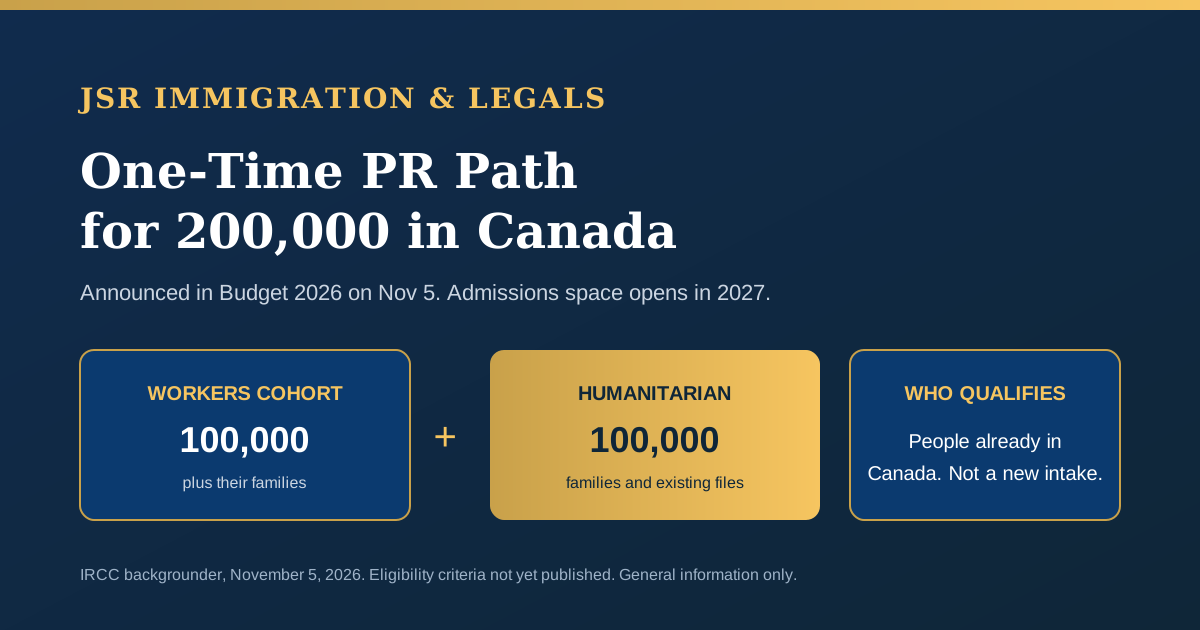
Budget 2026, tabled on November 5, 2026, does more than set the next three years of immigration targets. It also announces a time-limited measure to move up to 200,000 people already living in Canada to permanent residence through additional admissions space in 2027. IRCC set out the details in its official backgrounder, page dated November 5, 2026.
The measure is aimed at people who are already here, already working, and in many cases already waiting on a decision. It is not an open application program. No one can apply to it today, because IRCC has not yet published eligibility criteria or an application process. What exists now is the commitment, the two cohorts, and the 2027 admissions space behind them.
The two cohorts
The 200,000 figure splits into two equal halves, and they work differently.
| Cohort | Size | What it covers |
|---|---|---|
| Workers cohort | Up to 100,000 people, plus their families | Workers already in Canada, selected with provinces and territories |
| Humanitarian cohort | Up to 100,000 people | Existing humanitarian commitments and family files already in Canada |
The workers cohort
For the workers cohort, the federal government will work with provinces and territories to transition up to 100,000 people already in Canada, as well as their families, to permanent residence. The mechanism is extra space: increases to Provincial Nominee Program allocations, which provinces and territories can use to nominate workers who meet their regional needs.
Provinces and territories will also be able to identify workers who have already submitted an application under select federal programs. IRCC names the Atlantic Immigration Program, plus specific programs that are closed to new applications: the Start-up Visa Program, the Self-Employed Persons Program, the Agri-Food Pilot, and the home care worker programs. If your file sits in one of those inventories, this measure may create the room to finalize it in 2027.
The humanitarian cohort
The humanitarian cohort covers up to 100,000 people. With this admissions space, IRCC's stated goal is to:
- Process all remaining applications under the Hong Kong permanent residence pathways.
- Process all remaining applications under the Ukraine Family Reunification Pathway.
- Finalize applications from people already found eligible for permanent residence on humanitarian and compassionate grounds.
- Process permanent residence applications from spouses, common-law partners, and dependent children of Canadians and permanent residents already living in Canada.
On the family side, IRCC says the goal is to bring wait times closer to 12 months for the spouse and common-law partner class destined for provinces and territories outside Quebec. That is a processing goal for files in the inventory, not a guaranteed timeline and not a promise for files filed later.
Announcement date and admissions year are not the same
November 5, 2026 is the announcement date. The measure provides additional admissions space to process applications in 2027. Nothing opened on budget day. The distinction that matters is between the announcement, which has happened, and the operational details, which have not.
IRCC has not yet published:
- Eligibility criteria for either cohort.
- How provinces and territories will identify workers.
- When applications under each pathway will be prioritized.
Treat the 200,000 figure as planning space, not an entitlement. Nobody receives permanent residence under this measure by signing up for it. The measure helps finalize files that already exist, plus files provinces choose to nominate with their additional allocations.
What this means for you
If you are a worker with a file in a closed federal program, such as the Start-up Visa Program, the Self-Employed Persons Program, the Agri-Food Pilot, or a home care worker program, your application may be a candidate for the workers cohort. Keep your file current and watch for program-specific notices. See our work permit and PNP pages.
If you are pursuing a provincial nomination, the additional PNP allocations are the practical effect of the workers cohort. Ontario's streams are on our Ontario PNP page, and Express Entry candidates can compare options on the Express Entry page.
If you are a spouse, partner, or dependent child already in Canada under a family class application, the humanitarian cohort targets exactly that inventory. See our spousal sponsorship page.
If you are outside Canada, this measure does not apply to you. It covers people already living in Canada, and it is not a new intake stream.
We covered the 2027-2029 levels plan targets in our November 6 post. Use that post for the admission tables. Use this one for the one-time transition measure sitting alongside them.
To assess how this measure may affect an existing application, a provincial nomination file, or a family sponsorship already in process, contact JSR Immigration & Legals through our consultation page or the permanent residence service page.
This article is general information current to November 9, 2026, and is not legal or immigration advice. Eligibility criteria for this measure had not been published when this was written. Confirm the live backgrounder and Canada.ca program pages before you act.

Immigration & paralegal practitioner at JSR Immigration & Legals, helping newcomers and Ontario residents with their cases.
This post is general information about Canadian immigration and Ontario paralegal matters and is not legal advice. Rules change and every case is different — confirm current requirements for your own situation.