Renovictions Just Got Harder: Ontario's New City Licence Rules and Your Rights in 2026
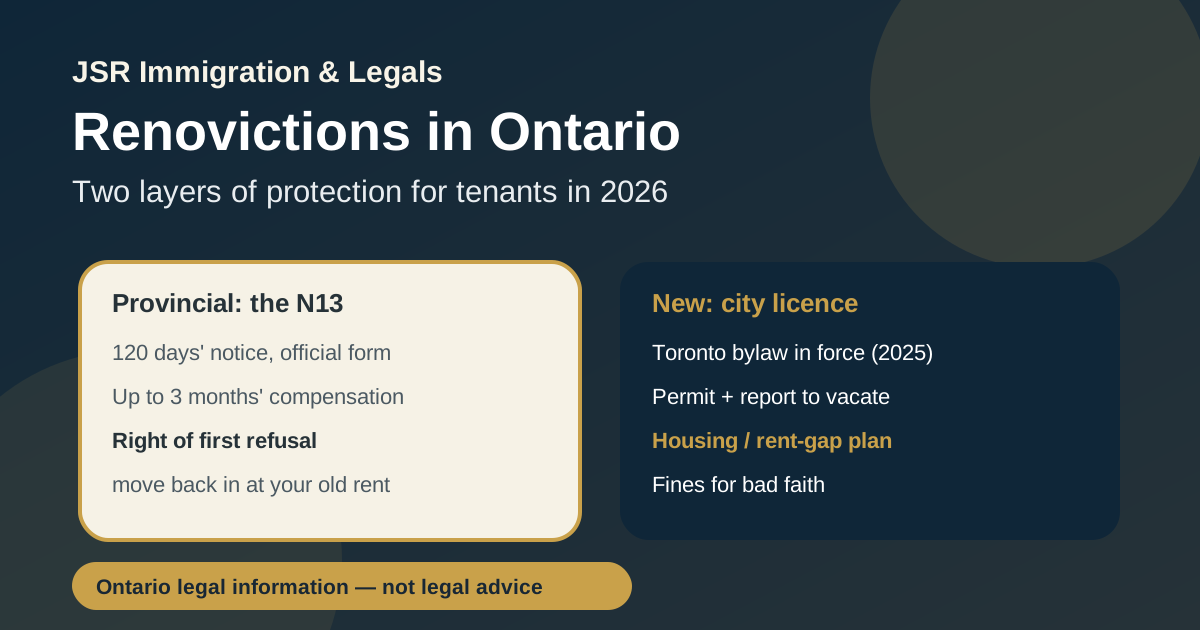
A "renoviction" is what tenants call it when a landlord uses a renovation as the reason to end a tenancy — sometimes genuinely, sometimes as a way to clear out a long-term tenant and re-rent the unit at a much higher price. Ontario's Residential Tenancies Act has always set rules for these evictions, but through 2025 and into 2026 a new layer has arrived: municipal renovation-licence bylaws that make a landlord get a city licence before a renovation eviction can go ahead. Here is a plain-language look at how both layers work and what they mean for you.
The provincial layer: the N13
Under the Residential Tenancies Act, a landlord who needs a unit empty to do major repairs, a conversion, or a demolition must serve an N13 notice. An N13 is only valid when the work genuinely requires a building permit and cannot be done with the tenant living there. A cosmetic refresh — new paint, new appliances — does not qualify.
A valid N13 comes with real tenant protections:
- Notice. The landlord must give at least 120 days' written notice on the
official LTB form, ending on the last day of a rental period.
- Compensation. In a building with five or more units, the landlord must
pay up to three months' rent (or offer an acceptable alternative unit). In a smaller building, it is generally one month's rent. This is owed on or before the termination date.
- The right of first refusal. You can move back in at your old rent
once the work is done — but only if you tell the landlord in writing, before you move out, that you intend to return, and you keep the landlord updated with your current address.
If a landlord skips the work, rents to someone else, or refuses to let you back, you can apply to the LTB — generally within two years — for remedies that can include your moving costs, the difference in rent, and general damages.
The new municipal layer: renovation licences
The gap the province left is that an N13 mostly runs on the landlord's word about their intentions. To curb bad-faith renovictions, several Ontario municipalities have added a licensing step on top of the N13.
Toronto led with its Rental Renovation Licence Bylaw, in force since 2025. Under it, a landlord who plans a renovation that requires tenants to move out under the N13 process must apply to the City for a licence — within a short window after serving the N13 — and, as part of that, show a real plan backed by a building permit and an engineer or architect's report confirming the unit must be vacant. The landlord also has to notify tenants of the application, post information at the building, and either provide temporary housing or make rent-gap payments for returning tenants, plus compensation for those who choose not to return.
The penalties are meant to bite: a landlord who ignores the rules can face significant daily fines and, for serious violations like evicting tenants and then never doing the renovation, penalties running into six figures. Ottawa, Hamilton and London have moved in the same direction — some with bylaws in force, others still consulting — so the exact rules now depend on which city you live in. Always check your own municipality's current bylaw.
that needs the unit empty] --> B[Serves an N13
120 days' notice + compensation] B --> C{Is the unit in a city with
a renovation-licence bylaw?} C -- "Yes (e.g. Toronto)" --> D[Landlord must also get a
City renovation licence] D --> E[Building permit + report,
tenant notice, housing/rent-gap plan] C -- "No bylaw" --> F[Provincial N13 rules apply on their own] E --> G{Tenant wants to return?} F --> G G -- "Yes, gave written notice before leaving" --> H[Right of first refusal
at the old rent] G -- "No" --> I[Compensation instead]
What this means for you
If you are a tenant who receives an N13: do not assume you have to leave. Start by checking whether the notice is even valid — the 120 days, the correct form, the compensation, and a genuine need to vacate for permitted work. Then check whether your city has a renovation-licence bylaw; if it does and the landlord did not get a licence, that is a serious problem for their case. And if there is any chance you want your unit back, put your intention to return in writing before you move, and keep a copy — that one letter is what preserves your right of first refusal.
If you are a landlord planning a real renovation, the message is that paperwork and good faith both matter more than ever. A missing permit, a late licence application, or an N13 that turns out to be a pretext can unravel the whole eviction and expose you to LTB remedies and municipal fines.
Where to confirm the current rules
- Tribunals Ontario — Landlord and Tenant Board:
- The Residential Tenancies Act, 2006 on Ontario's e-Laws:
ontario.ca/laws/statute/06r17.
- CLEO — "Being evicted for renovations":
cleo.on.ca/en/publications/renovictions.
- City of Toronto — Rental Renovation Licence Bylaw:
toronto.ca — renovictions bylaw.
Get in touch
Renovation evictions turn on details — the permit, the compensation, the right of first refusal, and now, in a growing number of cities, a municipal licence. If you have received an N13, or you are a landlord trying to do a renovation the right way, JSR Legals can help you understand your options and act in time. Reach us at info@jsrlegals.ca.
This article is general information about Ontario law, current as of July 2026, and is not legal advice for any specific situation. Municipal bylaws differ by city and effective dates, forms and rules can change — confirm the current requirements with the LTB, your municipality, or a licensed professional before you act.

Immigration & paralegal practitioner at JSR Immigration & Legals, helping newcomers and Ontario residents with their cases.
This post is general information about Canadian immigration and Ontario paralegal matters and is not legal advice. Rules change and every case is different — confirm current requirements for your own situation.